Superintendents Nationwide Join Forces to Defend Education Grants, Say They Will Take "All Possible Action"
- Input
- 2026-08-25 13:42:23
- Updated
- 2026-08-25 13:42:23
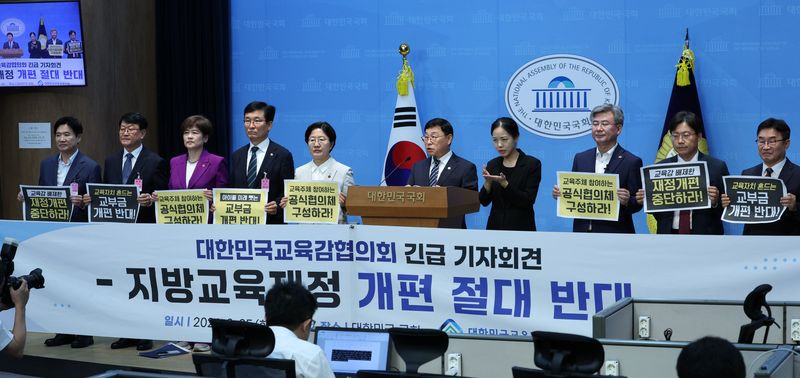
[Financial News] The superintendents of education from 16 cities and provinces boycotted a meeting of city and provincial education budget chiefs scheduled for the 25th, in protest against the government's plan to reform local education subsidy grants.
They urged the government to maintain the current 20.79% linkage rate to national tax revenue, saying, "Withdraw the unilateral reform of the grants immediately."
If the government pushes ahead with the reform, they plan to expand joint action in solidarity with teachers, parents and others in the education community.
The Korean Council of Superintendents of Education held an emergency press conference at the National Assembly on the same day and released a statement in the name of the 16 city and provincial superintendents of education, titled 'A Statement of Absolute Opposition to the Reform of Local Education Finance.'
The government has decided to overhaul the grant system by ending the current practice of automatically allocating 20.79% of national tax revenue to local education subsidy grants and replacing it with a new formula that reflects factors such as nominal growth and changes in the school-age population. In response, the superintendents argued that the current 20.79% linkage rate must be maintained to ensure the future of education and the stable operation of schools.
The council stressed that a decline in student numbers does not mean education funding needs will fall by the same proportion. Basic expenses such as school operations, facility management and staff salaries continue to arise, while new demands are expanding in areas such as AI and digital education, personalized learning, mental health, and care and safety.
It also cited students' mental health as evidence of why the grants must be maintained. The council pointed out that the number of teenage suicides nationwide reached a record 396 last year, yet the country still has not established a system of one professional counselor per school. It also argued that if grant funding is reduced while the financial burden of national projects that began with special grants is already shifting to city and provincial offices of education, it will be difficult to carry out existing education programs in a stable way.
The council also rejected the government's claim that the reform would increase the total amount of grants and raise per-student funding. It argued that even if the total grant amount does not fall from the previous year, the actual fiscal room schools can use may shrink if prices and labor costs rise. It added that per-student grants can rise arithmetically if the number of students falls, even when overall funding does not increase.
It also criticized the lack of sufficient consultation with city and provincial superintendents of education during the process of revising the grant calculation method.
The council said, "This reform is not simply a matter of adjusting the grant calculation method. It is a major issue that changes the foundation of local education finance, which has been maintained for the past half century," and called for the creation of an official consultative body with the participation of city and provincial superintendents of education. It added that the grant calculation method, the appropriate scale and stability of local education finance, and future education demand should all be discussed again from scratch in that body.
As its first collective action, it also decided to boycott the city and provincial education budget chiefs' meeting scheduled for the day. The council said, "This boycott is not simply an absence from a meeting. It is a clear warning against the government's unilateral policy push that treats city and provincial superintendents of education as mere implementing agencies rather than parties to policy decisions."
The council said 354 education-related organizations nationwide have expressed concern and opposition to the grant reform, and it plans to expand solidarity with teachers, parents and civil society groups in education.
The council said, "The more the government pushes ahead with the reform without consulting the education field, the stronger our response will become," adding, "The 16 city and provincial offices of education will jointly respond throughout the government's and the National Assembly's discussions over the grant reform."
[email protected] Lee Bo-mi Reporter