Ulsan City to Fully Cover City Bus Operating Deficits, Also Proposes a Plan to Resolve Drivers' Severance Pay Shortfall
- Input
- 2026-08-25 14:55:25
- Updated
- 2026-08-25 14:55:25
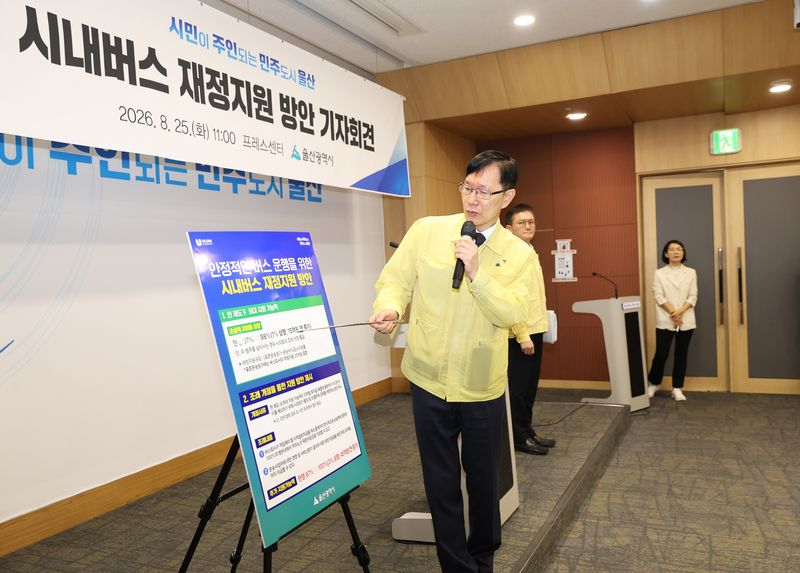
【Financial News Ulsan=reporter Choi Soo-sang】 Ulsan Metropolitan City has decided to raise its support rate for operating losses at local city bus companies to 98% this year and 100% by next year, while also providing an additional 3 billion won in differentiated financial support, in an effort to resolve the 81.3 billion won in unfunded severance pay that has become a key issue in wage negotiations between labor and management. However, the plan differs significantly from the union's demands, and attention is now focused on whether it will affect the city bus strike scheduled for the 28th.
Seo Nam-gyo, vice mayor for administration of Ulsan Metropolitan City, announced the revised financial support plan for city bus companies at a press conference on the 25th and called on both labor and management to cooperate.
Seo explained, "If the current support rate for financial deficits is raised to 100% and performance-based differentiated subsidies are included, each bus company will be able to set aside 6.5 billion won a year for severance pay starting next year." He added, "It will take about 13 years to fully eliminate the unfunded amount."
The severance pay liabilities of the seven city bus companies in the Ulsan area total 111.5 billion won, while the actual amount set aside is only 30.2 billion won. The funding ratio is just 25% to 30%.
The union is therefore demanding that each company set aside 5 billion won a year, or 30 billion won in total, in order to eliminate the 81.3 billion won in unfunded severance pay during this year's wage negotiations. In other words, the union's demands and Ulsan Metropolitan City's plan are far apart. Industry observers say the union is unlikely to withdraw the city bus strike it has announced for the 28th. On the other hand, if the city's plan is accepted, other pending issues now under negotiation are also more likely to be settled, including a 9% increase in base hourly wages, raising the retirement age from 63 to 65, easing the standards for accident-free bonuses and weekly holiday pay, and increasing meal expenses.
Ulsan Metropolitan City also faces a challenge in implementing the plan. Under the current Passenger Transport Service Act, the city can legally provide support only up to 100% of the operating deficit. Any amount beyond that would require a legal basis in a city ordinance.
Seo said, "To provide differentiated subsidies that exceed the loss amount, we need a legal basis through an ordinance revision, and that requires a proposal and approval by the Ulsan Metropolitan Council." He added, "I ask both labor and management to work together and persuade the council."
Meanwhile, the financial support Ulsan Metropolitan City provides to the seven local city bus companies has surged from 80.2 billion won in 2020 to 140.2 billion won in 2025, and it is expected to rise further to 151.9 billion won this year, putting pressure on the city's finances.
[email protected] Choi Soo-sang Reporter