South Korea's autonomous driving testbed is one-26th the size of Wuhan's; government pushes for Level 4 commercialization in Gwangju by 2027
- Input
- 2026-08-25 14:43:08
- Updated
- 2026-08-25 14:43:08
■ South Korea's autonomous driving mileage is one-twelfth of Waymo's
On the 25th, MOLIT and MOTIE each unveiled a commercialization roadmap for autonomous driving, with 2027 set as the turning point, at the Autonomous Driving Mobility Expo held at COEX in Gangnam District, Seoul.
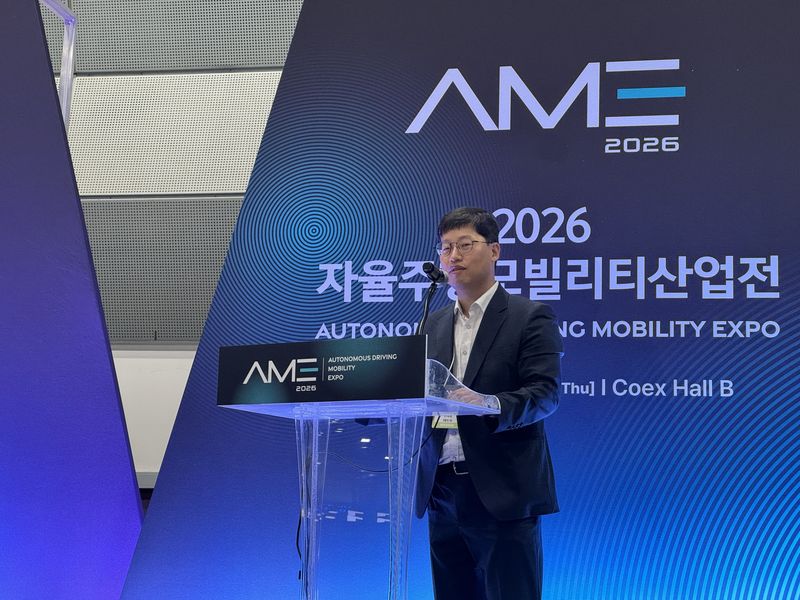
In a presentation titled 'Direction for Fostering the Autonomous Driving Ecosystem,' Ahn Jae-hoon, head of MOTIE's Future Mobility Team, said the automobile industry is moving simultaneously in three directions: becoming greener, smarter and more connected. He said, "Autonomous driving functions do not emerge on their own. They appear in combination with electrification and connectivity technologies," adding, "With Tesla, the line between an electric vehicle and an autonomous vehicle is becoming blurred."
He added, "To survive in the global artificial intelligence competition, our auto industry must be viewed not just through the lens of autonomous vehicles, but from the broader perspective of future mobility." He continued, "We are competing in Level 2 Plus for passenger cars and Level 4 for robotaxis, but in fact we are far behind."
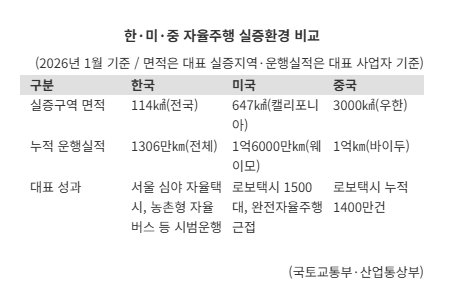
According to MOTIE's presentation materials, South Korea's autonomous driving technology level stands at 89.2% when the United States is set at 100%. In the U.S., Tesla is nearing full self-driving capability and Google is operating 1,500 robotaxis, while in China, Baidu has recorded a cumulative 14 million robotaxi rides.
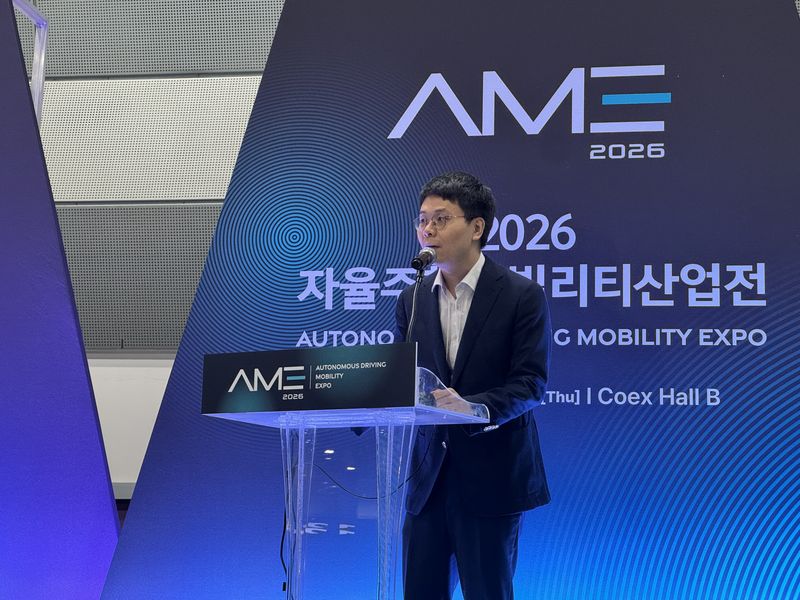
Lee Gwang-woo, head of MOLIT's Autonomous Driving Policy Team, attributed the U.S. and China's lead to gaps in test environments. He said, "Large-scale city-level testing like the cases in the United States and China has not yet been carried out." According to Lee, the U.S. and China have test environments that allow Level 4 driverless autonomous vehicles to operate across entire cities, making it possible to collect large volumes of data from diverse conditions and edge cases.
The gap in area has translated into a gap in mileage. South Korea's cumulative autonomous driving distance stands at 13.06 million kilometers, about one-twelfth of Waymo's 160 million kilometers and roughly one-eighth of Baidu's 100 million kilometers. MOLIT cited limited route-based testing, regulations that have restricted the use of raw video footage, and a lack of infrastructure and capital compared with global big tech firms as key reasons for the technology gap.
■ MOLIT designs the 'city,' MOTIE designs the 'ecosystem'
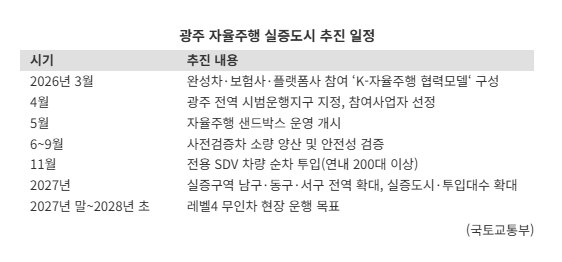
MOLIT set a long-term goal of becoming one of the world's top three autonomous driving powers, and a short-term goal of commercializing Level 4 fully autonomous driving by 2027. Its key tool is the Gwangju autonomous driving test city. The plan is to designate the entire city as a pilot operation zone, remove regulatory barriers, and run vehicles on a large scale to secure AI training data. Lee said, "Because the most important thing for AI technology is securing large amounts of training data, we are focused on getting as many vehicles on the road as possible."
In March, MOLIT formed the 'K-Autonomous Driving Cooperation Model' with automakers, insurers and platform companies. In April, it designated all of Gwangju as a pilot operation zone, and since May it has been operating an autonomous driving sandbox. Autonomous SDVs developed and supplied by Hyundai Motor Company will undergo safety verification for pre-validation vehicles from June to September, then be deployed sequentially from November. The goal is to have about 200 vehicles running on public roads by the end of the year.
Lee acknowledged the rollout has been "somewhat delayed," saying, "We are continuing to check everything and trying our best to stay on schedule." The test area will expand this year from parts of Gwangsan District, Buk District, and the West to the entire Nam-gu, Dong District, and the West next year, along with broader test-city coverage and more vehicles.
MOTIE is building the supply-side ecosystem. Over the next five years, it plans to invest 100 billion won in R&D to internalize core future-mobility technologies such as automotive semiconductors, data and AI. Ahn said, "The key to AI competitiveness is data, but we lack both quantity and quality," adding that the ministry will pursue both world-model development, which creates data without real-world driving, and data standardization.
MOTIE's timeline is also centered on 2027. By then, it aims to secure an end-to-end (E2E) autonomous driving model that learns from vehicle driving data rather than rule-based systems, as well as a standard SDV platform. It will also work in parallel on developing a VLA approach in which AI explains the basis for its own decisions.
Lee said, "By the end of this year, vehicles will actually be operating on roads in Gwangju, and by the end of 2027 or early 2028, we hope and expect that Level 4 driverless vehicles will be running in the field."
[email protected] Kim Dong-chan Reporter