To Cut Off Iran's Funding, the United States Would Have to Go After China. But Can Trump Do It Ahead of Talks?
- Input
- 2026-08-25 12:21:47
- Updated
- 2026-08-25 12:21:47
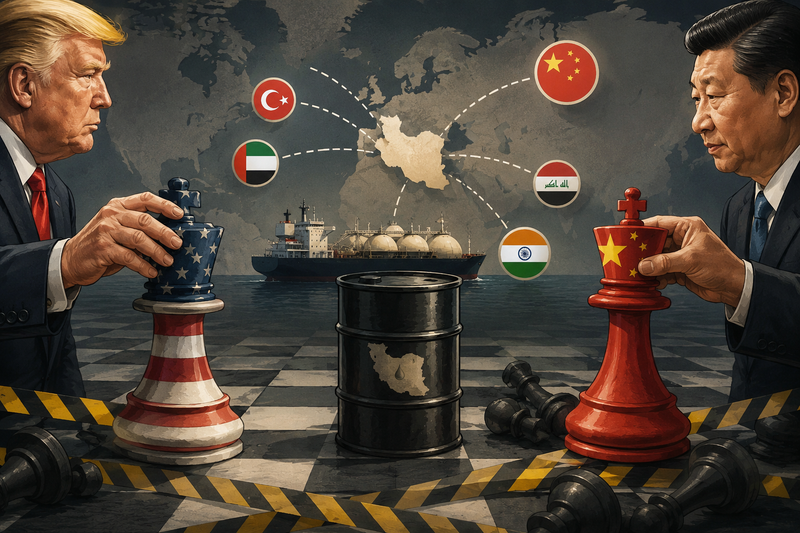
[Financial News] The Trump administration has unveiled an "economic ostracism campaign" that would sanction even third countries doing business with Iran, but it remains unclear whether it will directly target China, Iran's largest oil buyer. To truly cut off Iran's funding, Chinese financial institutions would also have to be sanctioned. Yet with a U.S.-China summit set for next month, Washington risks breaking the fragile "trade truce" between the two countries. The United States needs to pressure China to isolate Iran, but the more it does so, the more it risks destabilizing U.S.-China relations.
When asked on the 24th (local time) at the Treasury Department in Washington, D.C., whether China, a major trading partner of Iran, could also be sanctioned, U.S. Treasury Secretary Scott Bessent said, "No one is beyond the reach of U.S. sanctions." He stopped short of naming China directly, leaving the door open to that possibility.
The core of the "economic ostracism campaign" announced by the Trump administration on the day is secondary sanctions aimed at third countries that do business with Iran. Any transactions with Iran involving digital assets, technology, gold, aviation, or shipping could make those parties subject to U.S. sanctions.
But the key country that will determine whether the sanctions succeed is China. According to The New York Times, China buys as much as 90% of Iran's crude oil, making it the country's largest customer. World Bank data show that in 2022, Iran's exports to China totaled $22.4 billion, while imports from China reached $15.6 billion.
To block oil sales, Iran's main source of foreign currency, Washington would ultimately have to stop transactions between China and Iran. The United States would need to sanction not only Chinese refiners, but also Chinese financial institutions that facilitate deals and support payments if it hopes to get close to a "zero leakage" goal.
The problem is the state of U.S.-China relations. After clashing last year over Trump's steep tariffs, the two sides agreed to a "trade truce" and have been seeking strategic stability. A summit between Trump and Chinese President Xi Jinping is also scheduled for next month.
If the United States imposes heavy sanctions on Chinese financial institutions just ahead of the summit, the Iran issue could spill back into U.S.-China trade and diplomatic tensions. Analysts say this burden may help explain why Washington has so far sanctioned some Chinese refiners that bought Iranian crude, while avoiding large-scale measures against Chinese financial institutions that support the transactions.
For now, the United States appears to be leaning more toward pressure than sanctions. Bessent said the government would seek to halt dealings with Iran through confidential talks with individual countries. Trump has also been calling foreign leaders directly to pressure them to cut ties with Tehran.
Time, however, is limited. Bessent said additional sanctions targeting major financial institutions and others would follow over the coming days or weeks. Whether Chinese financial institutions are included on the next list is expected to become the first real test of the Trump administration's "economic ostracism campaign."
Daniel Tannebaum, a senior fellow at the Atlantic Council, told The New York Times that unless real action is taken against the "more important" countries and companies doing business with Iran, the latest sanctions may amount to little more than words.
U.S. pressure is already working on some other countries that trade with Iran. The United Arab Emirates said it would suspend trade and financial transactions with Iran until further notice, ahead of Washington's announcement of additional sanctions. Türkiye and Iraq are also closely tied to Iran in the energy and trade sectors, making them possible future targets of U.S. pressure.
China's response is likely to determine whether the United States can succeed in economically isolating Iran. Without China, it will be difficult to block Iran's biggest source of cash, crude oil exports. But if China is directly sanctioned, the U.S.-China summit and the trade truce could be thrown off course. With the summit approaching, whether Trump will actually sanction China or keep it as leverage for the negotiating table remains his choice.
[email protected] Kim Kyung-min Reporter