Nine out of 10 people aged 65 and older receive a pension; half get less than 500,000 won a month
- Input
- 2026-08-25 12:00:00
- Updated
- 2026-08-25 12:00:00
[Financial News] The number of people aged 65 and older receiving at least one pension, including the National Pension Service (NPS), Basic Pension and occupational pensions, has surpassed 9 million for the first time. That means 9 out of 10 people in that age group receive a pension. Their average monthly benefit is about 730,000 won. Meanwhile, 18- to 59-year-olds enrolled in pensions number 23.484 million and pay an average of about 360,000 won in premiums each month.
On the 25th, the Ministry of Data and Statistics released its 2024 pension statistics. The agency analyzes and publishes annual data on 11 types of pensions, including Basic Pension, National Pension Service (NPS), Korean Home Pension, Public Officials Pension, Teachers' Pension, Military Pension, and home and farmland pensions.
According to the statistics, the number of pension recipients aged 65 and older who received at least one pension in 2024 came to 9.122 million, up 5.6%, or 486,000, from a year earlier.
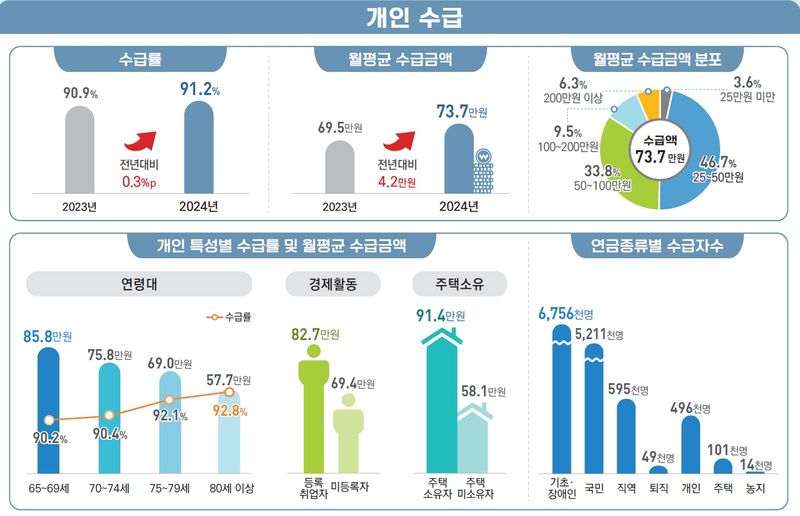
The share of pension recipients among the population aged 65 and older rose 0.3 percentage point from a year earlier to 91.2%.
The average monthly amount received from all pensions combined was 737,000 won, up 6.0%, or 42,000 won, from a year earlier.
The median monthly benefit was 497,000 won. Those receiving between 500,000 won and 1 million won accounted for 33.8%, while the 1 million to 2 million won range made up 9.5%. Benefits below 250,000 won accounted for about 3.6%. The shares of recipients below the median, in the under-250,000 won and 250,000 to 500,000 won brackets, fell by 0.3 percentage point and 4.1 percentage points, respectively, from a year earlier.
Song Ju-hwa, head of the Administrative Statistics Division at the Ministry of Data and Statistics, explained, "Although the average monthly benefit amount is rising every year, the 250,000 to 500,000 won bracket remains the largest at 46.7%, which is still below the median of 497,000 won." She added, "Most people aged 65 and older are still receiving relatively small pension amounts."
By gender, men received 957,000 won on average, about 400,000 won more than women, who received 546,000 won. By age group, those aged 65 to 69 received 858,000 won on average, and those aged 70 to 74 received 758,000 won, both above the overall average of 737,000 won.
Among the 17 cities and provinces nationwide, Jeollanam-do, with 441,000 recipients, had the highest pension receipt rate at 94.8%.
Recipients drawing two or more pensions accounted for 43% of all recipients aged 65 and older, or 3.926 million people. Among pension combinations, the share of those receiving both the Basic Pension and the National Pension Service (NPS) was the highest at 36.5%.
Looking at households with people aged 65 and older, the benefit amounts are higher than for individuals.
In 2024, the number of pension-recipient households with at least one recipient aged 65 or older reached 6.831 million, up 4.9%, or 317,000 households, from a year earlier.
The share of households with people aged 65 and older that receive pensions has steadily increased, reaching 95.9% in 2024.
The average monthly pension amount received by pension-recipient households was 959,000 won, up 6.7%, or 61,000 won, from a year earlier.
By household size, two-person households received 1.131 million won on average, while couples received 1.321 million won, both relatively higher amounts. Among regions, Sejong City recorded the highest average at 1.188 million won.
Unlike recipients, pension contributors aged 18 to 59 have been declining since peaking in 2022 at 23.839 million. The drop reflects demographic changes driven by the super-aged society.
As of 2024, the number of pension contributors aged 18 to 59 paying into at least one pension, including the National Pension Service (NPS), stood at 23.484 million, down 1.1%, or 258,000, from a year earlier.
The share of pension contributors among people aged 18 to 59 rose 0.1 percentage point from a year earlier to 81.1%.
The average monthly pension premium for these contributors was 363,000 won, the sum of individual payments and contributions from workplaces and the state, up 5.4%, or 19,000 won, from a year earlier.
The number of pension-contributing households with at least one contributor aged 18 to 59 fell 0.4%, or 61,000 households, from a year earlier to 15.252 million. Of these households, 92% are enrolled in at least one pension and pay an average monthly premium of 554,000 won. Premiums rose 4.6%, or 24,000 won, from a year earlier.
[email protected] Jung Sang-gyun Reporter