"There Is No Perfect Crime"... The Detective Who Tracked a 139.5 Billion Won Fraud Suspect to Japan [Number 112]
- Input
- 2026-08-26 15:38:37
- Updated
- 2026-08-26 15:38:37
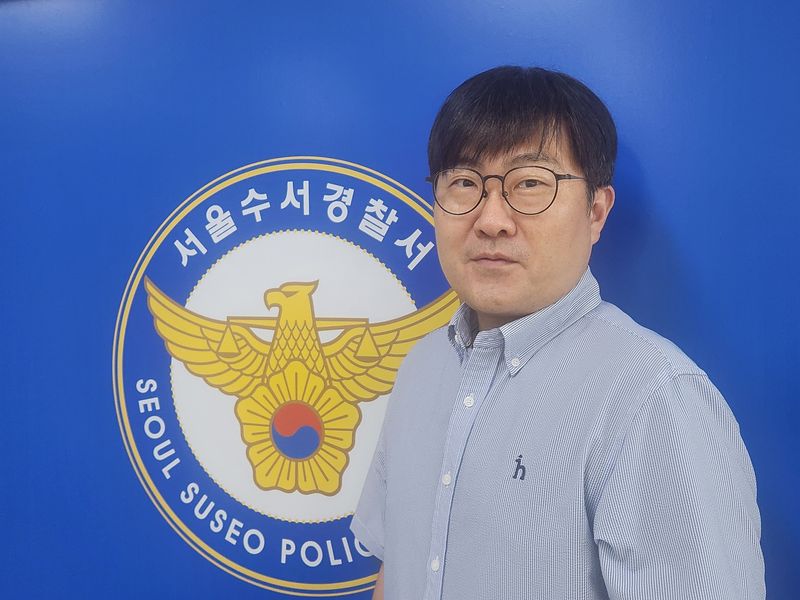
[Financial News] "There is no such thing as a perfect crime. I investigate with the belief that clues to the offense will always be found."
Yoom Myung-geun, a detective on the Intelligent Crime Investigation Team 1 of Investigation Division 2 at Suseo Police Station in Seoul, said on the 26th that "if you keep digging into even the smallest clue among countless accounts, statements and records, a pattern eventually emerges that connects it to the crime."
Yoom joined the police in 2015 and moved to Suseo Police Station in 2017 after serving at a police precinct and a mobile police unit. He later worked in the Tracking Investigation Team, the Economic Crime Investigation Team and the Special Investigation Team before joining the Intelligent Crime Investigation Team 1 in the first half of last year. He has handled major cases ranging from golf membership rights fraud, virtual asset sales and fraud involving state funds to embezzlement cases involving conglomerate chairmen. He said that each time he tracked down a wanted suspect or uncovered the truth behind a difficult case, he became more certain that investigative work suited him.
One of the clearest examples of Yoom's persistence was a fraudulent fundraising case involving losses of 139.5 billion won. Police had been tracking the suspect since 2013, but his whereabouts remained elusive. In 2018, Yoom took into account the scale of the losses and the large number of victims, and had the suspect included in the National Police Agency's wanted poster for key suspects. That same year, a tip from someone who saw the poster provided information that the suspect was staying in Japan, giving the investigation a turning point.
Police traced a KakaoTalk account and found clues that the suspect had fled to Japan by boat. They then issued an International Criminal Police Organization Red Notice, invalidated his passport, and worked with the National Police Agency's International Cooperation Bureau and Japan - Interpol to arrest him. Once the illegal departure was confirmed, the statute of limitations was also suspended. A case that could have ended because the limitation period expired was instead brought to a close with the suspect's arrest after a long pursuit and cooperation between agencies.
In other cases, Yoom followed the evidence all the way to the people behind the crime. In a golf membership fraud case, he merged cases assigned to several teams and identified not only the front man, middlemen and actual perpetrators, but also the suspect who directed the scheme from behind the scenes, leading to an arrest and referral to prosecutors. In a token trading fraud case, he identified and arrested the main operator of the sales company, then tracked the people who converted criminal proceeds, distributed fake deposit bank passbooks, served as intermediaries and stood further up the chain.
Yoom stressed that collaboration with fellow investigators is essential to solving major cases. "Just as it takes a village to raise a child, a major case is not solved by the lead investigator alone," he said. "The results come from the combined efforts of many investigators working behind the scenes."
When investigators arrested a distributor of accounts under borrowed names, about 15 colleagues joined the probe voluntarily even on their days off. Together, they urgently arrested the person who withdrew money from fake deposit bank passbooks and a middle manager, then pieced together the full scope of the case and tracked the chain higher up for referral. His teamwork also extended to sharing his own investigative experience. Yoom shared tracking techniques with another investigator pursuing a suspect in a large-scale internet fraud case and even took part in the arrest. At the scene, police also confirmed signs of drug manufacturing and distribution by the suspect, along with additional accomplices, expanding the investigation in cooperation with the Narcotics Investigation Team.
The growing importance of collaboration also reflects the increasingly sophisticated methods used in intelligent crimes. Yoom explained that whenever new investment vehicles such as stocks, virtual assets and court-auctioned real estate draw attention, crimes exploiting them soon follow. Some suspects even study laws that may apply in the future and prepare countermeasures in advance. Still, fraud schemes share common traits regardless of the target. A typical tactic is to offer a small profit at first to build trust, then gradually encourage larger investments.
Yoom said, "If someone tells you that investing will bring huge profits, you should assume it is 99% a scam and be suspicious." He added, "If the returns were truly that great, ask yourself why they would recommend the investment to someone with no connection to them."
In intelligent crime investigations, balancing speed and due process is also crucial. Key evidence can disappear quickly, so it must be secured without delay. But if procedures are neglected, problems can arise later in court. Yoom emphasized that "investigation and human rights protection are always linked" and that it is important to investigate quickly and thoroughly while still following due process.
The kind of investigator Yoom aspires to be is summed up by the phrase 'Hoshiubo' — watching sharply like a tiger, but moving steadily and without haste like an ox. He said, "I want to be a police officer who holds criminals accountable, but is kind to victims and colleagues." He added, "I hope to be remembered as an investigator with insight who never rushes, but keeps doing his best steadily."
[email protected] Kim Ye-ji Reporter