Voice phishing losses plummet 53% year-on-year... July hits 'annual low'
- Input
- 2026-08-25 12:00:00
- Updated
- 2026-08-25 12:00:00
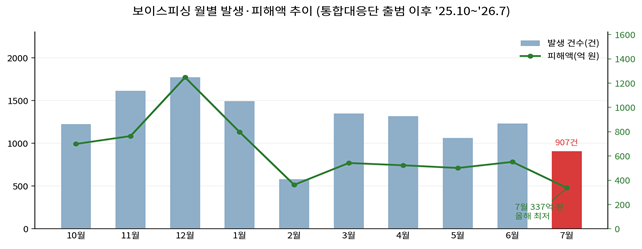
7 billion won, the lowest among all monthly figures this year. 2 billion won), which was affected by seasonal factors such as the Lunar New Year holiday. The police analyzed that government-wide preemptive measures, such as the emergency blocking of phone numbers, detection and blocking of phishing sites, and the suspension of transactions for accounts suspected of new types of scams, contributed to the reduction in damages.
Damages from so-called "new types of scams," including investment advisory rooms, team mission side jobs, proxy purchasing, and dating fraud, also decreased. The number of new types of scam cases last month was 1,349, a 41% decrease compared to the same month last year (2,275 cases). 1 billion won, marking the lowest level since the launch of the Integrated Response Team for Telecommunications and Financial Fraud.
The police believe that customized blocking measures tailored to the means of the crimes have been effective. Previously, the police have been implementing countermeasures for each criminal method since last March, centered around the Integrated Response Team. First, they strengthened efforts to identify suspicious phone numbers in advance through collaboration with the three major mobile carriers.
Mobile carriers are extracting suspicious numbers by analyzing the patterns of numbers used in crimes using artificial intelligence (AI). The number of detections has been increased to over 20 per day to facilitate blocking.
Crackdowns on private repeaters were also conducted in parallel. Since last May, the police have carried out intensive crackdowns, identifying 184 locations where private repeaters were installed and locating 9,199 repeaters.
In the process, 151 people, including repeater managers, were arrested. Regarding new types of scams using social networking services (SNS), the response has been strengthened by sending emergency alerts to those at risk of becoming victims.
The number of recipients of these emergency alerts—targeting individuals who access fake sites used for new scams or participate in chat rooms suspected of being investment advisory groups—increased significantly from 767 in February to 127,026 last month. The scope of blocking has also been expanded by developing techniques to identify accounts involved in criminal activities through the comparative analysis of conversations in investment advisory groups.
Responses are also being taken against fraudulent chat applications used in "team mission" side job scams. The police analyzed the source code of apps developed by criminal organizations and collaborated with Google, Apple, and Samsung Electronics to take measures to remove them from app stores and block their installation on devices.
The police explained that following these actions, "team mission" side job scams decreased significantly and have maintained a stable trend. The scope of phishing site blocking was also expanded.
They detected not only sites actually used for crimes but also backup sites identical in appearance and function to existing criminal sites, and included them in blocking requests after consulting with relevant agencies, such as the Korea Communications Standards Commission (KCSC). Cases where damage was prevented on-site before it occurred have also increased.
3 billion won for 33,652 people through on-site dispatches targeting individuals infected with malicious apps and those accessing phishing sites. 7 billion won.
The police believe there is a need to establish a clear legal basis for measures currently carried out through collaboration with relevant agencies, such as emergency phone number blocking, transaction suspension of accounts suspected of new types of scams, and detection and blocking of phishing sites. To this end, they plan to push for the enactment of the "Act on the Prevention of Multi-Victim Fraud Using Telecommunications," which stipulates procedures for the prevention and blocking of major means of crime, including phone numbers, information and communications networks, bank accounts, and virtual assets.
Hong Seok-ki, Head of the National Investigation Headquarters, stated, "The decrease in damages signifies that our preemptive responses thus far are paying off, but new types of scam crimes continue to change their methods and exploit new means of crime. " He added, "Discussions on the enactment of the Multi-Victim Fraud Prevention Act need to take place promptly so that current achievements do not remain merely a temporary response but can be institutionally supported.
7 billion won, marking the lowest figure of the year. According to the National Police Agency on the 25th, there were 7,940 cases of voice phishing from January to July, a 46% decrease from the same period last year (14,707 cases). 4 billion won.
[email protected] Kim Ye-ji Reporter