"It’s just a small wound" ... Facial injuries can leave scars if left untreated [Health Talk]
- Input
- 2026-08-25 10:05:02
- Updated
- 2026-08-25 10:05:02
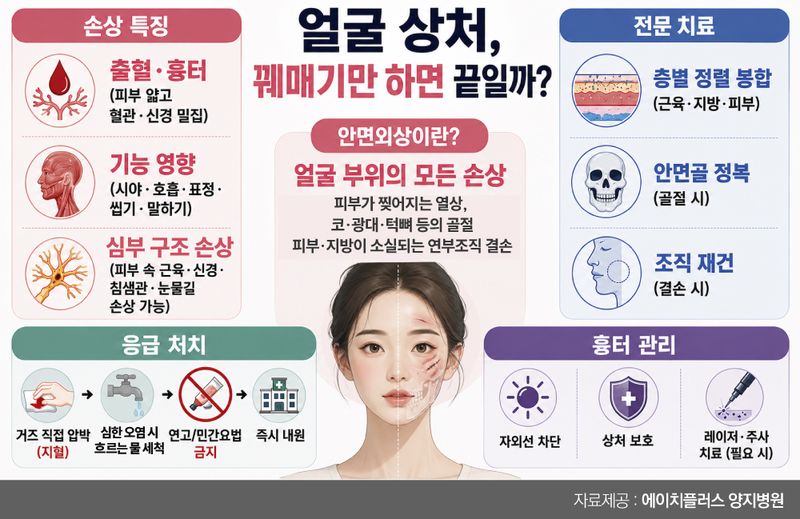
[Financial News] Even if the visible wound looks small, the muscles, nerves, or blood vessels beneath the skin may have been damaged. If treatment ends with simple stitching, scars or sensory problems may remain.
As summer brings more water activities, water sports, camping, and other outdoor pursuits, accidents involving falls or collisions and facial injuries are also becoming more common. Facial trauma ranges from lacerations that tear the skin to soft-tissue defects that involve loss of skin and subcutaneous tissue, as well as fractures of the facial bones, including the nose, cheekbone, and jaw.
Because the face has a dense network of blood vessels, nerves, and muscles, even a small wound can bleed heavily and leave a noticeable scar. In particular, injuries around the eyes, nose, and mouth are linked not only to appearance but also to functions such as vision, breathing, facial expression, chewing, and speaking, so the depth and extent of the damage must be assessed carefully.
Kim Mi-jeong, a plastic surgeon at H+ Yangji Hospital, said, "The key to treating facial trauma is not simply closing the skin, but accurately restoring the damaged tissue so that both function and appearance can recover." She added, "Because treatment can vary depending on the location, depth, degree of contamination, and whether there are accompanying injuries, an early specialist evaluation is important."
Wounds around the eyes, nose, and mouth require extra care
A common type of facial trauma is a laceration, in which the skin is torn by a fall, collision, or sharp object. These injuries often occur on the forehead, eyebrows, lips, chin, and around the nose. Because the face is rich in blood vessels, a wound may appear to bleed more than its size suggests, but it should not be dismissed just because the bleeding has stopped. If the wound is deep, the muscles, nerves, blood vessels, or salivary ducts beneath the skin may also have been injured.
In particular, injuries around the eyelids, lips, and nose require delicate treatment. The eyelids may involve damage to the tear ducts or structures around the eye, while misalignment along the lip border can make asymmetry or scarring more noticeable. Injuries near the nose can also be accompanied by a nasal bone fracture or breathing difficulties.
If the wound is widely open, the subcutaneous fat is exposed, bleeding does not stop easily, foreign material is embedded, the injury was caused by an animal bite, or numbness or impaired movement is present, prompt medical care is needed.
Initial response is crucial if you want to minimize scarring
Facial trauma often comes with fractures and soft-tissue defects. A nasal bone fracture can cause a change in the shape of the nose or nasal congestion, while fractures of the cheekbone or jaw can lead to facial asymmetry, difficulty chewing, limited mouth opening, and sensory loss.
Soft-tissue defects, in which skin and subcutaneous tissue are lost, may not be suitable for simple suturing. In such cases, appropriate reconstructive treatment such as flap surgery, skin grafting, or microsurgery is performed after considering the size of the defect, the condition of the surrounding tissue, blood flow, and the risk of infection.
Scar management after treatment is also important. Reducing exposure to ultraviolet light and preventing the wound from reopening are essential, and scar injections or laser treatment may be used if needed. If you injure your face, press the wound with clean gauze or a towel to stop the bleeding, and if there is dirt or debris, gently rinse it off under running water. However, do not try to force out deeply embedded foreign objects or scrub the wound hard.
Kim stressed, "Facial trauma should not be judged by the size of the wound alone." She added, "Because early treatment affects scarring and functional recovery, it is best to receive basic first aid such as stopping the bleeding and then visit a medical facility as soon as possible for an accurate evaluation."
[email protected] Reporter Jung Myung-jin, medical specialist Reporter