[fn Meets the Person] Governor Woo Sang-ho: "Turning Gangwon State's strengths into opportunities"
- Input
- 2026-08-27 16:00:00
- Updated
- 2026-08-27 16:00:00
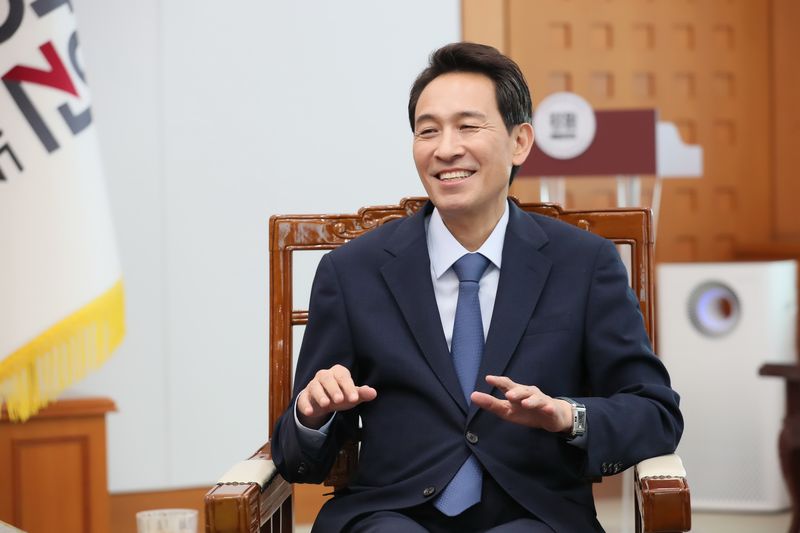
【Financial News, Chuncheon = Kim Gi-seop】 More than a month into his term, Governor Woo Sang-ho of Gangwon State has summed up his provincial administration philosophy in four words: strategic shift. Rather than waiting for support from the central government, he wants to turn the resources Gangwon State already has into opportunities and draw major companies there on their own.
The vision Woo shared in an interview with Financial News on the 24th is already producing results less than two months after he took office. A prime example is the GS Group investment in an AI data center in East Sea, which the government announced as one of its three mega projects. Long-standing military restrictions and the Civilian Control Line that had constrained Gangwon State for years are also beginning to ease. Woo is not stopping there. He plans to use Gangwon State's strengths in clean energy and ample land to attract additional investment, including a data center in Gangneung.
What he places even greater emphasis on, however, is people. He is not merely trying to bring in major companies; he is also drawing up a plan to place Gangwon youth in those jobs. By working with incoming firms, he wants to train local talent and fill half of the resident workforce with people from Gangwon State. But that vision can only work if the talent pipeline and partner-company ecosystem are in place before the doors open. That is why he says, "Those who prepare will eat." His calculation is to devote the next few years, until completion, to that preparation.
His long career in politics in the Seoul metropolitan area is one of his strengths. He has direct access to top corporate executives and knows which regulations are holding them back and what conditions are needed to secure investment. The same approach led to corrections in environmental regulation fairness for a cement company in Gangwon State after he raised the issue with the Ministry of Climate, Energy and Environment, and to resort investment in Sokcho after easing height restrictions around Yeongnangho Lake. The following is an interview.
— It has been a month since you took office. How do you feel about leading the provincial government?
▲ Even during the election, I felt a strong sense of crisis that Gangwon State was so underdeveloped that survival would be difficult unless we created change. I have been extremely busy attracting advanced companies one after another and handling the work needed to support them. In time, worthwhile results will begin to emerge. Public expectations are high, so I am drawing on my experience to get things done one by one.
— The idea of Gangwon being left behind has been raised throughout successive administrations. As someone who has spent a long time in politics, how have you viewed this issue?
▲ When people talk about being left behind, it ultimately means there is not enough support from the central government. But support alone is not enough for survival. We need a strategy that turns Gangwon State's strengths into opportunities. In the previous administration, there was an attempt to attract a semiconductor plant, but the conditions did not fit. A semiconductor plant needs 1 million pyeong of flat land, and Gangwon State does not have that much. By contrast, an AI data center needs only 100,000 pyeong of flat land, while the investment scale is similar. Once we shifted the strategy to fit our strengths, companies began to come in. Rather than waiting for support, we are using Gangwon State's resources to make it inevitable for major companies to invest here. I believe that is how we can move beyond the idea of being left behind.
— You recently asked the heads of affiliated agencies to make a decision about their future. What was the reason?
▲ I was speaking about the principles of democracy. The terms of elected officials and the heads of agencies they appoint should be aligned for the provincial government to function properly. Respecting a term does not mean people should never be replaced; it means they should not be forced to work with someone whose values and philosophy are different. In particular, I think those brought in because of ties to the election campaign should be reorganized. If someone has been recognized for their expertise and is doing a good job, they can stay on. But since there is no way to force them out, it becomes difficult to run the province together with agency heads who have different philosophies. Busan has resolved this issue through an ordinance. If the term is designed as two two-year terms, it naturally aligns with the term of an elected official. This is not about forcing people out, but about aligning terms. I intend to keep making this argument, because the public should know what is right. By the time my term ends, I will make sure the terms of the heads of affiliated agencies are neatly aligned with those of elected officials so that the next governor can take office more smoothly, whoever that may be.
— An AI data center stands out as one of your early achievements. What kind of changes do you expect it to bring to Gangwon State?
▲ The GS Group AI data center will come to East Sea. This is the first case of a major company making a large-scale investment in the region. As we set up a dedicated team and provide rapid support, word is spreading among major companies that Gangwon State handles permits quickly. It is not yet at the announcement stage, but the number of major companies considering coming here has increased. The key is clean energy. In the future, companies will settle in places with abundant clean energy. Gangwon State has hydropower, solar power, and onshore wind power, and new energy technologies such as biomass using wood and livestock manure have also been developed. If we hold on to these resources, more major companies could come in within five to 10 years, and we can place Gangwon youth in those jobs.
— There are also concerns surrounding data centers. What solutions do you have?
▲ That is why we are only attracting data centers linked to major companies. When any industry comes in, we need to think long term and keep communicating with the company. Above all, it is important to prepare so that investment leads to jobs. When a major company comes in, we need an agreement on how to hire local talent from Gangwon State. Over five years, the number of resident employees could reach 3,000 to 4,000, and we want half of them to be local talent. To do that, we need to train the people the region wants, which means changing educational programs. Major companies also say that when employees are stationed far from Seoul, turnover is high, and that it would be better if Gangwon State trained them. If we use local talent, they are less likely to leave. That is why we are preparing cooperation systems with universities, small and midsize firms, and the Chamber of Commerce. Those who prepare will eat; if we do not prepare, outside companies will take everything.
— In your campaign pledges, Gangneung was highlighted for data centers, and Wonju for drone and aerospace investment. What is your vision for Chuncheon?
▲ Since each city has different characteristics, the best approach is to grow them by making use of those strengths. Chuncheon has many good plans prepared by the previous city administration, including Camp Page, station-area development, Innovation Park, and the Sangjungdo provincial garden, but progress has been slow. I believe helping those projects move forward quickly would do more for Chuncheon's development. If the city develops while also becoming a place that is good to live in, its growth potential will be large. Since it is specialized in bio industries, we plan to provide focused support, and we also want to bring more vitality to the city center through the Bonguisan trail and the regeneration of the old downtown. We are also discussing ways to push ahead with a data center in Chuncheon that uses water thermal energy by revising the system. I think it is best to preserve Chuncheon's own model of change.
— What would you like to say to residents of Gangwon State?
▲ What I said during the election was not made lightly. It was based on a careful strategy, and it is now being put into action. Major domestic companies are signing MOUs and moving through the permitting process, leading to investments worth tens of trillions of won. We are seeing changes that did not exist before, including the relocation of SsangYong headquarters, easing of military regulations, and adjustments to the Civilian Control Line. Within my four-year term, I will make Gangwon State a place where people can make a living, where young people do not leave, and where the region moves from the periphery to the center. It will take time, but I will create results one by one as planned.
[email protected] Kim Gi-seop Reporter