NVIDIA's inference chip 'Groq 3,' produced with Samsung, secures first customer
- Input
- 2026-08-25 08:43:02
- Updated
- 2026-08-25 08:43:02
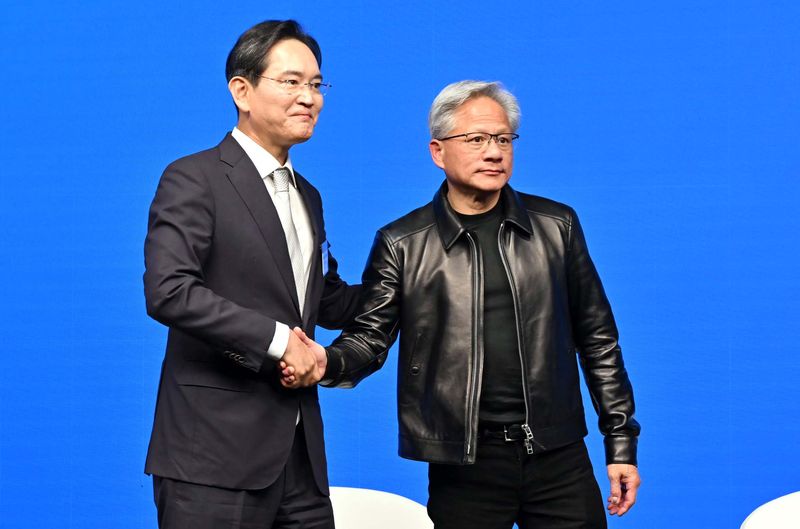
[Financial News] Samsung Electronics' foundry business has secured a new production base in NVIDIA Corporation's artificial intelligence ecosystem. As the center of gravity in the AI market shifts from training models to inference, which carries out real answers and tasks, NVIDIA's inference-only chip 'Groq 3,' produced by Samsung Electronics, has entered full-scale mass production. With its first customer also secured, expectations are rising that Samsung Electronics could benefit from the growing AI inference market.
NVIDIA said on June 24, local time, that it had begun mass production of 'Groq 3 LPX,' an inference acceleration system for AI agents. Groq 3 LPX is a system that connects 256 Language Processing Units (LPUs) in a single rack, and all LPUs are manufactured by Samsung Foundry.
The LPU is an inference-only chip that NVIDIA incorporated into its next-generation AI platform, Vera Rubin, after securing Groq's technology late last year. Instead of conventional DRAM, it uses faster SRAM, focusing on reducing the time it takes AI to answer user questions or write code.
While conventional graphics processing units (GPUs) handle large-scale computing, including AI model training, LPUs take care of inference after training is complete. NVIDIA's strategy is to improve the efficiency of AI systems by dividing roles between GPUs and LPUs. As AI evolves into the agent stage, where it can independently handle coding, data analysis, and tool use, the importance of inference speed is growing.
The company also secured a customer at the same time as mass production began. AI cloud provider Nebius was named as the first customer for Groq 3 LPX. Jensen Huang, CEO of NVIDIA Corporation, said, "Inference is the growth engine of AI," adding, "It will bring a huge leap in AI throughput, efficiency, and responsiveness."
For Samsung Electronics, the significance lies in the fact that its touchpoints with NVIDIA are expanding beyond memory into foundry services. While Taiwan Semiconductor Manufacturing Company Limited (TSMC) dominates production of NVIDIA's flagship GPUs, the diversification of AI semiconductors into CPUs, LPUs, and other chips is opening a new path for Samsung Electronics to enter NVIDIA's supply chain.
NVIDIA has also secured a customer for 'Vera,' the AI agent CPU, another key product in the Vera Rubin lineup. SpaceXAI, led by Elon Musk, has decided to adopt Vera CPUs on a large scale. Vera handles code execution and data processing for AI agents, allowing GPUs to focus on model computation.
SpaceXAI plans to use the Vera Rubin system not only in terrestrial data centers but also in data centers in orbit. It also intends to equip its first-generation AI satellite, 'StarMind,' with a Vera Rubin system optimized for the space environment.
NVIDIA's successive wins of LPU and CPU customers reflect the fact that competition in AI semiconductors is spreading beyond GPUs. AMD has unveiled its next-generation rack system, 'Helios,' and is expanding cooperation with Cerebras, a low-latency AI chip maker, further heating up competition in the inference market.
[email protected] Kim Kyung-min Reporter