T'way Air posts 90% international load factor in first half, with regional airport routes driving results
- Input
- 2026-08-25 08:36:32
- Updated
- 2026-08-25 08:36:32
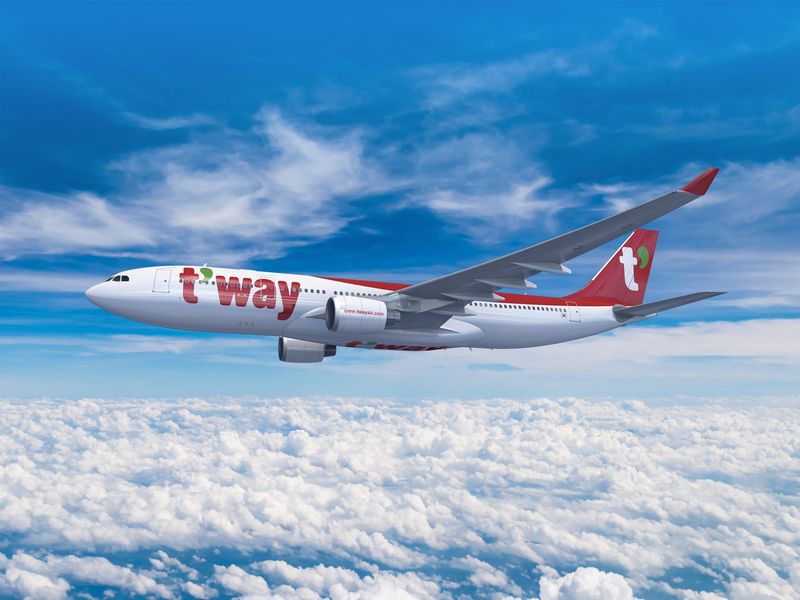
[Financial News] T'way Air continued its steady growth in the first half of this year, posting an average load factor of nearly 90% across all international routes. The airline delivered solid results across short- and medium-haul routes to Japan and Southeast Asia, as well as long-haul routes to Europe, while services departing from regional and city airports such as Cheongju, Daegu and Gimpo led the strong performance in the first half.
According to the industry on the 25th, T'way Air carried about 5.6 million passengers in the first half of this year. Of those, about 3.8 million traveled on international routes. That was up 12% from 3.38 million in the same period last year. The average international load factor reached 90%.
By route, demand remained steady not only on short- and medium-haul routes to Japan, Southeast Asia and Taiwan, but also on long-haul routes to major European cities, Sydney in Australia, and Vancouver in Canada. Analysts say T'way Air's strategy of diversifying its routes and expanding its medium- and long-haul network, unusual among low-cost carriers (LCCs), is translating into results.
Monthly popular routes showed clear differences in destination preferences depending on the season and travel period. The top routes by month in the first half were Cheongju-Fukuoka and Daegu-Fukuoka in January; Cheongju-Osaka and Cheongju-Fukuoka in February; Incheon-Boracay and Incheon-Nha Trang in March; Incheon-Bangkok, Incheon-Sapporo and Gimpo-Songshan (Taipei) in April; Daegu-Fukuoka in May; and Incheon-Bangkok and Incheon-Sapporo in June. These routes posted an average load factor of more than 96%.
At the start of the year, nearby destinations such as Japan, which are ideal for short trips, drove high load factors. From March onward, demand shifted to Southeast Asian resort destinations such as Boracay, Nha Trang and Bangkok. In the spring, destinations that combine urban sightseeing and natural scenery, such as Taipei and Sapporo, drew attention. Another notable trend was the relatively even demand throughout the year as the distinction between peak and off-peak travel seasons became less pronounced.
The diversification of departure points also stood out. International routes departing not only from Incheon but also from Cheongju, Daegu and Gimpo made the list of popular routes in the first half. As the strategy of expanding regional hubs and absorbing local demand took hold, travelers in both the capital area and regional cities gained more overseas travel options, analysts said. The trend also shows that routes from regional airports are emerging as a new growth engine amid slot saturation at Incheon International Airport and the dispersion of passengers.
Stable demand also continued on long-haul routes. European routes recorded average load factors of 87% for Paris, 89% for Rome, 91% for Barcelona and 85% for Frankfurt. The significance lies in the fact that the airline secured medium- and long-haul competitiveness comparable to that of full-service carriers while maintaining a low-cost structure. T'way Air had previously secured operating rights for four European routes and made a full-scale entry into the medium- and long-haul market.
The key focus of the second-half strategy is the introduction of a new brand and fleet expansion. T'way Air recently unveiled its SSC (Selective Service Carrier) business strategy and plans to begin operations under its new brand, TRINITY AIR WAYS, in the second half of the year. SSC is a model in which passengers choose only the services they need, and it is seen as a strategy targeting a new space between existing LCCs and FSCs.
On the fleet side, the airline will continue to bring in next-generation widebody Airbus A330neo aircraft and B737-8 jets through the end of the year. The Airbus A330neo is considered a fuel-efficient aircraft that can reduce the burden of operating long-haul routes compared with existing models. Through this, T'way Air aims to achieve two goals at once: expanding its medium- and long-haul network and strengthening cost competitiveness.
T'way Air plans to continue broadening travel options and maintaining stable operations in the second half of the year by managing routes in line with regional and seasonal travel demand as well as market conditions.
A T'way Air official said, "In the first half of this year, a variety of international routes posted balanced load performance depending on travel timing and purpose." The official added, "Going forward, we will continue to provide efficient route operations and a wider range of travel options based on safe operations."
[email protected] Kang Gu-gwi Reporter