Hanwha Ocean to reshape offshore plant bidding with low-carbon standard FPSOs
- Input
- 2026-08-25 08:12:12
- Updated
- 2026-08-25 08:12:12
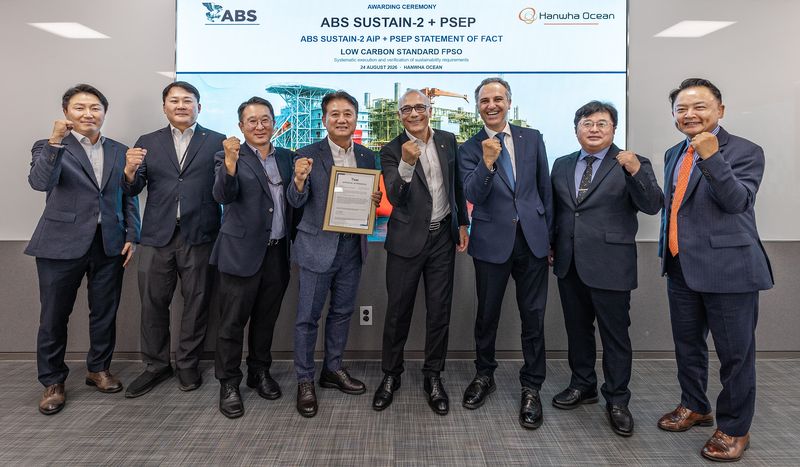
[Financial News] Hanwha Ocean is expanding its offshore plant standardization strategy into the low-carbon sector, backed by global classification certifications. As major energy companies around the world place carbon reduction at the center of their evaluation criteria from the earliest stages of new project orders, the latest certifications are expected to give the company a competitive edge in the bidding race for floating production storage and offloading units (FPSOs).
According to the industry on the 25th, Hanwha Ocean obtained approval in principle (AIP) from Norwegian classification society DNV for its low-carbon standard FPSO design system. It also received AIP from American Bureau of Shipping (ABS) and a Statement of Facts for its Project Sustainability Execution Plan (PSEP). The key achievement is that the company has now been verified on two fronts: low-carbon design and a sustainability execution framework.
An FPSO is a complex offshore facility that extracts crude oil or gas from subsea wells, processes and stores it, and then offloads it to shuttle tankers. Because it is essential for deepwater field development, each project is considered a high-value order worth trillions of won. AIP is a procedure in which a classification society formally recognizes the technical feasibility and applicability of a new technology or design concept, serving as a preliminary gateway to actual orders and construction.
The FPSO market is changing rapidly. In the past, price and delivery time were the top priorities in awarding contracts. Now, environmental competitiveness has emerged as a decisive factor. Major clients such as Petrobras in Brazil and oil majors in the United States and Europe are pushing for lower greenhouse gas emissions at the facility stage, driven by their 2050 carbon-neutral roadmaps. The International Maritime Organization's goal of reaching carbon neutrality in international shipping around 2050, along with tighter regulations from the European Union such as the Emissions Trading Scheme (ETS) and the Carbon Border Adjustment Mechanism (CBAM), is also making offshore plant orders more demanding.
In response, Hanwha Ocean is building a low-carbon standard FPSO platform based on its existing standard FPSO design. The company is systematizing applicable low-carbon technologies and combining them to match project-specific requirements. This marks a shift away from the previous approach, in which low-carbon technologies were reviewed and applied separately for each project, toward a structure that standardizes proven technologies and reuses them across multiple projects. The approach offers shorter design schedules, lower costs, and reduced risk at the same time.
Hanwha Ocean has steadily pushed ahead with its FPSO standardization strategy. In 2024, it developed a standard FPSO that can be applied across West Africa and received certification from ABS and Bureau Veritas (BV). This year, it developed a standard FPSO optimized for South America and secured certification from ABS and DNV. By successively completing standard designs tailored to regional offshore environments and regulatory conditions, the company has broadened its response range.
The latest AIP provides a key foundation for applying the low-carbon standard FPSO to real projects. DNV verified a low-carbon design framework that systematically incorporates emission-reduction technologies for major greenhouse gas sources into the design. ABS confirmed an execution framework that can implement and manage sustainability goals, such as carbon reduction and improved energy efficiency, throughout actual project delivery. In particular, PSEP is expected to help win client trust because it does not stop at a declarative sustainability goal. Instead, it specifies the responsible organization, key performance indicators, and verification procedures, turning the plan into a concrete execution framework.
Hanwha Ocean plans to use the verified low-carbon design and execution framework across customer discussions, bidding, front-end engineering design (FEED), and the full project lifecycle. The company will further develop the verified low-carbon technologies into reusable technology packages that can be selected and applied according to project requirements. It also plans to use PSEP as the standard sustainability execution basis for future FPSO projects.
The move also carries significance in the competitive landscape among domestic and overseas shipbuilding and offshore companies. In a market where Singaporean and Chinese rivals are chasing orders with low-price bids, Hanwha Ocean appears to be aiming to secure its technological edge through a differentiated strategy that combines standardization with low-carbon technology. The shipbuilding industry expects FPSO and other offshore plant orders to rise again, supported by the resumption of deepwater field development and the growing emphasis on energy security.
A Hanwha Ocean official said, "This certification is meaningful because it verifies both low-carbon design and the sustainability execution framework." The official added, "We will develop the verified results into reusable low-carbon technology packages and a sustainability execution framework to strengthen our bidding competitiveness and project execution capabilities."
[email protected] Kang Gu-gwi Reporter