"The U.S. Will Build a Nuclear-Powered Merchant Fleet" ... China Also Turns to Nuclear Energy
- Input
- 2026-08-25 06:06:56
- Updated
- 2026-08-25 06:06:56
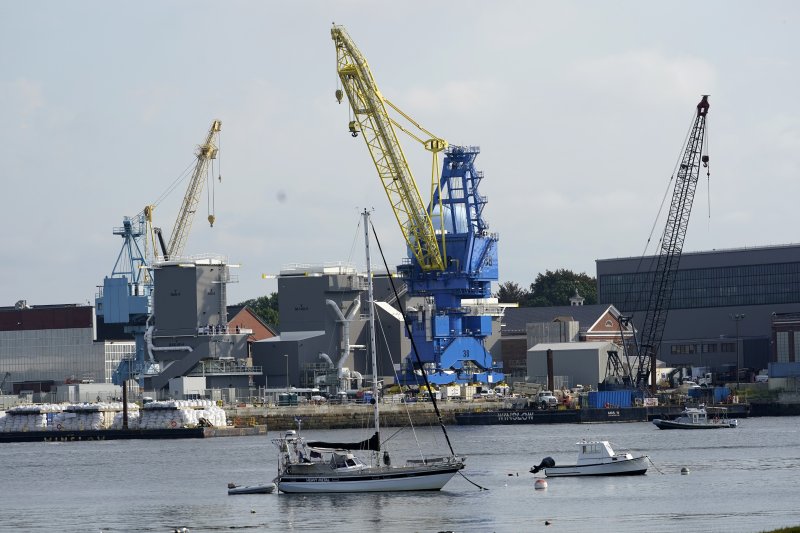
The executive branch of the United States federal government has decided to begin building nuclear-powered vessels with a British company in response to China's dominance over the global shipping supply chain.
The Financial Times (FT) reported on the 24th local time, citing a senior U.S. official, that the Trump administration has decided to assemble a nuclear-powered merchant fleet.
Stephen Carmel, director of the U.S. Maritime Administration under the Department of Transportation, told FT that the U.S. administration will sign a public-private partnership agreement with Core Power, which develops nuclear propulsion technology for ships, later in the day.
Carmel said, "We are not trying to beat China with ships that are cheaper than China's," adding, "They are the masters of low cost." He continued, "The way to win all of this competition is to change the terms of competition to something more favorable to us," and stressed, "So instead of competing on cost, we are competing on technology ... Nuclear technology is something we are really good at."
Public-private partnership fast track
The agreement, the first of its kind in the world, is designed to speed up the construction of nuclear-powered U.S.-flagged vessels. The fast-track program will be supported by administrative measures such as expedited permitting, insurance support, port access, and advanced safety standards.
London-based Core Power, which has worked with the Port of Corpus Christi in Texas, plans to begin building its first nuclear-powered merchant ship in 2028. Core Power said it has secured about $200 million in funding from investors including Mitsui, Mitsubishi, and Sumitomo Corporation. However, the U.S. federal government will not provide funding.
For decades, nuclear propulsion has been used only as military technology for aircraft carriers and submarines. High construction costs and safety concerns have led ports to ban such vessels, and the industry must also address complex international liability provisions.
Nuclear-powered merchant ships have developed significantly in Russia. That is because powerful nuclear vessels were needed to break through Arctic ice. As a result, Russia now has the world's largest nuclear-powered merchant fleet.
A key driver of shipbuilding revival: nuclear-powered merchant ships
The United States is pushing ahead with nuclear-powered vessels as a way to rebuild its shipbuilding industry.
In June, the American Bureau of Shipping (ABS), a nonprofit private technical organization, approved a nuclear-powered vessel designed by the MIT Sloan School of Management maritime consortium. A week later, senior U.S. officials discussed advanced nuclear-powered vessel technology with the United Kingdom, France, Japan, South Korea, and other countries at an IAEA event in Washington, D.C.
Mikal Bøe, CEO of Core Power, said China has also shifted toward nuclear-powered vessels, adding that it is strategically advantageous for the United States and its allies to focus on nuclear-powered merchant ships as well. He said nuclear-powered vessels are more competitive than today's fossil fuel-based system, explaining that they are 50% to 75% faster, can carry more cargo, and are not subject to environmental taxes.
He estimated that "8,200 of the ships that will need to be replaced over the next 25 years are suitable for nuclear propulsion," and that "only 10% to 20% of that demand can be supplied during that period."
Core Power believes that, based on a ship's life cycle, the cost of a nuclear-powered vessel will be around $500 to $600 per ton, roughly comparable to the cost of conventional fossil fuel-powered ships.
Obstacles
Although many of the technical barriers to nuclear-powered vessels have been removed, shipowners remain skeptical because of liability concerns in the event of an accident.
Demosthenes Sapsis, a professor of mechanical and marine engineering in the MIT consortium, said, "Without insurance, nothing will happen," adding, "Because if something goes wrong, someone has to pay for it."
He said safety has improved thanks to advances in reactor design, and argued that this should be used to build public support and create a common regulatory framework so nuclear-powered vessels can move between countries.
Meanwhile, if nuclear-powered merchant ships are introduced, a new economic model for sharing fuel costs is expected to be needed.
At present, the party chartering a ship pays the fuel costs needed for operation, but that model cannot be applied as is to nuclear-powered vessels, where nuclear fuel purchased at the time of construction can last for more than 20 years.
Peter James, managing director at Boston Consulting Group (BCG), said, "A reactor cost of hundreds of millions of dollars on the balance sheet is difficult for shipowners and operators to bear," adding, "Investment funds should be able to invest in the upfront capital expenditure itself."
Beyond cost, there is also the challenge of securing enough nuclear engineers to serve on these nuclear-powered merchant ships, or finding resources to train existing crews. Another key issue is whether local residents will allow nuclear-powered vessels to enter port.
For that reason, the industry expects nuclear-powered merchant ships will not be able to operate in practice before the 2030s at the earliest.
[email protected] Song Kyung-jae Reporter