U.S. Announces Economic Isolation Campaign Against Iran... "China Is No Exception"
- Input
- 2026-08-25 02:55:21
- Updated
- 2026-08-25 02:55:21
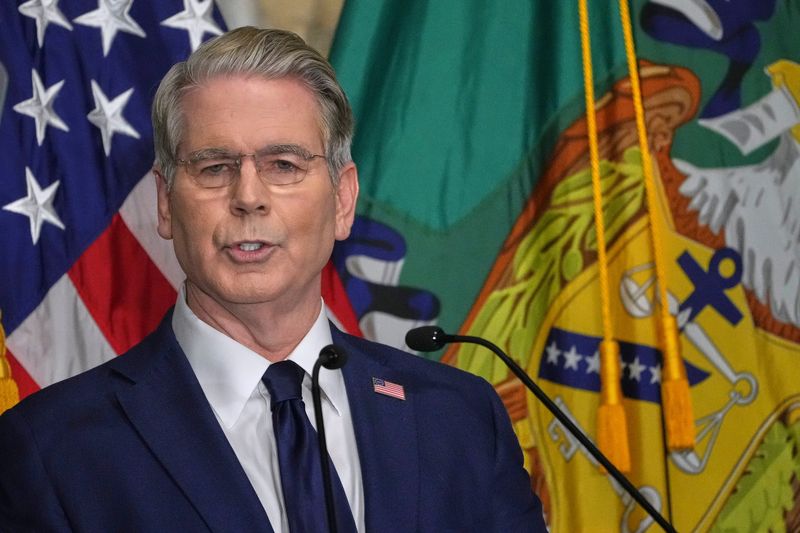
On the 24th (local time), U.S. Treasury Secretary Scott Bessent announced a plan to tighten economic sanctions on Iran, dubbed "Operation Economic Outcast." Earlier, President Donald Trump had referred to it as Iran's "economic D-Day."
The strategy is to isolate Iran by sanctioning companies and countries that do business with it, rather than carrying out military strikes.
Operation Economic Outcast
According to foreign media outlets including Axios and CNBC, Bessent has drawn a line of economic isolation and sanctions to break the stalemate of "no war, but no deal" and pressure the Iranian regime.
The United States will impose secondary sanctions on countries that trade with Iran in areas such as digital assets, technology, gold, aviation and shipping.
Secondary sanctions are penalties, including tariffs, imposed on third countries that do business with a sanctioned entity.
The Treasury Department also designated more than 60 new entities, individuals and vessels around the world that it said help the Iranian regime secure nuclear and missile technology, conduct cyber operations and generate oil revenue.
On digital assets, the department said Iran is increasingly using cryptocurrency as a major tool to evade sanctions and that the transactions support links to the Islamic Revolutionary Guard Corps (IRGC) and regime insiders. It also claimed that Iran is trying to gain access to advanced technology and integrate it into its domestic weapons manufacturing program.
Gold was added to the secondary sanctions list because, as the department put it, "with the collapse of the official financial sector, Iran is stepping up efforts to stabilize the value of the rial against rampant inflation."
Aviation was targeted because it is used to transport fighters, weapons and sensitive technology, as well as gold and cash to proxy forces. The Treasury Department also pointed to Iran's illegal transport of oil for the regime and the military.
In addition, agencies under the Ministry of Defense and Armed Forces Logistics (MODAFL) that support the procurement of proliferation-sensitive technology and equipment for ballistic missile development and nuclear research were also sanctioned.
The sanctions list also included malicious cyber groups directed by the Ministry of Intelligence and Security (MOIS). Brokers, companies and shadow fleet networks in the United Arab Emirates (UAE), Hong Kong, China, Singapore, Switzerland, Europe and elsewhere were also targeted for transporting Iranian oil and sending the proceeds to the Quds Force, the IRGC's elite unit, among others.
No timetable given... sanctions to continue beyond the midterms
Bessent said, "The Treasury Department has identified every hub, every intermediary and every network Iran has used to smuggle oil and evade sanctions," adding, "Starting today, we will tighten the noose further and cut off every possible source of revenue that funds the IRGC and the evil Iranian regime."
U.S. officials said the expanded use of secondary sanctions against institutions that do business with Iran will remain Washington's main tool for squeezing Tehran at least through the November midterm elections. Additional military action against Iran is expected to be discussed again after the midterms.
At the press conference, Bessent said, "We want to leave no ambiguity about the U.S. position," and added, "Anyone who engages in economic ties with this murderous regime in any way should expect the full force of American power."
He did not set a final deadline for the sanctions, but urged those currently doing business with Iran to end it as soon as possible. "I will not set a specific timeline," he said, "but our patience is not infinite."
China is no exception
Bessent also stressed that no country would be exempt, saying, "No one is above this." He added, "This is an economic strangulation campaign against the Iranian regime... no one should try to test our resolve," signaling that China, too, would face sanctions if it trades with Iran.
When asked whether Chinese banks would be included in the sanctions or whether Washington would spare them for the sake of relations with China, he said flatly that there would be no exceptions.
He emphasized, "If they facilitate transactions and are part of that ecosystem, then they are effectively turning Iranian oil into money... and will become a target."
Bessent had previously noted last week that China buys about 90% of Iran's exported oil.
The United States is already imposing broad secondary sanctions on countries that do business with Iran. The measures are especially focused on the oil sector, although only some violations have been penalized so far.
This time, with the goal of economically suffocating Iran, sanctions are expected to be tightened further. Washington plans to pressure Iran in coordination with its allies.
That would make sanctions unavoidable for countries that trade with Iran, including Pakistan, which has served as a mediator in the Iran war, as well as China, Russia, India, Qatar and Türkiye. The United States has so far turned a blind eye, but in the future these countries are also expected to face U.S. secondary sanctions like others.
Iran's economy pushed to the brink
Iran's economy, already strained by years of U.S. sanctions, has been pushed to the brink by the war that began on Feb. 28.
The Iranian rial hit 2 million against the U.S. dollar that day, setting a new all-time low. Import prices have soared, driving severe inflation.
In addition, with the USN moving to blockade Iran at sea, oil exports, the lifeline of the Iranian economy, have effectively been cut off.
U.S. officials said Iran is struggling to secure alternative land and sea transport routes, making it harder to provide basic necessities and services.
According to Trump and U.S. officials, Iran is also failing to pay salaries on time, including those of soldiers, police officers and other public servants.
One U.S. official said, "The Iranian system is designed to protect the elite... but some of those elites are worried, for the first time in their lives, about whether they will be paid on time."
[email protected] Song Kyung-jae Reporter