The foreign land transaction permit system appears to be working, with Seoul purchases down 8%
- Input
- 2026-08-24 18:31:19
- Updated
- 2026-08-24 18:31:19
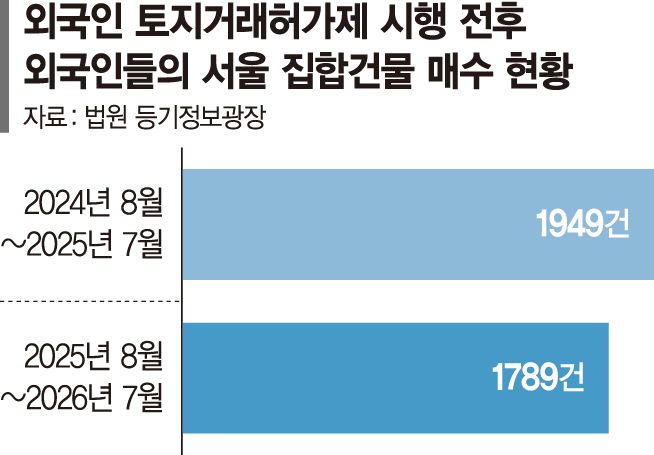
According to an analysis by Financial News of data from the Court Registration Information Plaza on the 24th, foreigners bought 1,789 apartment complexes in Seoul from August last year to July this year, down 8.2% from 1,949 in the same period a year earlier. Purchases fell in 18 of the city's 25 districts, or 72% of the total. The steepest decline was in Mapo District, where purchases dropped 46.6%. Gangnam District, home to ultra-high-end housing, saw a 20.3% decline, while Seocho District fell 4.4%.
By nationality, the sharpest decline was seen among Chinese nationals, who rank first among foreign buyers. Their purchases of apartment complexes in Seoul fell 13.7% to 749 from 868 between August 2024 and July 2025. Purchases by Americans, who rank second, also declined 4.9% over the same period.
The industry believes the government's intent has worked to some extent. When the foreign land transaction permit system was introduced on Aug. 26 last year, the government said its purpose was to prevent speculative home buying by foreigners.
Analysts say the real-residence requirement has been especially effective. Under the system, foreigners must obtain approval from the relevant local government when buying homes larger than 6 square meters in residential areas or 15 square meters in commercial areas. Once approved, they must move in within four months and live there for at least two years.
As the policy showed results, the government on the 20th extended the foreign land transaction permit system by one year, until Aug. 25 next year. Since some effects have already emerged, it plans to keep the restrictions on foreign housing transactions in place for the time being. The designated areas remain all areas of Seoul, as well as 23 cities and counties in Gyeonggi Province, including Suwon, Seongnam, Goyang, Yongin, Ansan-si and Anyang, and nine autonomous districts in Incheon.
[email protected] Kwon Jun-ho Reporter