Foreign Buyers Turn Away from Gangnam Areas... Transactions in Jongno Jump 93%
- Input
- 2026-08-24 18:28:10
- Updated
- 2026-08-24 18:28:10
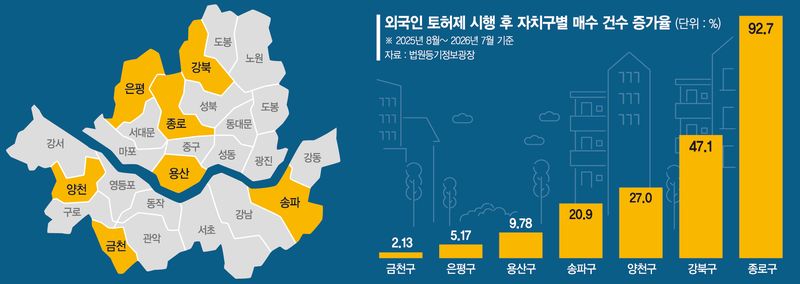
■ Transactions mostly declined, but seven districts saw gains
According to the real estate industry on the 24th, the number of multi-unit residential properties purchased by foreigners in Seoul from August last year to July this year increased from a year earlier in seven districts: Songpa District, Yangcheon District, Yongsan District, Gangbuk District, Geumcheon District, Eunpyeong District and Jongno District.
During this period, Jongno District posted the highest growth rate at 92.7%, followed by Gangbuk District at 47.1%, Yangcheon District at 27%, and Songpa District at 20.9%. Yongsan District and Eunpyeong District also rose by 9.8% and 5.2%, respectively, while Geumcheon District recorded a relatively modest increase of 2.1%. Most of these areas are on the outskirts of Seoul. Among the three Gangnam districts, known for their concentration of ultra-high-priced homes, only Songpa District was included.
This dispersion in foreign demand is being attributed to the growing burden of land transaction permit applications and taxes on ultra-high-priced homes. Unlike before the system was introduced, buyers now face an owner-occupation requirement, making them more cautious about purchasing homes.
Another reason is that foreign buyers are responding to signals from the government that taxes on high-priced homes will rise, and are turning their attention to relatively more cost-efficient areas. On the 3rd, the government announced in its 2026 tax reform plan that it would raise tax rates for owners of high-priced homes worth about 3.2 billion won or more, as well as for multi-home owners. The plan also appeared likely to increase the tax burden on non-resident single-home owners, but the possibility of revision has grown after the Democratic Party of Korea recently signaled opposition. Since foreigners who own homes in Korea are also subject to the Comprehensive Real Estate Holding Tax, analysts say their tax burden is the same as that of Korean nationals.
■ Trading volume in ultra-high-priced home districts plunges
This trend is also confirmed by data from the Ministry of Land, Infrastructure and Transport. According to the ministry, foreign home transactions in Seoul from September last year to June this year, after the land transaction permit system was designated, fell 37% from a year earlier. With the three Gangnam districts down 49%, Seocho District saw a 73% drop, highlighting the sharp decline in areas concentrated with ultra-high-priced homes.
Some observers say foreigners have also begun looking for a less premium single home. Now that they have seen the government's move to tighten regulations on high-priced homes, there is no need to buy the most desirable property at any cost. Park Won-gap, chief real estate expert at KB Kookmin Bank, explained, "Foreigners do not have any special know-how when it comes to buying homes; they think the same way as Korean buyers." He added, "In the end, they are riding the same market trend."
Some people are also trying to sell domestic high-priced homes and move overseas because of complex regulations. A real estate agent near the three Gangnam districts said, "Among the recent bargain apartment listings, there are also properties put up by people who are planning to return overseas."
By contrast, demand for lower-priced homes is rising. After the foreign land transaction permit system took effect, 81% of foreign home transactions in the metropolitan area were for homes priced at 600 million won or less. In Seoul, transactions were concentrated in Guro District, Geumcheon District, Songpa District and Gangseo District. However, some say the drop in transactions has not brought Seoul real estate prices under control. A real estate expert who requested anonymity said, "Most foreigners who came to Korea before the foreign land transaction permit system took effect bought multi-unit residential properties for the purpose of making money and living in them themselves." He added, "It is hard to frame this as speculation." The expert also predicted that "the impact of fewer foreign transactions on market prices will be limited."
[email protected] Kwon Jun-ho Reporter