Only 1 of 10 aging nuclear reactors approved for life extension, raising concerns over 30 GW power supply
- Input
- 2026-08-24 18:26:53
- Updated
- 2026-08-24 18:26:53
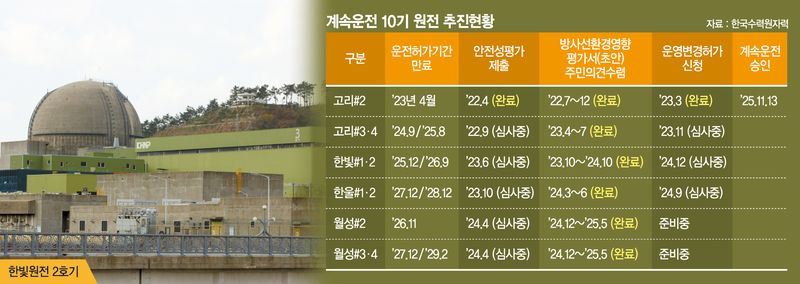
Of the 10 reactors whose operating licenses will expire by 2030, only one has actually received approval for continued operation. Meanwhile, the new semiconductor and AI power demand is approaching 30 gigawatts (GW), nearly equal to the total installed capacity of all nuclear reactors in South Korea. Yet the continued-operation process expected to help fill that gap is moving sluggishly.
■ Continued operation seen as inevitable amid rising demand
According to the Ministry of Climate, Energy and Environment on the 24th, the government plans to supply 15 GW of power to the Yongin Semiconductor Cluster and 6.3 GW to the southwestern semiconductor cluster on time. In addition, more than 8 GW must be supplied to large-scale AI data centers being built in the Chungcheong, Yeongnam, Honam and Gangwon regions. Together, those projects amount to nearly 30 GW, a scale comparable to the total installed capacity of about 26 nuclear reactors in South Korea, or roughly 26 GW, all of which will be newly needed during this administration's term.
How that demand will be met depends on the 12th Basic Plan for Electricity Supply and Demand. The 12th Basic Plan for Electricity Supply and Demand will determine whether new nuclear reactors and Small Modular Reactors (SMRs) will be introduced, and the government aims to finalize it before the regular National Assembly session this year.
The problem is that new nuclear reactors typically take more than 10 years from groundbreaking to completion, making it difficult to immediately cover demand that will peak in the early to mid-2030s. For that reason, continued operation of existing reactors is likely to be treated as one of the few supply options available in the 12th Basic Plan for Electricity Supply and Demand. The reactors whose licenses expire by 2030 include Kori Units 2, 3 and 4, Hanbit Units 1 and 2, Hanul Units 1 and 2, and Wolsong Units 2, 3 and 4, for a total of 10. Hanbit Unit 1 stopped operating in December last year, while Hanbit Unit 2 and Wolsong Unit 2 are set to expire this year. So far, only Kori Unit 2 has completed the approval process for continued operation, with its extension granted until 2033. The remaining nine reactors are still under review for safety assessments or operating changes, or are still in the preparation stage for application.
■ Why is a 10-year extension really only 6 to 7 years?
The issue is that the approved period for continued operation does not match the actual operating period. The clock for continued operation starts not from the application date or approval date, but from the expiration date of the existing operating license. However, the review process, from safety assessment to approval for operating changes, usually takes three to four years. In effect, the time spent waiting for the review is excluded from the uninterrupted 10-year period. On top of that, shutdowns for equipment upgrades before and after approval further reduce the time the plant can actually generate power, leaving only six to seven years of real operation, according to industry officials and experts.
A revision to the Nuclear Safety Act passed the National Assembly in April this year included measures on the safe management of nuclear fuel materials, a pre-review system for reactor design, restrictions on business closure notifications, and a cleanup of the fine system, but it did not include an extension of the continued-operation period.
The deadlock stems from a structure in which no single agency can make the decision alone. Extending the continued-operation period to 20 years is not as simple as changing the number from 10 to 20. Authorities must first regain public acceptance from local residents, and they must also decide how to handle the safety review documents for the nine reactors already under review on the assumption of a 10-year extension. With the NSSC, the ministry, operators and local governments all involved, no one is in a position to push ahead with the revision first.
Kori Nuclear Power Plant Unit 1 received approval for continued operation in December 2007 and restarted in January the following year, but it was shut down early in 2017 after a change in government policy. Wolsong Unit 1 also received approval for continued operation in February 2015 and resumed operation in June that year, but it was later ordered to close early under the government's phaseout policy and stopped in 2019. The two cases show that a change in administration can reverse energy policy direction. An NSSC official said, "There is still no discussion on extending the continued-operation license period," adding, "The government, operators and local governments must first hold discussions together."
[email protected] Lee Yubum Reporter