Vacancy Rate at Bangsan Market, the Printing Hub, Hits 28%... "Production Has Fallen to One-Tenth" [Self-Employed on the Brink (Part 2)]
- Input
- 2026-08-24 18:23:19
- Updated
- 2026-08-24 18:23:19
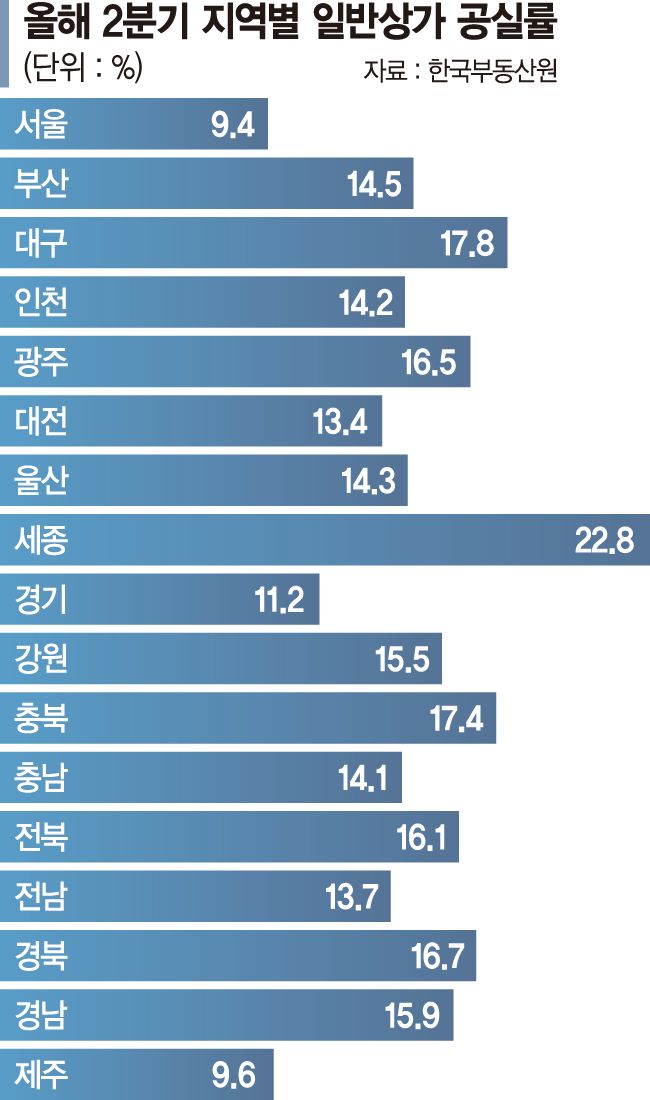
As closed shops fail to find new tenants, vacancies are lingering for long periods in traditional markets, neighborhood shopping districts, and small and mid-sized cities in the provinces. In the April-June period this year, vacancy rates for general retail properties were in the double digits in most regions nationwide, except for places such as Seoul and Jeju Province. The divide is becoming especially stark between businesses that cater to foreign tourists and those that do not.
According to the Korea Real Estate Board (KREB) on the 24th, the nationwide vacancy rate for general retail properties in the second quarter of this year stood at 13.4%, up 0.3 percentage point from the previous quarter. The rate was 14.3% for large and medium-sized retail properties and 8.5% for small retail properties. Excluding Seoul and Jeju, most regions recorded double-digit vacancy rates for general retail properties. In particular, the vacancy rate for general retail properties at Bangsan Market reached 28% in the second quarter. During the boom years of the printing industry, businesses were so strong that some were passed down through generations, but they have been hit hard by the expansion of online transactions and the decline in demand for printed materials.
The drop in demand has led to a sharp decline in production. One merchant at Bangsan Market said, "If we used to produce 1,000 sheets before COVID-19, now we make and sell only about 100. Production has fallen to one-tenth of what it was." Even merchants who are still hanging on are considering closing down. A supermarket operator in his 40s, identified as B, said, "On weekends, it is hard to even hire one part-time worker. Many merchants are moving to places with lower management fees because business is so slow."
Bangsan Market is not the only place suffering from vacancies. Traditional university districts such as Sinchon, Sungshin Women's University, and Hongdae-Hapjeong are also showing high vacancy rates. By contrast, areas popular with foreign tourists, including Bukchon Hanok Village, Gwanghwamun, and Myeong-dong, have relatively low rates.
■ The provinces are also facing population decline
Vacancy growth is being driven by a combination of weak consumer spending, the expansion of online shopping, and the downward rigidity of high rents. In fact, KREB's survey showed that the nationwide integrated retail rent index fell 0.03% in the second quarter from the previous quarter. The problem is that even when sales decline, existing rents do not fall immediately. Lee Young-ae, a professor in the Department of Consumer Science at Incheon National University, explained, "Even when more consumers begin visiting offline stores, commercial districts fail to fully recover because of the heavy burden of high rents. Rents are downwardly rigid, so once they rise, they do not easily come down even if demand weakens." The fact that online shopping became part of everyday life during the COVID-19 era is also slowing the recovery of traditional commercial districts.
The situation in the provinces is even more serious. In the second quarter, Sejong City had the highest vacancy rate for general retail properties in the country at 22.8%, followed by Daegu at 17.8%, North Chungcheong Province at 17.4%, and North Gyeongsang Province at 16.7%. Seoul, meanwhile, recorded a vacancy rate of 9.4% for general retail properties, below the national average.
Rising vacancies are not just a problem for individual buildings. As empty stores increase, foot traffic declines and sales at nearby shops also fall. That can in turn trigger more closures and more vacancies, creating a vicious cycle. If the slump in commercial districts drags on, it could weaken not only property values but also local consumption, employment, and the tax base of provincial governments. Choi Cheol, a professor in the Department of Consumer Economics at Sookmyung Women's University, advised, "Ultimately, it is important to build an infrastructure base that allows the economy and culture to sustain themselves at the local level. Each commercial district needs to find its appropriate scale and be reorganized in line with local conditions."
[email protected] Kwon Jun-ho Reporter