Investment Funds Move Faster as Demand Deposit Turnover Hits Highest Level in 10 and a Half Years
- Input
- 2026-08-24 18:20:37
- Updated
- 2026-08-24 18:20:37
Stock market swings send deposit accounts surging
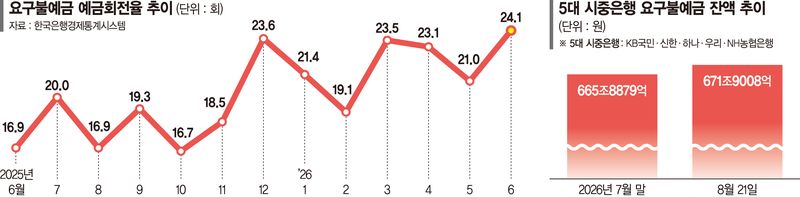
According to the Bank of Korea Economic Statistics System on the 24th, demand deposit turnover at deposit banks stood at 24.1 times in June. That was the highest monthly level since December 2015, when it reached 24.6 times, and the strongest reading in 10 years and six months.
Demand deposit turnover has remained at a high level recently. After hitting a 10-year high of 23.6 times in December last year, it climbed further to 24.1 times in June this year. In particular, the rate had fallen from 23.1 times in April to 21.0 times in May, but rebounded sharply a month later, showing that short-term fund movements have accelerated again.
Turnover for checking accounts, a type of demand deposit, also rose sharply. Checking accounts are mainly used by companies to issue checks or bills for commercial payments. In June, checking account turnover jumped to 724.8 times from 632.8 times in the previous month.
Deposit turnover is calculated by dividing the cumulative amount of deposits paid out over a given period by the average balance. For example, if the banking sector's average balance in June was 100 trillion won and the cumulative amount of demand deposits withdrawn during that month was 2,400 trillion won, the turnover rate would be 24 times.
The higher the turnover rate, the shorter the time funds stay in an account and the more actively money is moving.
Industry observers say the recent rise in demand deposit turnover was partly driven by more active movement of waiting investment funds as stock market volatility increased. In June, the KOSPI (Korea Composite Stock Price Index) surged past the 9,000 mark for the first time ever before falling back to the low 8,000s by the end of the month, swinging sharply up and down. A banking industry official explained, "As stock market trends changed quickly, funds for buying and selling shares may have moved more frequently between bank demand deposit accounts and brokerage accounts."
Demand deposits surge as stocks lose momentum
Demand deposit balances at commercial banks are also rising rapidly this month. As of the 21st, demand deposit balances, including money market deposit accounts, at the five major commercial banks — KB Kookmin Bank, Shinhan Financial Group, Hana, Woori Bank and Nonghyup Bank — totaled 671.9008 trillion won. That was up 6.0129 trillion won from the end of last month, suggesting that some short-term funds that had left the banking sector are flowing back in.
The trend shows that money is not simply sitting in accounts, but moving quickly as needed. It suggests continued demand for idle funds as investors weigh the timing of investment or consumption while watching market conditions.
As market interest rates have recently risen, bank deposit rates have also climbed into the mid-3% range, broadening the range of options for managing funds. According to disclosures by the Korea Federation of Banks (KFB), THE JEONBUK BANK LTD.'s "JB Direct Deposit Account" offers the highest base rate at 3.76% for a 12-month term, while the three internet-only banks are offering rates around 3.60%.
A banking industry official said, "With stock markets and market interest rates moving sharply recently, customers are showing a greater desire to manage their money while keeping liquidity rather than leaving it in one place for a long time." The official added, "Since demand deposits include various types of funds, such as corporate settlement money, the recent trend should be seen as the result of multiple factors, not just the stock market."
[email protected] Lee Hyun-jung Reporter