Domestic lunar surface space radiation dosimeter gains traction... "Development to be completed next year"
- Input
- 2026-08-24 18:04:48
- Updated
- 2026-08-24 18:04:48
■ Measuring the effects of lunar radiation on the human body
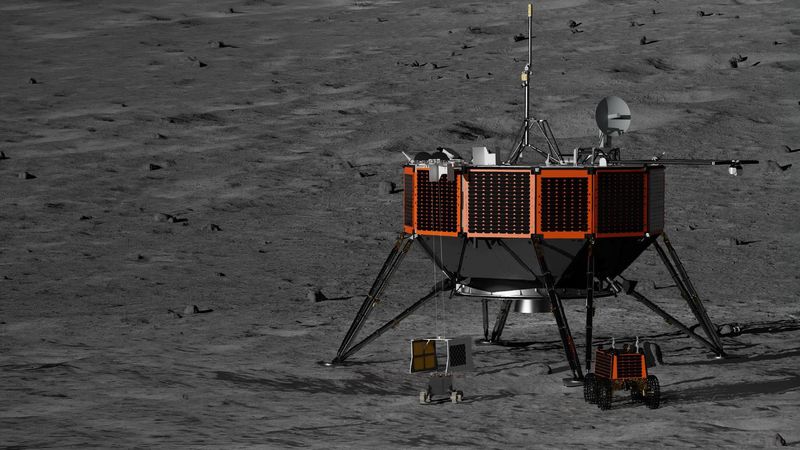
According to the scientific community on the 24th, the lunar surface space radiation dosimeter now under development is a payload for measuring space radiation on the lunar south pole surface. It is being developed for installation on a lander under NASA's Commercial Lunar Payload Services program. On the 14th, KASA and NASA signed an implementation agreement, formally deciding to include it on the mission.
NASA's Commercial Lunar Payload Services program is part of the Artemis Program, the U.S. crewed lunar exploration project. It can be seen as an uncrewed lunar landing mission that analyzes the lunar environment and conducts scientific investigations before humans actually land on the Moon. South Korea's dosimeter will be installed on one of the lunar landers used for that purpose.
The LVRAD now under development is an instrument that measures the space radiation environment on the lunar surface and analyzes radiation dose and particle characteristics. The data it collects will be used to study how radiation reaching the lunar surface affects crewed and uncrewed exploration, including landers and astronauts.
The dosimeter consists of a space radiation dose and spectrometer for measuring radiation penetration and a neutron spectrometer for measuring the neutron environment. The space radiation dose and spectrometer measures the linear energy transfer, or LET, and energy spectrum of high-energy particles. It also uses materials that simulate human tissue to measure radiation penetration and assess biological effects.
In other words, it can help determine whether space radiation poses a risk when astronauts operate on the lunar surface, as they would in a crewed spacecraft. The neutron spectrometer then detects fast neutrons. It also measures epithermal and thermal neutrons to analyze the lunar surface environment.
KASA plans to complete development of the flight model in 2027 and transfer it to the United States in line with NASA's lunar lander schedule.
A KASA official said, "We aim to complete development of the dosimeter as a flight model that can be sent to the lunar lander by the end of next year." The official added, "After that, we will store the instrument and send it to the United States according to the lunar lander launch schedule."
■ Seven payloads plus additional equipment to observe the lunar environment
The dosimeter will be loaded onto the lunar lander along with six other payloads. First, a camera will be installed to observe the interaction between the engine plume and the lunar surface, as well as the scattering of surface material during descent. Also aboard will be an instrument that uses near-infrared spectroscopy and imaging to examine the mineral composition of the lunar surface and the possible presence of volatile substances such as hydroxyl, along with a mass spectrometer that measures volatile components around the lander to analyze the lunar surface environment and resource characteristics.
Another payload will use a mobile nanosensor platform to measure environmental changes and volatile substance information around the lunar surface after landing. A laser retroreflector will also be installed to support precise positioning on the lunar surface and future exploration and navigation. In particular, an archive device for the lunar surface, a kind of time capsule containing records of human civilization and scientific and cultural history, is also scheduled to be included. So far, there are seven payloads in total, including South Korea's dosimeter. Excluding South Korea's instrument, all of them are U.S. payloads. Additional payloads could still be added before the 2030 launch.
NASA will place the South Korean-developed dosimeter on the private lunar lander and support its operation and data transmission from the lunar surface after the 2030 launch.
Oh Tae-seok, Administrator of the Korea AeroSpace Administration, said, "We will continue to expand international cooperation, advance technologies related to lunar exploration, and further strengthen our contribution to the international community in the field of space science."
[email protected] Reporter Yeon Ji-an Reporter