Development of the world's first environmental and ocean satellite, Chollian Satellite 6, moves into full swing
- Input
- 2026-08-25 09:00:00
- Updated
- 2026-08-25 09:00:00
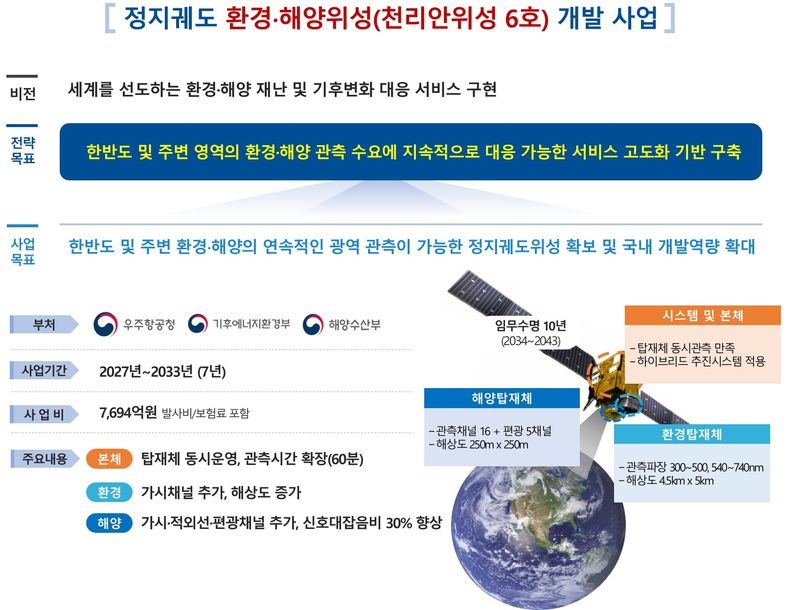
[Financial News] Development of Chollian Satellite 6, the world's first environmental and ocean satellite, is now moving into full swing.
Korea AeroSpace Administration (KASA), the Ministry of Climate, Energy and Environment, and the Ministry of Oceans and Fisheries (MOF) said on the 25th that the jointly planned project to develop a geostationary environmental and ocean satellite, Chollian Satellite 6, has passed the preliminary feasibility study for a national R&D project.
Chollian Satellite 6 is a follow-up satellite that will take over the mission of Chollian Satellite 2B, the world's first geostationary environmental and ocean satellite, which was launched in 2020. The project will involve a total investment of about 769.4 billion won, with development scheduled to begin in 2027 and continue for seven years before launch in 2033.
Once the Chollian Satellite 6 project is completed, its improved performance will allow faster and more accurate monitoring of air quality impacts from disasters such as ultrafine dust, ground-level ozone and wildfires, as well as changes in the marine environment such as red tides, oil spills and low-salinity water. It is expected to actively support the response of relevant agencies, protect public health and improve everyday safety.
In addition, by localizing the payload for a geostationary satellite for the first time in South Korea and developing a hybrid propulsion system that combines chemical and electric propulsion, along with simultaneous observation technology for environmental and ocean payloads, the project is expected to strengthen the country's technological self-reliance in satellite development and lay the groundwork for entry into overseas markets.
The three ministries and agencies jointly promoting the Chollian Satellite 6 project plan to establish detailed implementation measures and prepare follow-up procedures without delay, including budget securing and the selection of R&D institutions.
Seong Ji-won, head of the Air Environment Research Division at the Ministry of Climate, Energy and Environment, said, "With this approval, we will carry forward the world-class experience we have built through Chollian Satellite 2B in developing and operating environmental satellites into the more advanced Chollian Satellite 6." He added, "Through denser and more accurate observations, we will quickly identify changes in the air environment and actively use them for environmental information services that the public can directly experience."
Jang Myo-in, administrator of KHOA, said, "The broad, long-term ocean observation data spanning more than 30 years from Chollian Satellite 1 through Chollian Satellite 6 will be used as key data for marine and fisheries policy decisions and responses to climate change." He added, "Through Chollian Satellite 6, we will more accurately track environmental changes in our seas and support responses to marine disasters and safe ocean activities for the public."
Kim Jin-hee, head of the Satellite Division at KASA, said, "Chollian Satellite 6 is a key national space asset that continuously observes the atmosphere and marine environment closely tied to people's daily lives, while also serving as an important project to expand South Korea's geostationary satellite development capabilities." He stressed, "By shifting toward a full-scale private-sector-led satellite development system, we will expand domestic development of core technologies and enhance the competitiveness of the space industry."
[email protected] Youn Ji-an Reporter