HD Hyundai Heavy Industries Union Ends Mediation and Turns to Strike Action...Shipbuilding Wage Talks Enter a Full-Scale Standoff
- Input
- 2026-08-24 17:16:24
- Updated
- 2026-08-24 17:16:24
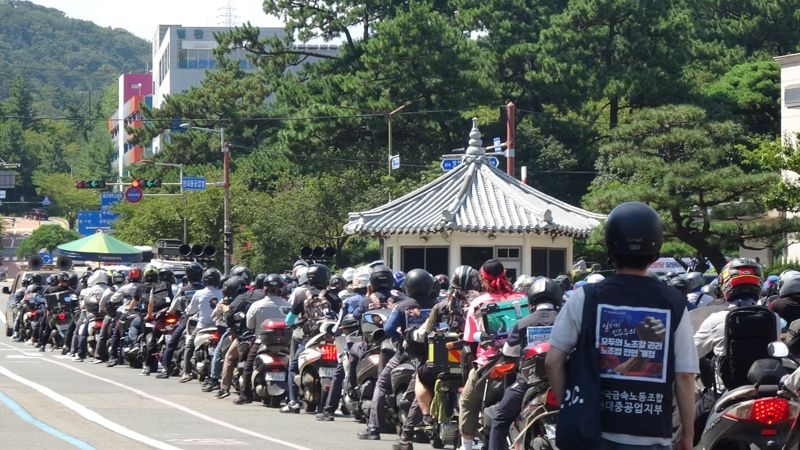
[Financial News] The HD Hyundai Heavy Industries union has pulled out the strike card. The standoff over wage increases in the shipbuilding industry is now entering a full-scale phase.
According to the industry on the 24th, labor and management at HD Hyundai Heavy Industries failed to narrow their differences even at the second mediation meeting of the National Labor Relations Commission over 2026 wage negotiations, and ultimately accepted the suspension of mediation procedures. That means the union has formally secured the right to dispute, allowing it to legally push ahead with a strike. In the long history of labor disputes involving major shipbuilders such as Hyundai Mipo and DSME, HD Hyundai Heavy Industries has often served as a barometer for wage negotiations across the shipbuilding industry. Its latest move has now crossed a turning point.
The union plans to hold a strike authorization vote for three days, from the 25th to the 27th. If member turnout is strong, an actual strike could begin as early as after the 27th. The shipbuilding industry has already suffered losses worth hundreds of billions of won from strikes at DSME and Hyundai Mipo in 2023, and concerns among international shipowners over delivery delays remain high.
The HD Hyundai Heavy Industries union is demanding a 5% increase in base pay and guaranteed regular bonuses equivalent to eight months of salary. The company has drawn the line at a 2% base pay increase and bonuses worth six months of salary, citing difficult business conditions. That leaves a 3 percentage point gap in base pay and a difference of two months of annual bonuses.
Wage negotiations in the shipbuilding industry are no longer just a fight over how to divide profits between labor and management. They are now directly tied to the international competitiveness of South Korea's shipbuilding sector. As latecomer shipbuilders in China rapidly catch up in technology, labor costs for domestic shipbuilders continue to rise every year.
An industry official said, "Even as the global ship order market is cooling rapidly, domestic unions are trying to maintain a high-wage trend," adding, "At a time when supply chain diversification is accelerating, a decline in the competitiveness of Korean shipyards could quickly lead to fewer orders."
What makes the situation even more complicated is the current economic backdrop. South Korea's real wage growth remains stagnant, while inflation has stayed relatively high. In that environment, where workers' purchasing power is being eroded, the union's demand for higher wages has a clear rationale. At the same time, it is also hard to deny that business conditions have worsened amid the global slowdown.
Historically, the shipbuilding industry has been a battleground for wage negotiations. A series of strikes at Hyundai Mipo in 2015 and 2016, DSME's management crisis in 2019, and another round of strikes in 2023 all centered on wages and employment. The outcome of these disputes ultimately ripples across the entire industry. That is because the result of HD Hyundai Heavy Industries' negotiations quickly becomes a benchmark for other shipbuilders.
The union side argues that "the company is refusing to properly share the profitability it has available," while management says that "raising base pay in a volatile order environment means higher fixed costs." Both sides, in other words, have realistic grounds for their positions. But with the institutional buffer of mediation no longer functioning, the dispute has reached a point where it may end up being decided by sheer leverage.
Wage negotiations in the shipbuilding industry are more than a simple distribution issue. They are an important signal that could shape the competitiveness of South Korea's entire manufacturing sector. Whether HD Hyundai Heavy Industries goes on strike, and what kind of agreement is reached in the process, is likely to determine the management direction of Korean shipyards for years to come. The vote starting on the 25th is expected to be the first step that sets the course for the entire shipbuilding industry.
[email protected] Kang Gu-gui Reporter