Two special counsel teams clash again over when the insurrection ended; Special Counsel for Insurrection says the key is when the insurrection forces surrendered
- Input
- 2026-08-24 17:08:11
- Updated
- 2026-08-24 17:08:11
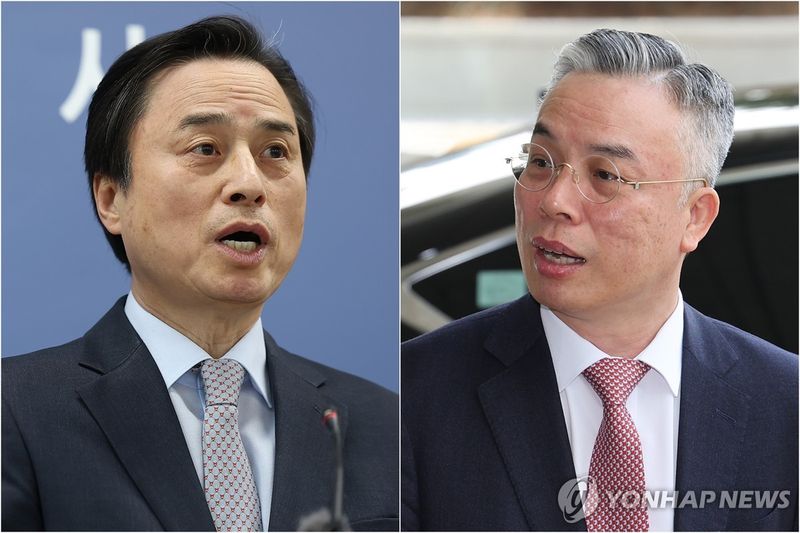
[Financial News] The Special Counsel for Insurrection and the Second Comprehensive Special Prosecutor Team have again offered conflicting interpretations of when the 'insurrection act' ended during the December 3 Martial Law declaration.
In a briefing on the 24th, the special counsel team said, "The end point of the insurrection should be judged, regardless of whether it was an 'insurrection from below' or an 'insurrection from above,' based on when the insurrection forces subdued the resistance or, alternatively, when they surrendered to it." The team considers the insurrection to have ended on December 4, 2024, when the National Assembly voted to lift martial law.
That was a rebuttal to the Second Comprehensive Special Prosecutor Team's view that December 14, 2024, when the impeachment motion against former President Yoon Suk Yeol was passed and his presidential duties were suspended, was effectively the end point of the insurrection.
The special counsel cited precedent from the Coup d'état of May Seventeenth. It argued that, since the Supreme Court of Korea had determined the end of the insurrection based on the lifting of martial law, the December 3 Martial Law case should also be assessed by examining when the actual command and mobilization capabilities of the insurrection forces were neutralized.
The special counsel further stressed that the Coup d'état of May Seventeenth was also an 'insurrection from above,' in which Chun Doo-hwan, who seized effective control of the government and the military through the 12/12 Military Insurrection, used the president's declaration of martial law as a tool.
The special counsel concluded that the two pillars of the insurrection had already been neutralized when the prosecution's special investigation headquarters began investigating insurrection charges on December 6 and questioning top military commanders, followed by the emergency arrest of former Defense Minister Kim Yong-hyun on the 8th.
In particular, it described the appearance of former Special Warfare Commander Kwak Jong-geun and former Commander of the Capital Defense Command Lee Jin-woo on Democratic Party of Korea lawmaker Kim Byung-joo's YouTube broadcast on the 6th as a de facto "surrender." It said that with the duties of former Defense Counterintelligence Command chief Yeo In-hyung and other key commanders suspended that same day, it would have been difficult for Yoon Suk Yeol to mobilize the military and police even if he had declared martial law again.
The special counsel also pointed out that if the suspension of presidential duties were used as the benchmark for the end of the insurrection, the legal scope of those considered to have joined the rebellion would become excessively broad.
It said, "By the same logic, former Prime Minister Han Duck-soo, a key participant in the insurrection, could also have declared martial law as acting president, so his suspension from duty should be regarded as the end of the insurrection." It added that this reasoning could extend to ruling party leaders who blocked the impeachment vote, as well as figures who attended the ruling party-government-presidential office meeting on December 4, potentially classifying them as major participants in the insurrection.
Earlier, Kwon said at a briefing on the overall investigation results that "at the very least, once an impeachment motion is passed and duties are suspended, martial law can no longer be declared," adding, "At that point, I thought the country had been freed from the risk of martial law being declared again."
[email protected] Choi Eun-sol Reporter