Is the 100 Trillion Won Future Response Fund a Slush Fund? Ruling and Opposition Parties, Government Agree on National Assembly Oversight
- Input
- 2026-08-24 16:42:22
- Updated
- 2026-08-24 16:42:22
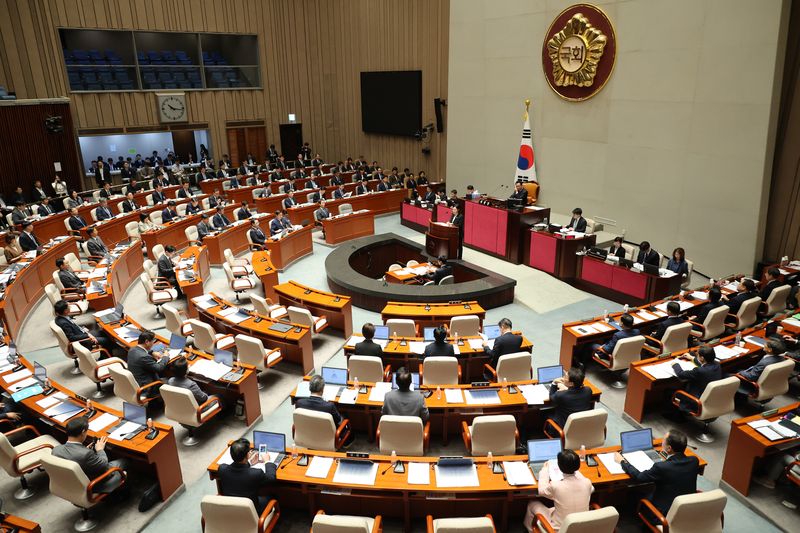
[Financial News] The Lee Jae-myung administration's planned Future Response Fund, which is expected to exceed 100 trillion won, is drawing criticism that it could become a slush fund that bypasses National Assembly review. The Democratic Party of Korea also appears to share that concern, raising the likelihood that legislative review will strengthen parliamentary oversight in the next stage of deliberations.
According to the ruling camp on the 24th, the government and the ruling party are preparing a plan to establish the Future Response Fund in order to channel extra tax revenue from the semiconductor boom into advanced industry development and talent training. After a public notice period, the bill will be submitted to the National Assembly on the 3rd of next month. A revision to the National Finance Act is also being pursued to require that a portion of any excess tax revenue be placed into the fund.
The opposition, including conservative and progressive parties, has voiced concerns. Jang Dong-hyuk, leader of the People Power Party, told Kim Min-seok, the Democratic Party of Korea leader, during a courtesy visit on the same day that if the fund is seen as a way to avoid National Assembly oversight, it could be misunderstood as a "support rating and election response fund." He added, "Excess tax revenue should be used to pay down debt, and half should go to support young people, self-employed workers and others."
At a comprehensive policy questioning session of the Special Committee on Budget and Accounts that day, Im Lee-ja, the People Power Party's Policy Committee Chairperson, said there was a strong risk that the fund would turn into a "permanent supplementary budget" that can be drawn on at any time to evade National Assembly oversight and become a slush fund. Senior lawmaker Cho Bae-sook also pointed out that "the fund allows the government to change the operating plan within a 20% range, leaving room to cleverly bypass National Assembly oversight."
Even Cho Kuk of the Rebuilding Korea Party (RKP), which is part of the broader pro-government bloc, criticized the plan, saying, "There is no guarantee that the unprecedented semiconductor boom will continue every year, so it is premature to inject excess tax revenue." He added, "Preemptively deciding that the government can use revenue generated when tax estimates go wrong as it wishes is a design that infringes on the National Assembly's budget review authority."
Gang Gyeong-suk, the RKP's floor spokesperson, urged the government to clearly spell out parliamentary review and oversight provisions in the bill, saying, "The fund is reviewed by the National Assembly every year, but up to 20% of the spending plan can be changed without going through the National Assembly."
The need for National Assembly oversight of the Future Response Fund is also being acknowledged by the government and the ruling party. In response to Jang's criticism, Kim said, "I fully agree," adding, "Regardless of party lines, there must be a public consensus on transparent control over national finances and on the direction they should take."
Minister of Planning and Budget Park Hong-keun explained at the committee meeting that "excess tax revenue does not necessarily have to be set aside in the Future Response Fund, and no project can be used arbitrarily by the government without prior review and approval by the National Assembly."
Accordingly, once the Future Response Fund bill is submitted to the National Assembly on the 3rd of next month, the ruling and opposition parties, along with the government, are expected to work out effective parliamentary oversight during the review process. People Power Party lawmakers on the Strategy and Finance Committee of the National Assembly, which has jurisdiction over the bill, have already taken a position. They said, "A fund must have a specific purpose, but if its scope is too broad, covering youth, growth engines, local regions and talent, then the general account is the right approach," effectively rejecting the need to create the fund in the first place.
[email protected] Kim Yun-ho Reporter