A Patient in Her 90s Starts a New Life After 11 cm Abdominal Aortic Aneurysm Surgery: "Advanced Age Is Not an Exception"
- Input
- 2026-08-24 16:24:56
- Updated
- 2026-08-24 16:24:56
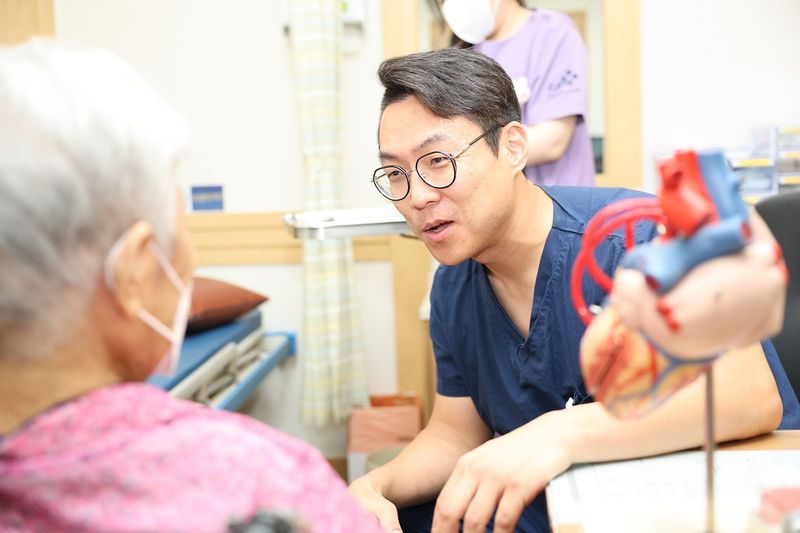
[Financial News] Breaking the common belief that surgery is too difficult for elderly patients, a 90-year-old woman successfully recovered after undergoing surgery to remove an 11 cm abdominal aortic aneurysm. Although she was at extremely high risk due to conditions including kidney failure and cirrhosis, the medical team’s careful collaboration led to a successful outcome.
Ninety-year-old Ms. Kim was diagnosed with an abdominal aortic aneurysm 14 years ago after visiting a hospital for severe abdominal pain. She later underwent Endovascular Aneurysm Repair (EVAR) twice, in 2014 and 2016. However, the aneurysm did not shrink, and it continued to grow over time, reaching about 11 cm in diameter recently.
An aortic aneurysm is a condition in which the wall of the aorta, the body’s largest artery that carries blood from the heart throughout the body, weakens and bulges like a balloon. Depending on where it occurs, it is called a thoracic aortic aneurysm if it develops in the chest and an abdominal aortic aneurysm if it develops in the abdomen.
The larger an abdominal aortic aneurysm becomes, the higher the risk of rupture. In Ms. Kim’s case, the aneurysm was extremely large, and its location made it difficult to treat with an additional stent-graft procedure.
In the end, Ms. Kim underwent surgical treatment despite being 90 years old. Joo-woo Cho, a professor in the Department of Cardiovascular and Thoracic Surgery at Chung-Ang University Hospital, removed part of the stent that had been inserted into her abdominal aorta and iliac artery, then replaced the severely enlarged aneurysm with an artificial graft.
Although Ms. Kim was at high surgical risk not only because of her age but also because of comorbidities such as kidney failure and cirrhosis, she received intensive monitoring and recovery care from the medical team. She was discharged on the 12th day after surgery in good health, without any major complications.
This case shows that rather than giving up on surgery simply because of advanced age, it is important to assess the patient’s condition and treatment options comprehensively when deciding on a treatment plan. That approach matters not only for survival, but also for quality of life.
According to HIRA, the number of patients treated for abdominal aortic aneurysms rose from 6,892 in 2015 to 15,650 in 2025, an increase of about 2.3 times. In particular, patients aged 60 and older accounted for about 96% of the total in 2025, making it a representative vascular disease of old age.
The problem is that abdominal aortic aneurysms often cause no noticeable symptoms until they become quite large. In many cases, they are discovered incidentally during abdominal CT scans or ultrasounds performed as part of health checkups or for other medical conditions.
If an aortic aneurysm ruptures, it can lead to massive bleeding and become life-threatening. Emergency surgery is required after rupture, and the risk of death rises sharply. For that reason, once an aneurysm is detected, it must be followed regularly and treated at the appropriate time.
Treatment for an abdominal aortic aneurysm is determined by comprehensively considering the patient’s age, overall condition, the size and location of the aneurysm, and the shape of the surrounding blood vessels.
In recent years, endovascular treatment using a stent-graft inserted through the femoral artery and other vessels has been widely performed for elderly patients or those at high surgical risk. Compared with open surgery, it has the advantages of a smaller incision and faster recovery.
However, not all patients with abdominal aortic aneurysms are eligible for endovascular treatment. Depending on the aneurysm’s location, shape, and vascular condition, it may be difficult to secure the stent-graft firmly. In such cases, surgery is considered.
Open surgery for an abdominal aortic aneurysm is a highly complex procedure that involves making an incision in the abdomen and replacing the weakened, enlarged section of the aorta with an artificial graft. Because the surgical field is extensive and blood flow to major organs must be carefully controlled during the operation, the patient’s overall condition must be evaluated in detail. Skilled judgment by the medical team and close cooperation among the surgical staff are essential for safe surgery.
Professor Joo-woo Cho of the Department of Cardiovascular and Thoracic Surgery at Chung-Ang University Hospital, who performed the operation, said, "The goal of aortic surgery in very elderly patients is not simply to prolong life by making the surgery successful." He added, "It is important to decide on the treatment method by also considering the patient’s remaining quality of life and daily life after surgery."
Once an abdominal aortic aneurysm develops, it is difficult to restore the enlarged vessel to its original state with medication or lifestyle changes alone. Therefore, it is important to check the condition regularly and manage risk factors so that the aneurysm does not grow further or rupture.
Professor Cho said, "Abdominal aortic aneurysms often go undetected because they usually cause no specific symptoms, and once they rupture, they can be life-threatening. For that reason, older patients with hypertension or arteriosclerosis, as well as people with a history of smoking, should check the condition of their aorta through health screenings or abdominal imaging tests."
[email protected] Medical Reporter Jung Myung-jin Reporter