Korean business sentiment turns positive for first time in six months, extending beyond semiconductors to domestic demand and materials
- Input
- 2026-08-25 06:00:00
- Updated
- 2026-08-25 06:00:00
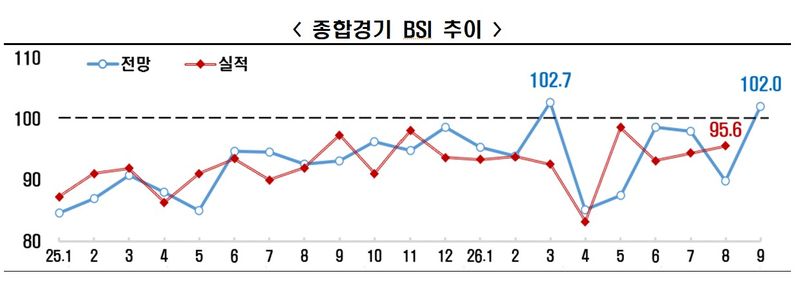
[Financial News] The outlook for domestic companies has turned positive for the first time in six months. The recovery in business sentiment, which had been concentrated in exports and semiconductors, is now spreading to domestic demand and a wider range of industries. As a result, the manufacturing and non-manufacturing outlooks both moved above the benchmark for the first time in four years and 11 months. In particular, the domestic demand outlook also turned positive for the first time in four years and three months, raising expectations for an economic recovery.
The Federation of Korean Industries (FKI) said on the 25th that its survey of business sentiment among the country's top 600 companies by sales showed a September Business Survey Index (BSI) outlook of 102.0. The outlook moved above the benchmark of 100 for the first time in six months, since the March forecast of 102.7 taken before the outbreak of the U.S.-Iran crisis, suggesting that business sentiment has improved.
The September manufacturing BSI outlook rose 13.3 points from the previous month to 101.7, while the non-manufacturing outlook also turned positive, climbing 10.9 points to 102.4 from 91.5 in the previous month. It was the first time in four years and 11 months, since the October 2021 outlook, that both manufacturing and non-manufacturing posted positive forecasts at the same time.
Among the 10 manufacturing subsectors, six showed strength: medication (125.0), wood, furniture and paper (116.7), textiles, clothing, leather and footwear (115.4), nonmetallic materials and products (114.3), automobiles and other transport equipment (109.7), and General and Precision Machinery and Equipment (109.5). Three subsectors, excluding electronics and communication equipment, which was right at the benchmark of 100, posted negative outlooks.
A key feature of the September outlook is that the improvement in manufacturing sentiment was driven by a broad range of industries centered on parts and materials, unlike the earlier recovery phase in June, which depended on a few flagship sectors such as semiconductors and healthcare. FKI explained that "as the exchange rate has recently shown signs of stabilizing, concerns over the prices of imported raw materials and parts, as well as the burden of foreign-currency payments, have eased somewhat."
Among the seven non-manufacturing subsectors, wholesale and retail (115.6) and transportation and warehousing (104.2) performed well. Four subsectors, excluding information and communication, which was at the benchmark of 100, posted negative outlooks.
By segment, domestic demand (100.3) and exports (100.9) both showed positive outlooks and led the improvement in business sentiment. In particular, the domestic demand outlook (100.3) returned above the benchmark for the first time in four years and three months, since June 2022 (102.2), helped by easing exchange-rate pressure and the Chuseok holiday season. The export outlook (100.9) has remained solid, staying above 100 for four straight months since June despite instability in the Middle East and uncertainty in the global trade environment.
Sangho Rhee, Head of the Economic Headquarters at FKI, said, "It is encouraging that the improvement in business sentiment, which had been limited to exports and semiconductors, is now spreading to domestic demand and a wider range of industries." He added, "For this improvement to translate into investment and consumption, institutional support is needed, including expanding the scope of the tax credit for domestic production and enacting the Framework Act on Service Industry Development."
[email protected] Im Subin Reporter