Why Did the Haenam Earthquake Swarm Occur? ... "Fault Movement Caused by Crustal Stress"
- Input
- 2026-08-24 16:00:00
- Updated
- 2026-08-24 16:00:00
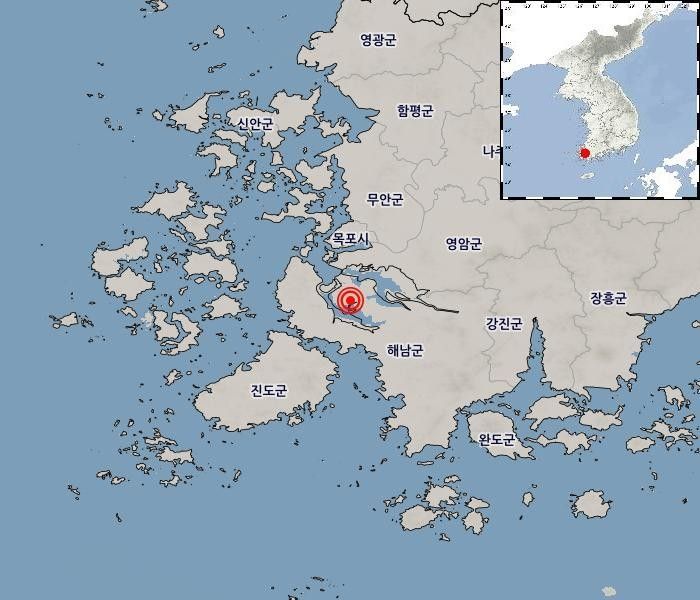
[Financial News] The recent string of earthquakes in Haenam County, Jeonnam-Gwangju Integrated Metropolitan City, has been analyzed as having occurred in the lower crust at a depth of about 20 kilometers, as faults moved under stress applied to the Korean Peninsula's crust. Experts said the pattern is similar to the earthquake swarm that struck the same area in 2020, and they judged that the chances of it developing into a major earthquake are low. Still, because earthquakes are recurring in the same area, the government plans to maintain monitoring and emergency response readiness for the time being.
The Ministry of the Interior and Safety (MOIS) said on the 24th that it had held an expert meeting on the Haenam County earthquake swarm, with officials from related agencies and private-sector experts taking part, including the Korean Meteorological Administration, the National Disaster Management Research Institute, Pusan National University (PNU), the Korea Institute of Geoscience and Mineral Resources (KIGAM), and the Korea Electric Power Corporation Research Institute.
Experts concluded that the recent earthquakes in Haenam were the result of persistent stress on the Korean Peninsula's crust, which triggered fault movement. The quakes occurred at a depth of about 20 kilometers, in the lower crust below the surface.
Since the 14th, Haenam County has recorded 72 minor earthquakes through the 23rd, including seven with a magnitude of 2.0 or higher. Of those, 65 were below magnitude 2.0. In particular, a magnitude 3.1 quake struck at 6:43 a.m. on the 23rd, and maximum intensity IV was observed. No damage reports have been received so far.
Experts said the current earthquake swarm is similar to the one that occurred in the same area in 2020. From April 28 to May 31, 2020, Haenam saw five earthquakes of magnitude 2.0 or higher and 70 below magnitude 2.0. The largest quake at that time was also 3.1.
Based on the analysis so far, experts believe the current swarm is unlikely to lead to a major earthquake. However, because the quakes are recurring in the same area, they agreed that it is necessary to closely monitor the trend for now and continue preparedness drills and efforts to strengthen the seismic resilience of facilities.
As the small earthquakes continued, MOIS raised the earthquake crisis alert from "watch" to "caution" at 11 a.m. on the 23rd and activated its emergency response team. The government also plans to conduct a joint tabletop exercise simulating a major earthquake in Haenam County.
The government will also continue reinforcing the seismic safety of public facilities. MOIS is aiming for a 84.6% seismic reinforcement rate for public facilities this year and plans to raise that figure to 100% by 2035. Since May, the Korean Meteorological Administration has been fully operating its earthquake on-site alert service, which sends emergency text alerts to cities, counties and districts within a 40-kilometer radius of the first observation point when an earthquake of intensity VI or higher occurs.
Kim Yong-geun, director of the Natural Disaster Bureau at MOIS, said, "Based on the expert analysis, the likelihood of a major earthquake in Haenam County is not considered high. However, related agencies should maintain emergency preparedness for the time being and do their utmost to manage the situation in case of any contingency."
[email protected] Reporter Lee Bo-mi Reporter