Samsung aims to give HBM a 'brain,' while SK builds ultra-high stacks... The battleground for HBM shifts to design and packaging
- Input
- 2026-08-24 16:59:33
- Updated
- 2026-08-24 16:59:33
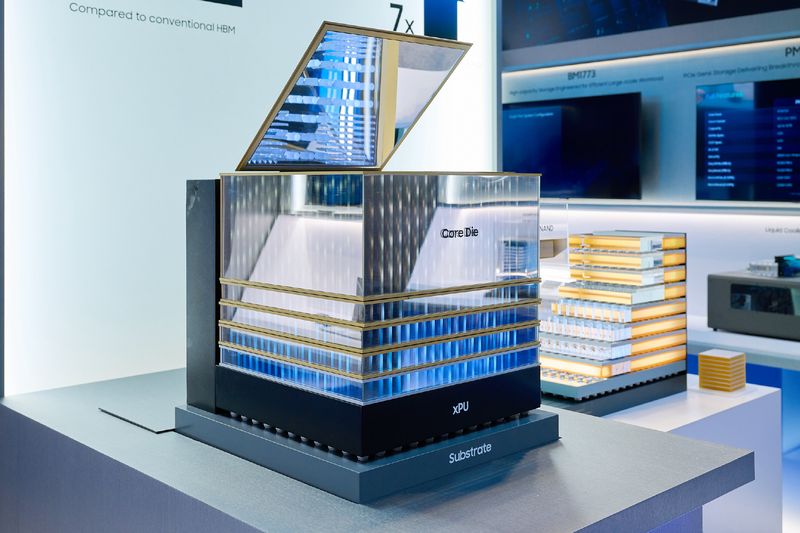
[Financial News] Samsung Electronics and SK hynix have each presented their vision for the future of high-bandwidth memory (HBM) as global chipmakers compete on next-generation technologies. Samsung Electronics unveiled a roadmap to evolve the HBM base die into a "brain" that can also handle AI computing. SK hynix officially announced the mass production of its HBM4 12-layer product for NVIDIA's next-generation AI accelerator, Vera Rubin, and said its 16-layer product has entered customer qualification. It also showcased next-generation packaging technology for ultra-high stacking of more than 20 layers. As competition in AI accelerator performance intensifies, analysts say the HBM race is expanding beyond simple gains in speed and capacity to include base die, ultra-high stacking, and packaging technologies.■ Samsung evolves the HBM 'brain' base die According to industry sources on the 24th, Samsung Electronics and SK hynix presented their next-generation HBM strategies side by side at Hot Chips 2026, held on the 23rd local time at Stanford University in the United States. Hot Chips, which began in 1989 and is held every year in Silicon Valley, is a leading conference in the high-performance semiconductor and computing architecture field. Global companies such as NVIDIA, Advanced Micro Devices, Inc. (AMD), Intel, and International Business Machines Corporation (IBM) use the event to unveil advanced technologies that can be applied to real products, including next-generation CPUs, GPUs, AI accelerators, memory, and packaging. Because it focuses on practical products and implementable technologies rather than academic research, it is seen as a venue for gauging the future direction of semiconductor technology.
At this year's Hot Chips, Samsung Electronics and SK hynix agreed that solving bottlenecks in AI semiconductors requires designing the GPU, HBM, foundry, and packaging as a single system. However, they presented different solutions.
Samsung Electronics focused on advancing the HBM base die. The base die is the semiconductor at the bottom of HBM that controls data, power, and signal transfer between the DRAM and the GPU. Samsung proposed moving some GPU functions, such as the memory controller, to the base die and using the freed-up space for compute cores. The company said that relocating the memory controller, which accounts for about 5% to 10% of the GPU area, could improve performance by 10% to 20%. It also introduced aHBM, which processes some AI workloads directly on the base die to reduce data movement and power consumption.
An industry source said, "Samsung Electronics is focusing on evolving the base die from a simple data pathway into a 'brain' that handles some functions of the AI system," adding that it is an approach that leverages Samsung Electronics' strengths across memory, foundry, and packaging.
In the long term, the company plans to develop zHBM, which vertically integrates the GPU and DRAM. At present, the two chips are placed side by side and connected, but the new approach would stack them directly on top of each other to shorten the data path. Samsung Electronics expects that, if zHBM is commercialized, DRAM power consumption could fall by about 70% compared with HBM5, while data transfer speeds could increase 2.3 times from HBM4E.
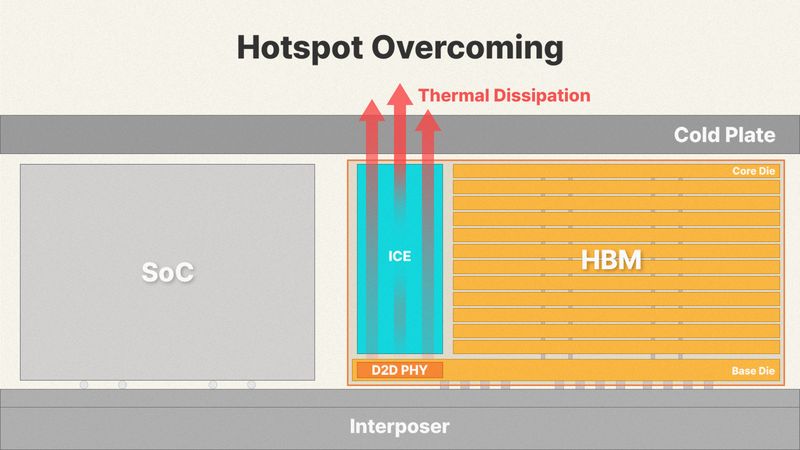
The company also presented hybrid bonding technology for future HBM with more than 20 layers. By eliminating conventional bumps and fillers and connecting chips directly, the method reduces the gap between chips and allows more layers to be stacked without making the DRAM excessively thin. SK hynix also unveiled iHBM, a technology that lowers heat generation. It creates a separate heat-dissipation path and reduces thermal resistance by more than 30% compared with existing methods.
An industry source said, "In the past, competition centered on the performance of the DRAM itself, but the center of gravity in next-generation HBM competition is shifting to the base die and packaging."
[email protected] Jung Won-il Reporter