Comprehensive special counsel wraps up 180-day probe, with 58 people indicted in bulk; the real battle starts now
- Input
- 2026-08-24 15:57:28
- Updated
- 2026-08-24 15:57:28
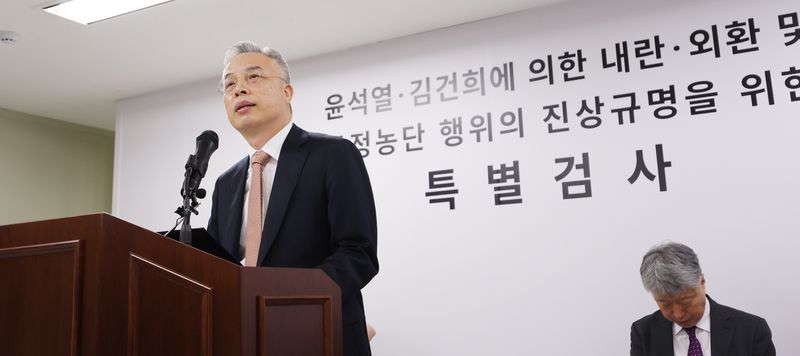
According to the special counsel team's press briefing on the 24th, it received 152 cases, handled 126 of them, and indicted 58 people. Of those, seven were indicted while detained and 51 while not detained, along with one corporation. The remaining 46 unresolved cases were transferred to the National Office of Investigation and other agencies.
■Heavy-tail strategy drives mass indictments at the end of the probe What stands out is the timing and scale of the indictments. Last week, the special counsel team indicted 17 people at once, including former President Yoon Suk Yeol and People Power Party lawmakers Na Kyung-won, Kim Gi-hyeon, Yoon Sang-hyun and Kwon Young-jin, concentrating its efforts in the final stretch of the investigation. At the briefing, Kwon said, "The goal is to break the capabilities of the insurrection forces and crush their will," underscoring the justification for the mass indictments. He stressed a hard-line stance not only against the heads of state institutions but also against mid-level figures accused of insurrection-related offenses.
A closer look at the cases shows that they all involve major political or power-related corruption. On the 18th, Kim Keon-hee was indicted without detention on charges of broker bribery and abuse of authority to obstruct the exercise of rights under the Act on the Aggravated Punishment of Specific Crimes, in connection with allegations of preferential treatment in the relocation of the presidential residence under the Yoon Suk Yeol administration. She is accused of receiving valuables, including a Dior jacket worth 10.12 million won, in return for helping secure a contract for residence renovation work. People Power Party lawmaker Yoon Han-hong, who was the key working-level decision-maker at the time, was also indicted on abuse-of-authority charges, along with Kim Tae-young, head of the allegedly unqualified contractor 21 Grams, and others.
In the insurrection-related case, former Army Ground Operations Command chief Kang Ho-pil was indicted on the 17th for allegedly ordering the establishment of a district martial law command, while former Commander of the Defense Counterintelligence Command Yeo In-hyung was also indicted on abuse-of-authority charges related to the Defense Counterintelligence Command blacklist. These are cases in which tens of thousands of pages of investigative records and conflicting testimony from each suspect stand in sharp opposition.
■Legal community expects difficulties in maintaining the cases amid complexity and staffing shortages The legal community expects the special counsel team to struggle in maintaining the prosecutions, and the reason lies in the nature of the crimes themselves. In ordinary criminal cases, the elements of the offense can usually be established relatively clearly through physical evidence and witness testimony. By contrast, the political crimes indicted by the special counsel team, such as abuse of authority, insurrection and broker bribery, require highly sophisticated legal interpretation and proof of the actor's intent. For example, in the residence relocation process, the court will have to carefully determine whether Kim Keon-hee's requests and Yoon Han-hong's instructions were merely "expressions of opinion" or an "illegal exercise of power" that undermined the public system. The defendants are also expected to hire large law firms and devote all their efforts to their defense.
A prosecutor with experience on special counsel assignments said, "Most of the people being investigated by the special counsel are not ordinary offenders such as drunk-driving fatalities, but political suspects with extremely complicated facts," adding, "Even maintaining a case against one defendant is difficult, but if dozens are indicted at once, the staff handling the prosecutions will spend all their physical working hours simply attending hearings and reviewing records."
The staffing shortage is already becoming a reality inside the special counsel team. When it first faced an urgent need to secure prosecutors for trial maintenance, the team took the unusual step of asking the chairperson of the Legislation and Judiciary Committee of the National Assembly to amend the Special Prosecutor Act so that a new special investigator system could be created for lawyers with at least five years of legal experience. While the power to indict and maintain prosecutions normally belongs exclusively to prosecutors, the team is now seeking to bring private lawyers into the courtroom to handle the enormous burden of 58 defendants.
Even so, a difficult road lies ahead. When asked during the briefing about securing future trial staff, a special counsel official said, "We are trying to fill the special investigator positions through interviews, but it seems difficult to fully meet the quota for dispatched prosecutors from the start." It is also understood that there is a strong reluctance within the prosecution service to be sent to the special counsel team and take charge of what could be a long-running trial.
The 180-day investigative period is over, but the real showdown between the 58 defendants and the special counsel team is only beginning. One legal source said, "Whether the special counsel team, armed with a thin trial staff, can tightly bind the defendants' charges in the courtroom ring, or whether it will face a backlash over an excessive mass indictment, remains to be seen."
[email protected] Kim Dong-gyu Choi Eun-sol Reporter