"Down 89% and crying out in pain"...Delisting fears hit designated risk stocks, and even after mergers 83% are back to penny-stock levels [Delisting storm 1]
- Input
- 2026-08-26 05:00:00
- Updated
- 2026-08-26 05:00:00

[Financial News] "I started as a listed stock and ended up at rock bottom."That was a post uploaded on the stock discussion board for E8, a KOSDAQ-listed company, on the 21st. Under the title "Where is the basement?" the writer said, "I started investing at 30,000 won per share, kept averaging down, participated in two rights offerings, and even went through a reverse stock split. Then they told us to do another rights offering, and I was about to lose it. I bought more one last time and lowered my average price to 4,788 won, but I just can't hold on anymore."
At the time of the post, the writer's return stood at -89.74%. Another user responded to the complaint, saying, "How much more averaging down do you need...? At 4,788 won, it would have to rise tenfold just to break even," expressing sympathy.
E8 was designated as a risk stock on the 12th after falling short of both market capitalization and share price requirements. It is not the only stock to receive the risk-stock label. Since the revised delisting rules took effect on the 1st of last month, such cases have continued to pile up, deepening the worries of individual investors in KOSDAQ as well.
Tougher delisting rules...43 risk stocks in just a month and a half
In policy terms, it is called "more births, more deaths." Based on this principle of increasing new listings while quickly removing weak companies, the financial authorities implemented revised listing rules on the 1st of last month. If a stock stays below 1,000 won for 30 consecutive trading days, or if its market capitalization falls below the benchmark (20 billion won for KOSDAQ, 30 billion won for KOSPI, and so on), it is designated as a risk stock. If it then fails to recover the standard for at least 45 consecutive trading days within the next 90 trading days, it is ultimately delisted.
There are also forecasts that the number of delisted companies could exceed 100 this year. In fact, when the Financial Services Commission (FSC) and the Korea Exchange announced the system overhaul in February, their own simulation projected as many as 220 companies. With the implementation schedule brought forward amid a sharp market downturn, some say the gap is widening between the policy goal of "swift removal" and the need to avoid unintended consequences in separating the strong from the weak.
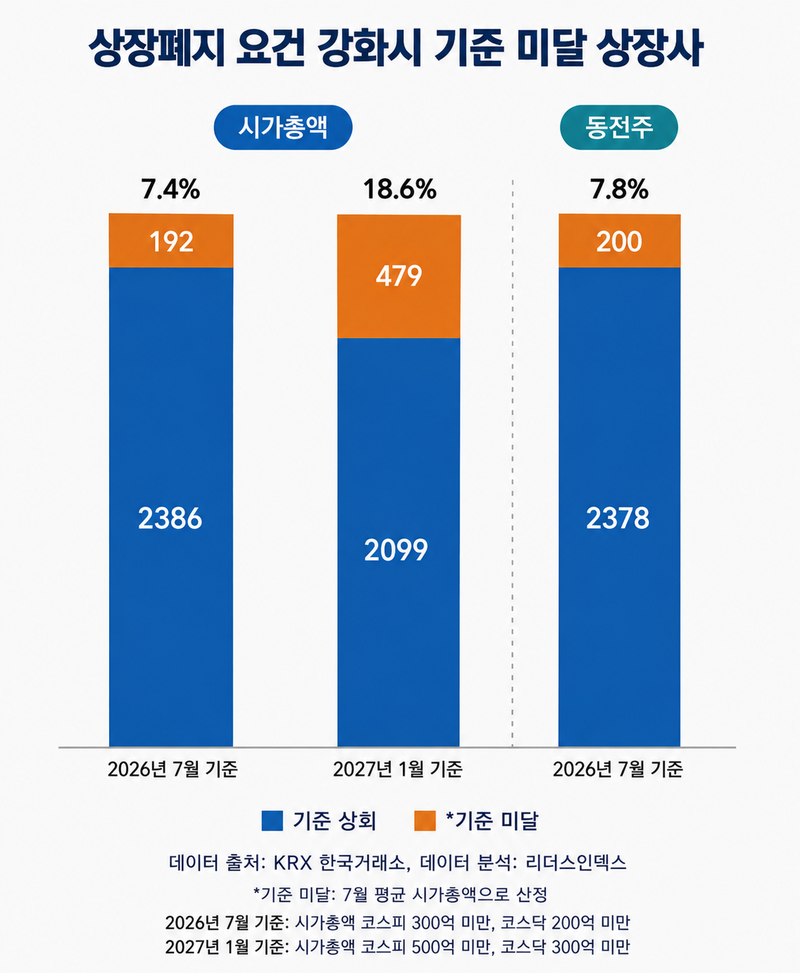
According to a full survey by Leaders Index of all 2,578 KOSPI and KOSDAQ-listed companies on the 11th, 192 companies, or 7.4%, currently fell short of the market-capitalization requirement, while 200 companies, or 7.8%, were so-called penny stocks trading below 1,000 won. If the tightened 2027 standards are applied as they are (50 billion won for KOSPI and 30 billion won for KOSDAQ), that number would rise to 479 companies, or 18.6%.
The actual figures also support these concerns. According to the Korea Exchange's corporate disclosure channel, 43 KOSPI and KOSDAQ-listed companies were labeled as risk stocks between the 12th and the 20th. On the 12th alone, 36 companies were designated at once, and seven more were added by the 20th. Of these, 32 were below the share-price threshold, 15 were below the market-cap threshold, and four fell short on both counts.
In a report released on the 19th, Small Insight Research said that among 27 KOSDAQ companies designated as risk stocks on the evening of the 12th, it compared closing prices that day with those on the 14th and found an average decline of 5.47% and a median decline of 5.67%. Excluding five gainers and one unchanged stock, all 21 others fell.
Small Insight Research noted, "The declines seen in many stocks after designation suggest the possibility of a so-called stigma effect, in which delisting fears dampen investor sentiment." It added, "If risk-stock designation is perceived as a strong warning signal, buying interest and trading liquidity can fall, which in turn may make it harder for share prices and market capitalizations to recover."
276 merger cases, but 83% are back to penny-stock levels
Being designated as a risk stock does not mean immediate delisting, but companies are responding sensitively. One noticeable response is a reverse stock split. Examples include Jeongmoon Information, which merged five common shares with a face value of 1,000 won into one share with a face value of 5,000 won, and Wooree Enterprise, which merged five common shares with a face value of 500 won into one share with a face value of 2,500 won.
According to a recent report by Hanwha Investment & Securities, there were 276 reverse stock splits carried out over the six months from February 12 to August 12, including 57 on the KOSPI and 219 on the KOSDAQ. That is a sharp surge compared with just five in 2024 and 12 in 2025.
The effect, however, did not last long. As of the 15th of last month, 130 of the 156 companies that had completed a merger, or 83.3%, had fallen back below their new face value. Even if a company raises its face value from 500 won to 2,000 won and its share price rises to 1,200 won, it still remains subject to delisting if it falls below the new face value of 2,000 won.
The rules themselves were designed to target this kind of "survival through repeated mergers." In May, when the FSC approved amendments to the Korea Exchange listing rules to implement the delisting reform plan, it also introduced measures to block such loopholes. If a company has carried out a merger or capital reduction within the past year, it is barred from making additional mergers or capital reductions for 90 trading days after being designated as a penny-stock risk stock. The same 90-trading-day ban also applies if the merger or capital reduction ratio exceeds 10 to 1.
"I agree with the direction, but..." The worries of more than 470,000 KOSDAQ retail investors
The problem is that the impact of the delisting system does not stop at a company's listing status or management team. Among the 36 companies that triggered risk-stock designation on the 12th, Small Insight Research collected disclosure data for 32 firms (27 on KOSDAQ and five on KOSPI) and found a combined 470,367 minority shareholders, based on a simple total.
Because each company's disclosure reference date differs, and because the same investor may hold multiple stocks, this figure cannot be treated as the number of unique individual investors. Still, it is clear that the fallout from risk-stock designation does not stop with a small number of major shareholders or executives.
Jeong Eui-jeong, head of the Korea Stock Investors Association, recently described the situation facing KOSDAQ retail investors by saying, "Everyone is shedding blood-like tears in this horrific bear market." He then explained, "KOSDAQ has already taken a major hit because of the concentration in 'Samsung Electronics and SK hynix,' and with the tougher delisting standards added on top, retail investors' sentiment toward KOSDAQ is becoming even more depressed."
He added, "I agree with the direction, but the polarization has become too severe, with most KOSDAQ stocks sinking into darkness under the bright sunlight of Samsung Electronics and SK hynix. To restore balance with the KOSPI, the government needs to come up with measures to revitalize KOSDAQ. The 'more births, more deaths' policy creates a structure in which an unspecified number of retail investors end up suffering."
Attorney Kim Gwang-jung of the law firm Hankyul, who mainly handles securities damage lawsuits, stressed the need to protect both current and future retail investors.
Kim said, "For controlling shareholders, delisting can even be an opportunity to increase their stake at a bargain price, and a company does not necessarily collapse just because it is delisted, so it is fair to say that individual investors suffer the most." He added, "However, marginal companies that are not delisted are often abused for crimes such as stock manipulation. Since these marginal companies cannot simply be left alone, I think the policy is necessary."
[email protected] Kim Hee-sun Reporter