Moon Dae-rim Says "April 3 Compensation Is Not Pocket Money"... 127.6 Billion Won Diverted to Other Projects Over 4 Years
- Input
- 2026-08-24 15:03:27
- Updated
- 2026-08-24 15:03:27
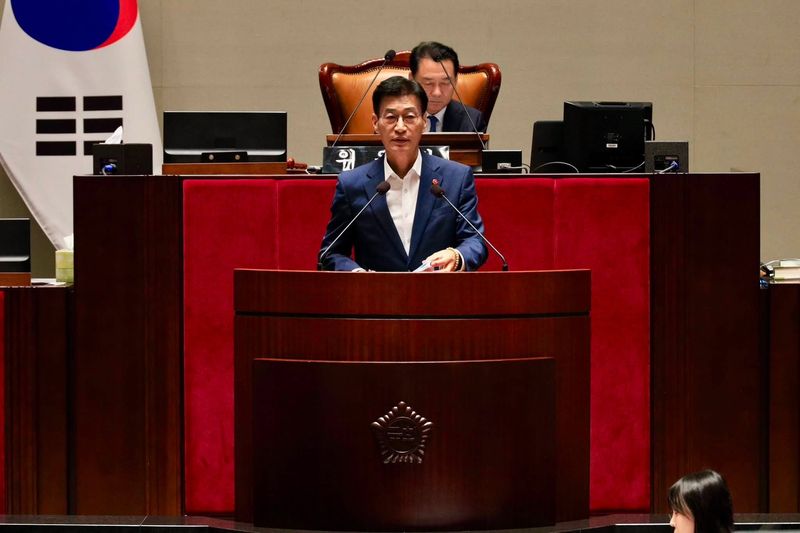
[Financial News, Jeju = Reporter Jung Yong-bok] The government was found to have diverted 127.6 billion won of the compensation funds that should have been paid to Jeju uprising victims to other projects over four years. On the other hand, as demand for criminal compensation surged due to ex officio retrials related to the Jeju uprising, the Ministry of Justice failed to secure enough of the necessary budget and covered 85.4 billion won last year with funds from other projects and reserve funds. Critics say the government has repeatedly shown a mismatch in managing the same state responsibility budget for the Jeju uprising, with surplus funds being used elsewhere in one area while insufficient funds had to be pulled in from elsewhere in another.
At the National Assembly's comprehensive policy questioning session on the 24th, Moon Dae-rim of the Democratic Party of Korea strongly raised the issue of repeated diversion of Jeju uprising victim compensation funds to other projects and the underallocation of criminal compensation funds.
According to data submitted by the Ministry of the Interior and Safety (MOIS), the amount of Jeju uprising victim compensation funds diverted to other projects from 2022 to 2025 totaled 127.6 billion won.
The compensation funds are payments the state provides to victims under the Jeju 4.3 Special Law. Compensation amounts are set according to the type of damage, with 90 million won paid in cases where the victim died or went missing.
The problem is that the budget set aside for compensation payments was moved to other projects for four consecutive years. In particular, 8.5 billion won from the Jeju uprising victim compensation fund was used last year to cover a shortfall in personnel expenses at the MOIS headquarters.
Moon said, "Jeju uprising victim compensation funds are not 'pocket money' that the government can spend and leave over as it sees fit. They are a responsibility the state must repay to each and every victim," adding, "Using the funds for four consecutive years has become a practice, not an exception."
Vice Minister of the Interior and Safety Kim Min-jae responded, "I strongly agree with what Rep. Moon said," and added, "We will properly allocate the budget so compensation can be paid in a timely manner, and we will visit elderly victims and bereaved families directly to help them apply."
The Ministry of Justice faced the opposite problem with its criminal compensation budget. Criminal compensation is paid by the state to prisoners and others whose convictions were overturned in retrials for the period during which they were unjustly detained. As ex officio retrials related to the Jeju uprising expanded, criminal compensation claims from prisoners who were found not guilty also increased sharply.
Criminal compensation spending rose 3.8 times, from 28.1 billion won in 2022 to 108.4 billion won last year. However, the Ministry of Justice had only 42 billion won allocated in last year's main budget.
To secure the shortfall, the ministry transferred 42.5 billion won from other projects and injected an additional 42.9 billion won from reserve funds. The amount secured beyond the main budget alone came to 85.4 billion won. In other words, while compensation funds were left over and diverted to other projects, criminal compensation funds were underestimated, forcing the ministry to pull in money from other budgets.
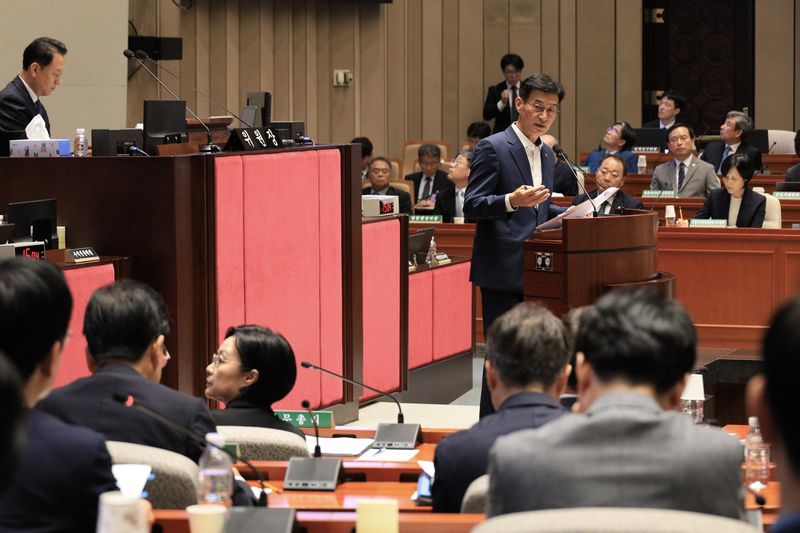
Moon asked Prime Minister Han Seong-sook, "Is it the normal way to manage the Jeju uprising state responsibility budget for MOIS to divert leftover victim compensation funds to other projects and for the Ministry of Justice to cover insufficient criminal compensation funds by drawing from other projects?"
Prime Minister Han replied, "I think there are shortcomings," and said, "We need to ensure that eligible people can receive compensation actively, and we also need to secure the budget proactively."
Vice Minister of Justice Lee Jin-su also said regarding the criminal compensation budget, "We will analyze the cases more closely and review them actively so that the budget is not underallocated."
Moon also urged the government to establish a legal basis for supporting the stable activities of the Association for the Bereaved Families of the April 3 Victims.
The amendment to the Jeju 4.3 Special Law, introduced by Moon as the lead sponsor, includes provisions allowing subsidies to be paid to the bereaved families' association and reducing or exempting usage and lease fees for national and public property. The aim is to provide legal support for the association's public role in honoring victims, supporting bereaved families, and carrying out peace and human rights education.
Prime Minister Han said of the bill, "I will pay close attention and review it actively."
Moon emphasized, "The Jeju uprising victim compensation fund is a budget meant to fulfill the state's responsibility to victims and bereaved families," adding, "The rights of victims and bereaved families must not be undermined by administrative delays and repeated irregular budget operations."
[email protected] Jung Yong-bok Reporter