Convenience Stores Soar Despite Offline Slump as Tailored Strategies Prove Effective Amid Changing Market Conditions
- Input
- 2026-08-25 14:49:01
- Updated
- 2026-08-25 14:49:01
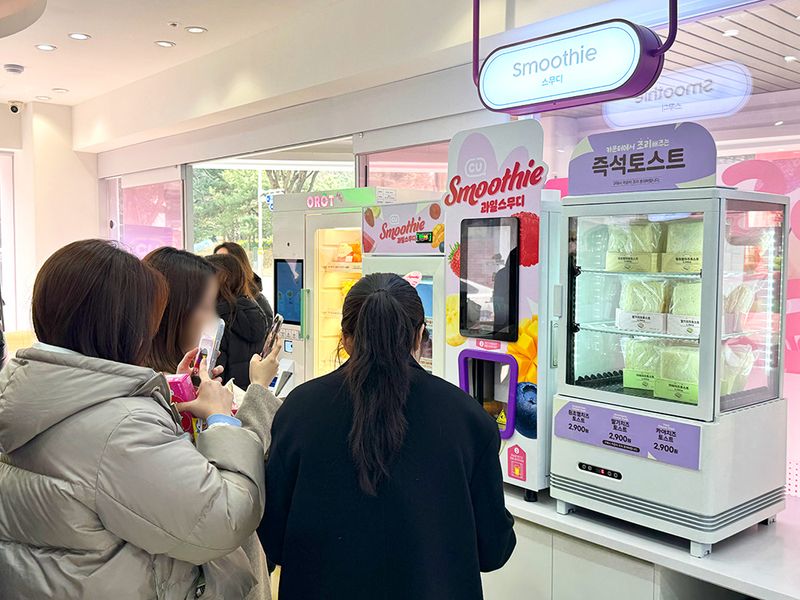
[Financial News] The convenience store industry has maintained growth for 12 consecutive months. This stands in contrast to the broader offline retail sector, which is facing a structural crisis as shopping demand shifts online. Analysts say the key has been expanding beyond affordable single-meal offerings to include small-scale grocery shopping, foreign customer demand and specialty stores. Rather than competing through uniform store openings, the industry has focused on improving store operations to fit each trade area and customer base.
According to the Ministry of Trade, Industry and Energy on the 25th, sales at major domestic convenience stores increased year on year for 12 straight months from July last year through June this year. The year-on-year growth rate in purchase counts also steadily widened, from 0.6% in February to 3.1% in June.
Food sales were especially strong. In June, convenience store food sales rose 7.8% from a year earlier, while ready-to-eat food sales increased 10.3%. As the burden of dining out grew amid high inflation, demand for quick meals from convenience stores helped support the uptrend. In response, major convenience store chains have all revamped their prepared-food offerings this year while expanding into fresh foods and grocery items.
The trend was also reflected in second-quarter results from major operators this year. BGF Retail, which runs CU, posted sales of 2.4268 trillion won and operating profit of 84.9 billion won in the second quarter. That marked increases of 6.0% and 22.3%, respectively, from a year earlier. For the first half as a whole, sales rose 5.6% to 4.5472 trillion won and operating profit jumped 33.7% to 123 billion won. GS25 also reported second-quarter sales of 2.3844 trillion won and operating profit of 71.4 billion won, up 7.1% and 21%, respectively, from a year earlier. In particular, same-store sales growth reached 7.5%. The company said expanding fresh-food-focused stores and pursuing a scrap and build strategy, which involves enlarging stores and relocating them to better sites, helped improve the performance of existing outlets. Sales of grocery items such as vegetables, meat, eggs and fruit rose 49.6%, showing that the strategy to target small-scale grocery demand has been effective.
Korea Seven, which operates 7-Eleven, also returned to quarterly profit in the second quarter, posting sales of 1.2178 trillion won and operating profit of 4.1 billion won. Sales fell 2.6% from a year earlier due to a decline in store count, but operating profit improved by 12.8 billion won. The company cited stronger coordination among store operations, merchandising and marketing teams, along with data-driven efforts to improve store fundamentals, as reasons for the turnaround.
The companies are also strengthening customized strategies in the second half to adapt to the changing environment. CU plans to expand its grocery-focused stores aimed at one- and two-person households from 300 to 500 and increase offerings such as small-pack vegetables and fruit. It is also broadening models tailored to specific customer groups and trade areas, including dessert-focused stores, running stations and foreigner-oriented stores.
GS25 aims to expand its fresh-food-focused stores from 1,000 to 1,100 by the end of the year. It is also concentrating on improving existing stores through expansion and relocation to boost productivity and profitability per outlet. The company is also pushing to expand its overseas business in Vietnam and Mongolia. 7-Eleven plans to strengthen the market presence of key product categories such as global sourcing items, prepared foods, ready-to-eat meals and whisky, while also enhancing its ability to capture inbound tourist demand and improve its O4O service competitiveness, including quick commerce.
An industry official said, "Consumer sentiment may remain weak in the second half due to high inflation, and economic uncertainty stemming from a strong won will also be a burden." However, the official added, "Rising demand for ice cream and frozen treats during the heat wave, the inbound boom driven by the K-culture wave, and demand for nearby shopping are all likely to have a positive effect on the industry as a whole."
[email protected] Kim Hyun-ji Reporter