"Tax if You Sell, Tax if You Don’t" ... The Real Estate Tax Dilemma Shifting from 'How Much' to 'How'
- Input
- 2026-08-25 06:00:00
- Updated
- 2026-08-25 06:00:00

[Financial News]#. For an 80-something man identified as A, one apartment in Seoul worth 5 billion won is effectively his entire fortune. He bought it for around 100 million won more than 30 years ago and has lived there ever since, so its value has risen dozens of times over. But he retired long ago and no longer has monthly wage income.As the government’s 2026 tax reform proposal announced on the 3rd is expected to increase the holding tax burden on high-priced homes, A’s worries have deepened. On paper, he is a wealthy asset holder with tens of billions of won in property value, but in reality he has almost no cash to pay the tax.
With the tax reform proposal as a catalyst, the debate over real estate taxes is now expanding into a question of how taxes should be paid. Beyond the idea of deferring the comprehensive real estate holding tax, discussions have also begun on extending tax deferral to capital gains tax.
Living in a 5 billion won home ... defer the comprehensive real estate holding tax and settle it at inheritance
A system already exists under current tax law for elderly one-home owners like A. It is the comprehensive real estate holding tax deferral system.
Nam Ki-up, head of the Land Liberty Institute, explained, "During the years of active economic participation, income is sufficient to cover taxes on an expensive home. But after retirement, income inevitably falls sharply. In such cases, one option is to defer payment until the home is sold or inherited. That is tax deferral."
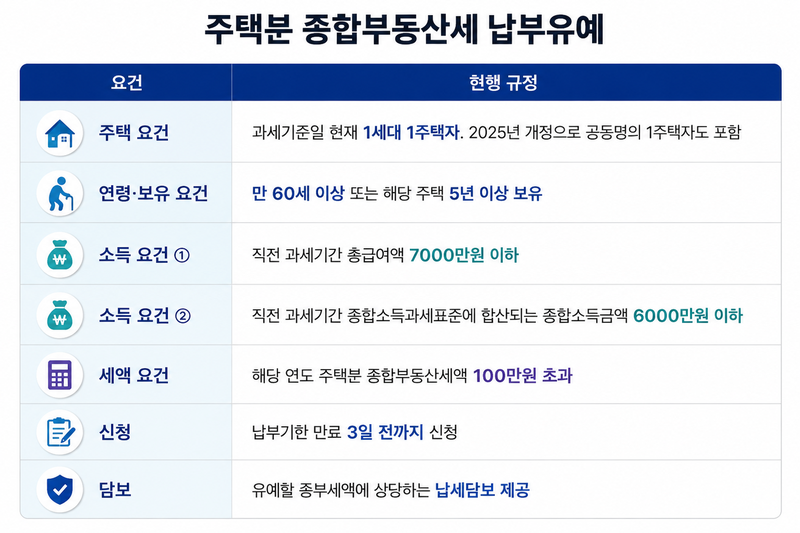
The exact name of the tax deferral measure Nam referred to is the 'home-based comprehensive real estate holding tax payment deferral system' (Article 20-2 of the Comprehensive Real Estate Holding Tax Act).
Under the act, a one-household, one-home owner aged 60 or older, or someone who has held the home for at least five years, may apply for a deferral by providing collateral if they meet income requirements such as annual salary of 70 million won or less, or total income of 60 million won or less, and if the annual home-based comprehensive real estate holding tax exceeds 1 million won.
What matters is that this does not eliminate the tax. If a deferral-ending event occurs, such as transferring or gifting the home, the deferred tax and an amount equivalent to interest must be settled. If the owner dies while still holding the home, settlement takes place at the inheritance stage.
In the 2026 tax reform proposal announced on the 3rd, the government decided to expand this system further. In effect, it acknowledged that home prices and actual ability to pay taxes do not always match, and it moved to broaden the system by adjusting the timing of payment.
The current income requirement of annual salary at 70 million won or less will be eased to 80 million won or less, while the total income threshold will be raised from 60 million won to 70 million won or less. In particular, the government introduced a new measure allowing payment deferral for elderly long-term residents aged 65 or older who have lived in the home for at least 10 years and whose holding tax burden in the current year is at least 10% higher than their income in the previous year.
The plan also includes reducing the additional amount equivalent to interest, up to the amount of the insurance premium, when payment is deferred using a guarantee insurance certificate.
Could capital gains tax deferral also apply to 'downsizing'?
Lawmakers are also working on legislation for another form of tax deferral. The idea is to apply tax deferral to capital gains tax as well.
A revision to the Income Tax Act recently proposed by People Power Party lawmaker Park Soo-min would allow a one-household, one-home owner who has held and lived in the home for at least three years to defer tax on part of the capital gain from the old home until the new home is sold, if they sell the existing home and move to a smaller, cheaper one.
The portion eligible for tax deferral would be determined by multiplying the capital gain on the old home by the ratio of the new home’s price to the sale price of the old home.
For example, if someone sells a home for 2 billion won and moves to a home worth 1 billion won, tax on half of the capital gain from the old home would be deferred until the new home is disposed of.
Here, too, the structure is not one of tax reduction or exemption. As with holding tax deferral, it simply pushes back the timing of capital gains tax payment on the portion of the gain tied to funds used for housing relocation.
Downsizing tax deferral is drawing attention because of the 'lock-in effect' that keeps older homeowners from moving.
In A’s case, selling a home bought for 100 million won more than 30 years ago for 5 billion won would realize a huge capital gain. Even with the one-home tax exemption and the long-term holding special deduction, capital gains tax could still arise on the portion of the sale price above 1.2 billion won for a high-priced home.
In the end, the choice becomes either holding tax if you stay, or capital gains tax if you sell and move to a smaller home.
Songpa official price up 25.49% ... property tax also rose 23.73%
In areas where official housing prices have recently risen, calls are also growing for a reassessment of property taxes. Comprehensive real estate holding tax and property tax together make up the holding tax burden.
Songpa District in Seoul said on the 24th that it had proposed to the Ministry of Land, Infrastructure and Transport a 'plan to improve the calculation system for official apartment prices' because residents’ tax burdens have increased following a sharp rise in official apartment values.
According to Songpa District, the official apartment price increase rate this year was 25.49%, well above the Seoul average of 18.67%. As a result, the property tax on homes rose 23.73% from a year earlier.
Songpa District asked the government to minimize the reflection of abnormal transactions in areas with short-term price spikes, apply median prices, use flexible market-price reflection ratios, phase in excessive increases gradually, and institutionalize tax impact analysis and taxpayer burden assessments.
[email protected] Seo Yoon-kyung Reporter