Kim Min-seok and Jang Dong-hyuk Shake Hands, but Clash Over Cho Hee-dae
- Input
- 2026-08-24 12:00:24
- Updated
- 2026-08-24 12:00:24
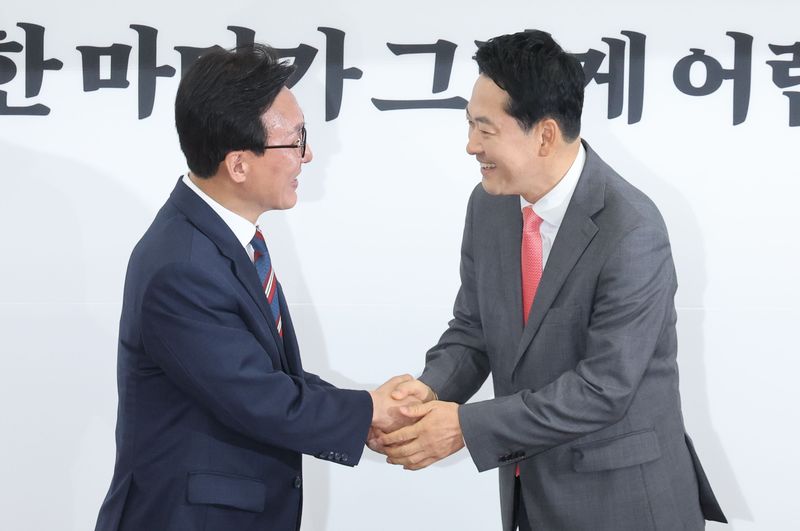
[Financial News] Kim Min-seok, leader of the Democratic Party of Korea, met Jang Dong-hyuk, leader of the People Power Party, for the first time since taking office as party chief on the 24th. The two agreed on the need for frequent communication to open the door to bipartisan cooperation. At the same time, they sparred over the controversy surrounding Chief Justice of the Supreme Court of Korea Cho Hee-dae's "written recommendation."
The two party leaders met at the National Assembly and discussed ways to improve bipartisan cooperation so that state affairs can be managed smoothly going forward.
Kim first said of Jang, "We have had differences over the impeachment of former President Yoon Suk Yeol over the past one or two years, but there has also been an overlap in that we stood together on lifting martial law. He is also a leader who crossed an important historical turning point with us." He added, "In that sense, I see Jang's role as meaningful."
Kim said, "We are not completely far apart, and there are many things we stand on together, such as democracy, the market economy, and concern for the country." He added, "I want to build an unbroken bridge of dialogue with Jang. As long as politics continues in the ROK, I think Jang and I may be the two people who should never let go of that thread of dialogue until the very end."
Kim proposed, "Wouldn't it be better to go beyond regular and permanent communication between the two parties and make it frequent?" He added, "Since we are in the same National Assembly, I came to see Jang with the hope that we could meet when needed, call each other, and communicate often."
Jang strongly agreed with strengthening communication between the two party leaders. He said, "The offices of the two party leaders are not far apart, but the two of us have not had many conversations so far." He added, "I strongly agree with the proposal that the two party leaders meet in person and talk frequently."
He also offered some sharp criticism to Kim. First, he urged Kim to "support the president's state administration for the sake of people's livelihoods and the economy, but when the National Assembly needs to exercise its checks on the executive branch, please join forces with the opposition."
He also criticized the ruling bloc's attempt to impeach Chief Justice Cho. He cited a 2003 case during the Roh Moo-hyun administration, when then-Chief Justice Choi Jong-young recommended Kim Yong-dam, then chief judge of the Gwangju High Court, as the successor to Supreme Court Justice Seo Seong. Jang said Roh had shown resolve by ultimately accepting the recommendation, even though he expressed dissatisfaction. "I believe former President Roh made that decision out of the conviction that protecting judicial independence is the last bastion of Korean democracy," he said. "As the ruling party leader, I hope you will play your role on the side of the people."
He also criticized the newly created future response fund, which will be set up at 100 trillion won. Jang said, "If a fund worth 100 trillion won is operated without being subject to the National Finance Act, there is a high possibility that it will be run recklessly or used for purposes other than its original intent, so caution is needed." He added, "It could invite suspicions that it is a fund for responding to approval ratings or a fund for responding to elections." He also said that 50% of any excess tax revenue should be used as funds for the middle class, ordinary people, and young people.
On housing policy, he said, "Housing policy should be carried out on a basis that people can trust and that is consistent." He added, "To eliminate confusion and avoid side effects in the long term, policy should be based on market order while moving in a direction that compensates for market failures." In that context, he said he "welcomed" the Democratic Party's request at the Senior Party-Government Council on the 23rd to eliminate the distinction between one-home owners who live in their homes and those who do not.
Kim and Jang also briefly exchanged sharp words. The dispute arose after Jang, while referring to the Roh administration example, said that "there may be procedural issues, but what matters more than procedure is the rule of law in the ROK." Kim interpreted that as meaning that "there seems to be an acknowledgment that there was a procedural problem."
Jang then stressed, "This is not the place for an argument on our first meeting, but there should be no misunderstanding." He added, "What I meant by procedural issues was that we should not get bogged down in procedure and turn it into a problem. Preserving the constitutional intent behind the Supreme Court justice nomination power is what protects judicial independence." He continued, "There may have been procedural customs, but my constitutional interpretation and conviction is that it is not appropriate to consult or coordinate in advance with the presidential office on Supreme Court justice nominations."
[email protected] Lee Hae-ram Reporter