New Trade Minister Park Jung-sung Says U.S.-Korea Strategic Investment Talks Will Create a Cooperation Framework Comparable to the FTA
- Input
- 2026-08-24 11:31:25
- Updated
- 2026-08-24 11:31:25
[Financial News]
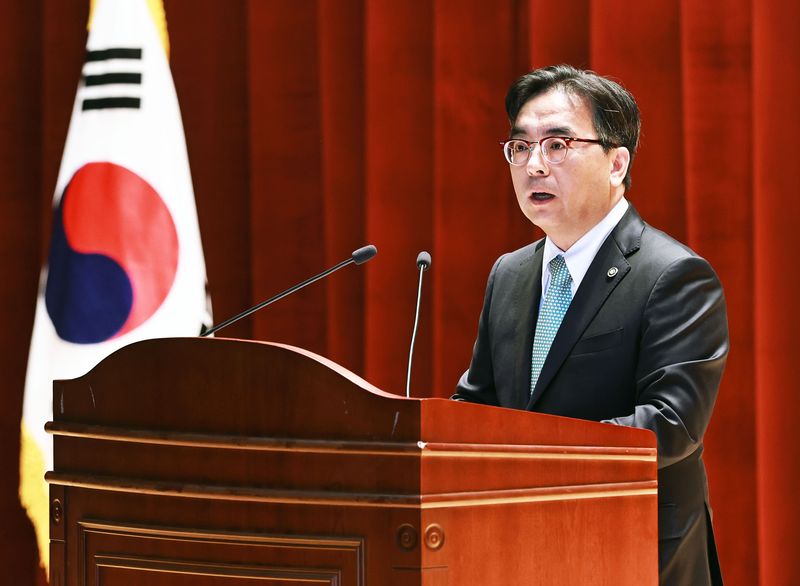
Park Jung-sung, the new Minister for Trade at the Ministry of Trade and Industry, said he plans to develop U.S.-Korea strategic investment talks into a new framework for bilateral cooperation comparable to the past United States–Korea Free Trade Agreement (KORUS FTA). He also said he will focus on managing trade risks between the two countries while actively taking part in shaping a new trade order centered on economic security, using semiconductors, nuclear power, and shipbuilding as key strategic industries.
At the swearing-in ceremony held on the 24th at Government Complex Sejong, Park said, "The implementation of strategic investment between the United States and Korea has emerged as the biggest challenge and opportunity in bilateral relations." He added, "Through the strategic investment talks, we will build a new framework for bilateral cooperation comparable to the past KORUS FTA."
He then stressed that every effort must be made to produce the right outcome from the strategic investment talks, and identified trade-risk management between the United States and Korea as the top priority.
Park described the current global trade environment not as a simple economic cycle, but as a "historical turning point." He said the era dominated by openness, efficiency, and non-discrimination under the World Trade Organization (WTO) is ending, and that a new trade order centered on economic security is taking shape, driven by tariffs, subsidies, industrial policy, supply chains, export controls, and investment screening.
He emphasized that Korea's trade strategy must also shift, moving beyond responding to the old order and toward actively participating in the formation of the new one. Park said, "In the past, we had no choice but to adapt to the global trade order. Now we are in a position where, as a stakeholder, we can confidently speak up in shaping the new trade order as well."
He identified "irreplaceable industries" as the core of the new trade strategy. He explained that trade policy should place strategic sectors in which Korea has strong competitiveness, such as semiconductors, nuclear power, and shipbuilding, at the center of global supply chains. He also said Korea will secure irreplaceable competitiveness in new areas such as the Korean Wave (Hallyu), consumer goods, and industries linked with Artificial Intelligence (AI), while strengthening international standards and digital platform strategies.
Park said, "Countries with irreplaceable industries are chosen, while countries with only replaceable industries are forced to make choices. That is the reality of economic security." He added that Korea will actively identify and lead trade negotiation agendas, and stressed the need to rapidly expand export infrastructure, including trade finance, as annual exports grow from $700 billion toward $1 trillion.
He also plans to reshape trade strategy for essential resources such as food and critical minerals. The idea is to move away from a defensive approach that only supports industries hurt by market opening, and toward an active strategy that secures essential supply chains from an economic security perspective.
Meanwhile, Park's first major test is expected to be drawing up concrete implementation measures for the U.S.-Korea strategic investment talks. Having led the working-level negotiations on tariffs and investment with the United States, he now faces the task of maintaining continuity with previous talks while coordinating details such as investment targets and methods, and managing additional trade risks.
[email protected] Park Ji-young Reporter