Recruiting members by deceiving them with promises of "sale in 10 years"... 2 years in prison for indirect business practices
- Input
- 2026-08-24 16:40:43
- Updated
- 2026-08-24 16:40:43
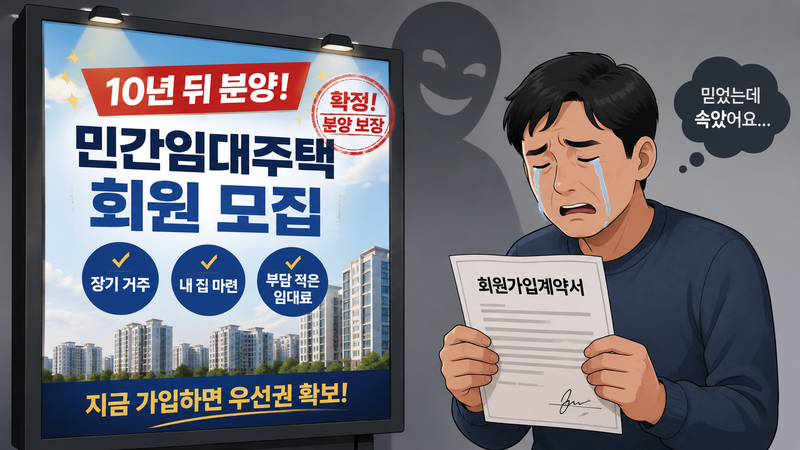
Repeated damages from "membership contracts" According to the National Assembly on the 24th, the "Partial Amendment to the Special Act on Private Rental Housing" was passed in its original form at the plenary session on the 20th. The core of the amendment is to prohibit the act of recruiting tenants or prospective tenants of private rental housing through methods not permitted by law. By defining the scope of application as "those intending to be selected as tenants of future private rental housing, regardless of title such as prospective tenants, investors, members, or promoters," the bill blocks business practices that circumvent regulations by changing contract names to "membership" or "investment. " Violations are punishable by imprisonment of up to two years or a fine of up to 20 million won, with an additional administrative penalty of up to 30 million won.
The bill will go into effect following the promulgation process, and actual field application is expected to begin next year. The background of this legal amendment lies in recurring disputes related to private rental housing across the country. "Guri Inchang The Hana Seongwon Santeville" in Guri, Gyeonggi Province, is a representative case. Although it recruited subscribers by promising priority conversion to ownership after a 10-year long-term lease, the actual contract form was a "membership contract" rather than a standard lease.
The project site in question was being managed as a separate regional housing cooperative project, and procedures for business plan approval or building permits had not yet been initiated. To date, 50 victims have been identified, with damages totaling 3 billion won, averaging 60 million won per person. The police have referred the case to the prosecution, applying fraud charges against the representative of the development company. ■ Already paid 60 million won.
Existing victims in a 'blind spot' for relief According to the Korea Consumer Agency, a total of 190 consultations related to private rental housing were received between 2023 and June 2025. The number increased from 46 in 2023 to 85 in 2024, with 59 cases received in the first half of 2025 alone. 5% increase compared to the same period of the previous year.
The problem lies with the contract holders who have already suffered damages. Since the new punishment regulations do not apply retroactively to recruitment activities prior to the law's enforcement, contract holders from around 2024 must individually proceed with civil and criminal procedures, such as lawsuits for contract cancellation and deposit refunds, as well as filing complaints for fraud. While there have been cases where some victims have won lawsuits for the return of funds based on a written guarantee promising a full refund of the down payment if the construction review is not passed, actual recovery may be difficult even after winning if the developer has no assets remaining for compulsory execution.
Some point out that while this amendment helps prevent new damages, separate recovery and support mechanisms are needed for existing victims. An industry insider stated, "Although this amendment provides grounds to prevent new damages, mechanisms for victims who have already paid down payments are still insufficient. " He added, "It is necessary to require down payments or membership fees received during the early stages of a project to be deposited into a separate account, and to establish a return procedure that allows victims to receive their money back quickly if the project falls through.
"
[email protected] Choi Ga-young Reporter