"Hiring Part-Timers Could Shut Us Down": 80,000 More One-Person Businesses [Self-Employed on the Brink (Part 1)]
- Input
- 2026-08-23 18:41:03
- Updated
- 2026-08-23 18:41:03
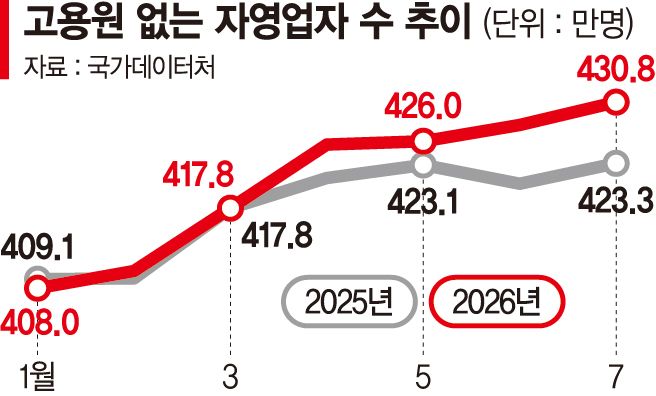
According to the Ministry of Data and Statistics' Employment Trends for July 2026 released on the 23rd, the number of self-employed workers last month rose by 150,000 from a year earlier. Given that total employment increased by 108,000, self-employment effectively drove job growth. In particular, the number of self-employed workers without employees rose by 75,200 from a year earlier. The number of solo business owners, which had been declining recently, has turned upward again. The fact that more owners are cutting staff and running stores alone suggests that self-employed workers who can no longer afford labor costs amid weak sales and rising expenses are shifting back to family-run or one-person operations.
Still, the underlying conditions in the self-employed market remain far from easy. Korea Credit Data (KCD), which analyzed about 160,000 businesses nationwide, found that average sales per business in the first quarter of this year came to 42.58 million won, up 1.89% from a year earlier. By contrast, costs rose 3.36% to 32.59 million won, while average profit fell 2.63% to 9.99 million won. Even when sales rise, costs are climbing faster, deepening a structure in which businesses are selling more but keeping less.
The burden of closures remains heavy as well. In 2024, the number of closed businesses reached 1.008 million, surpassing 1 million for the first time. Last year, 976,000 businesses shut down, a slight decline from the previous year, but there are concerns that the figure could again exceed 1 million this year. Closures are becoming a permanent feature rather than a temporary shock. Their traces are being left behind as empty stores. According to the Korea Real Estate Board (KREB), the vacancy rate for general retail properties nationwide in the second quarter of this year reached 13.4%, the highest level since related statistics began.
The problem is that closures and vacancies do not end with individual stores. As empty units increase, foot traffic and spending decline, which can lead to lower sales at nearby shops and more closures. There is growing concern that the collapse of self-employed businesses could lead to a "hollowing out of the grassroots economy." This refers to a phenomenon in which the most basic parts of the local economy, such as small merchants, the self-employed, neighborhood commercial districts, and everyday service businesses, break down and leave the regional economy hollow.
[email protected] Kim Hyun-cheol Reporter