Banks' Mortgage Loan Growth Slows 44% This Year, Limiting Growth Through Interest Income Alone [Survival Competition in Non-Interest Income Across the Financial Sector (Part 1)]
- Input
- 2026-08-23 18:35:26
- Updated
- 2026-08-23 18:35:26
The traditional banking model of taking in deposits, making loans, and earning profits from the spread between deposit and lending rates no longer guarantees growth.
■Mortgage loan growth falls 44%
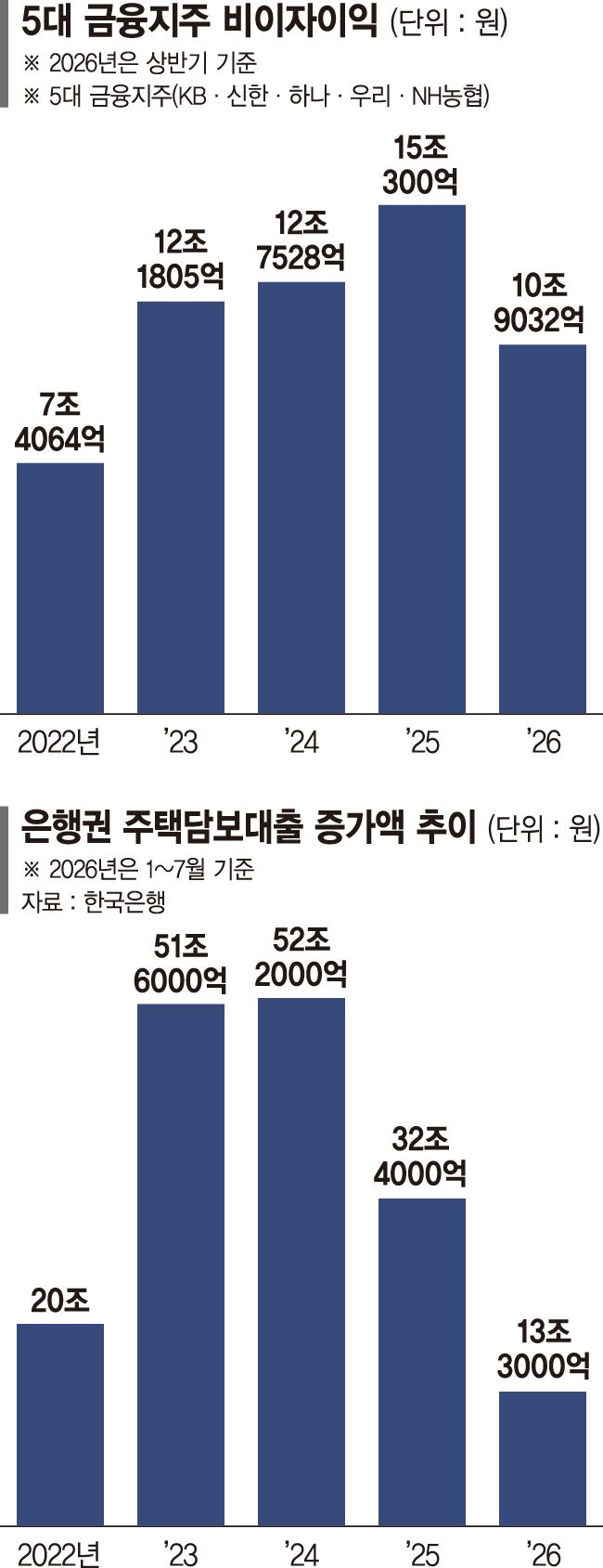
According to the Bank of Korea (BOK) on the 23rd, the outstanding balance of mortgage loans at banks stood at 948.4 trillion won as of last month, up 13.3 trillion won from the end of last year. That marks a 44.4% decline compared with the 23.9 trillion won increase seen in the same period last year.
Mortgage loan growth at banks expanded to 51.6 trillion won in 2023 and 52.2 trillion won in 2024, but it fell to 32.4 trillion won last year. A further slowdown in the increase of outstanding mortgage loans is also expected this year.
This is seen as the result of the gradual tightening of household loan regulations. In February 2024, financial authorities introduced the first stage of stress DSR (Debt Service Ratio) for bank mortgage loans. The second stage was implemented in September that year, and the third stage was introduced in July last year. Stress DSR is a system that calculates a borrower’s loan limit by applying an additional interest rate that is not reflected in the actual loan rate. With the third stage, the stress rate was raised to 1.50%, and its scope was effectively expanded to nearly all household loans. Since October last year, the minimum stress rate for mortgage loans in the Capital Region and regulated areas has been raised to 3.0%.
Measures that directly restrict total volume and lending limits have also continued. Under the June 27 Real Estate Measures last year, the target for household loan volume management in the second half of the year was cut to about half of the original plan. Mortgage loans for home purchases in the Capital Region and regulated areas were capped at 600 million won, and additional mortgage loans for the purpose of buying another home were also banned for multi-homeowners.
In September last year, the LTV for mortgage loans in regulated areas was lowered from 50% to 40%. In principle, mortgage loans for housing sale and rental businesses in the Capital Region and regulated areas were banned, and the jeonse loan limit for one-home owners in those areas was unified at 200 million won. In October last year, mortgage loan limits for home purchases in the Capital Region and regulated areas were differentiated by home price at 600 million won, 400 million won, and 200 million won. In April this year, extensions of maturity for apartment-backed loans held by multi-homeowners in the Capital Region and regulated areas were also, in principle, restricted.
■Limits to interest income growth
Restrictions surrounding household loans are expected to continue for the time being. In its comprehensive real estate finance measures announced on the 13th, the government raised this year's target for household loan volume growth from 1.5% to 3%. However, the additional room will be concentrated on relocation funds for reconstruction and redevelopment projects, interim and final payments for new apartment complexes, and support for young people’s housing stability and end users. Even with a larger total quota, banks are still in a difficult position to expand lending while considering profitability.
Capital costs tied to lending are also rising. The minimum risk weight for bank mortgage loans was raised from 15% to 20% in January this year. That means banks must secure more equity capital than before even when handling the same amount of mortgage loans. The August 13 measures also included a plan to classify high-value, high-DSR mortgage loans and high-priced, high-LTV mortgage loans as high-risk types. Financial authorities presented examples in which these loans would be assigned risk weights two to four times higher than ordinary mortgage loans.
In addition, the effect of higher interest income is expected to remain limited despite the recent upward trend in interest rates. If household lending remains constrained, banks will find it difficult to significantly expand the loan assets that generate interest income, even if lending rates rise following a benchmark rate increase. Moreover, if funding costs such as deposit rates and bank bond yields also rise, the improvement in NIM may not be substantial.
A financial industry official said, "The trend toward strengthening profitability in wealth management, fees, and non-banking businesses, rather than relying on lending asset expansion, is becoming increasingly important."
[email protected] Ye Byeong-jeong Reporter