Already 2 Trillion Won in Lost Sales: Hyundai Motor Company Faces Dark Clouds Over Full-Scale Strike
- Input
- 2026-08-23 18:33:58
- Updated
- 2026-08-23 18:33:58
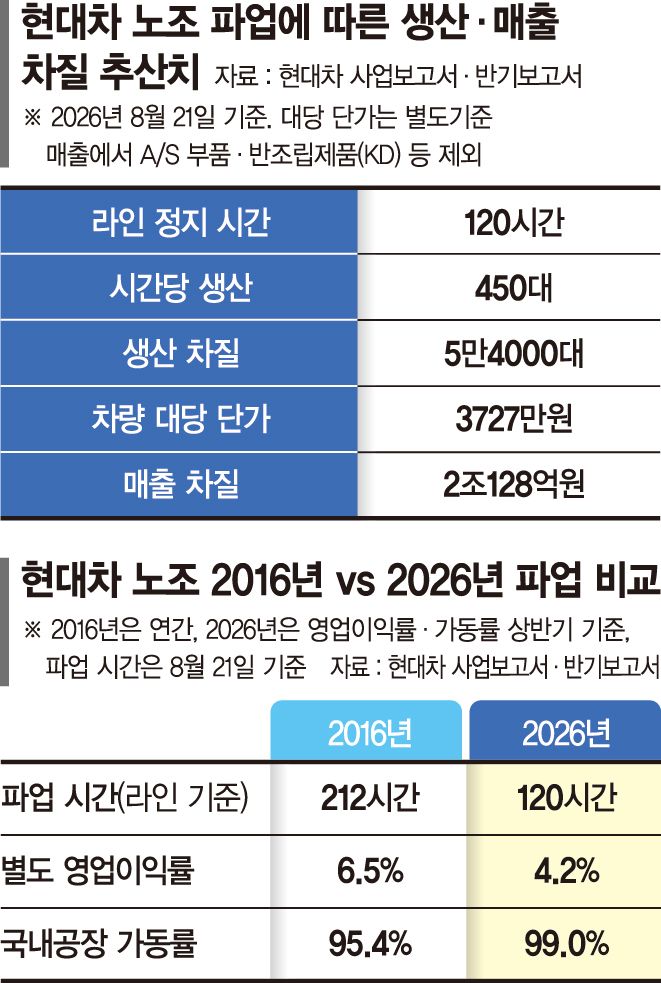
On the 23rd, this newspaper analyzed Hyundai Motor Company’s annual and semiannual reports and found that cumulative sales losses have already exceeded 2 trillion won. Based on the company’s product-by-product sales figures, excluding after-sales service parts and knock-down kits, the revenue per vehicle was estimated at 37.27 million won. Applying 120 hours of line stoppages and an hourly output of 450 vehicles, production losses so far are estimated at 54,000 vehicles, with sales losses of about 201.28 billion won.
The problem is that profitability had already weakened before the strike began. In the first half of this year, operating profit on a standalone basis came to 1.6219 trillion won, down 55.3% from 3.6259 trillion won a year earlier. The operating margin fell 4.8 percentage points, from 9.0% to 4.2%. The gap is also clear when compared with the full-scale strike in 2016. At that time, the union staged a 106-hour strike, and the annual standalone operating margin for 2016, reflecting the damage, came in at 6.5%. That was 3.1 percentage points lower than in 2015, the year before the strike, but still 2.3 percentage points higher than the first half of this year.
Domestic plant utilization had already declined in the first half. From January to June this year, Hyundai Motor Company produced 897,929 vehicles in Korea against domestic production capacity of 907,000 units, for a utilization rate of 99.0%. Last year, utilization reached 102.1%, meaning the plants were running above standard operating time. Looking at the 2016 case, it is unclear whether overtime production can make up for the losses. Domestic output fell from 1,858,395 vehicles in 2015 to 1,679,905 in 2016, a drop of 178,490 units, and utilization ended at 95.4%, or 80,000 units below capacity.
■ Front expands to parts makers and Kia
As the labor-management standoff drags on, concerns about weak earnings in the second half are growing. On the 21st, all production lines at Hyundai Motor Company’s Ulsan, Jeonju and Asan plants were shut down for 16 hours in a single day. Cumulative strike time this year has reached 120 hours on a line basis.
Negotiations are effectively at a standstill. Since the initial meeting on May 6, the two sides have met 16 times but failed to find common ground. Talks resumed on the 18th, more than 40 days after the previous session on the 8th of last month, but the gap remained unchanged.
The key issues are a 50% increase in bonuses, reinstatement of union members dismissed during past union activities, and an extension of the retirement age. The union says fixed wages account for only 54.8% of total pay, leaving workers dependent on overtime and special shifts. It also argues that the company can absorb the cost, citing 101.3 trillion won in retained earnings last year. The union’s planned partial strike has been temporarily put on hold, and Hyundai Motor Company and the union are scheduled to hold their 17th round of talks at the Ulsan plant on the 24th.
Strike tensions are spreading beyond the group. According to the Korean Metal Workers' Union (KMWU), 12,000 workers went on strike on the 20th at parts makers concentrated in the Gyeongju, Chungnam and Daejeon-Chungbuk branches, as well as at some Hyundai Mobis production plants and a Hyundai Glovis logistics site in Ulsan. On the 21st, 38,000 members of the Hyundai Motor Union joined in, bringing total participation to 50,000. Kia labor union members also held a strike countermeasures committee meeting that day and decided on a partial strike of two to four hours per shift for three days, from the 26th to the 28th. If the strike actually begins, the five-year streak of labor peace since 2021 will be broken.
An industry source said, "As the labor dispute drags on, the strike is becoming more intense." The source added, "If Kia also goes on strike, the group’s overall production plan will inevitably be disrupted."
[email protected] Kim Dong-chan Reporter