Ruling Party Says Single-Homeowners Should Not Be Split Between Residents and Nonresidents Under Property Holding Tax
- Input
- 2026-08-23 18:30:14
- Updated
- 2026-08-23 18:30:14
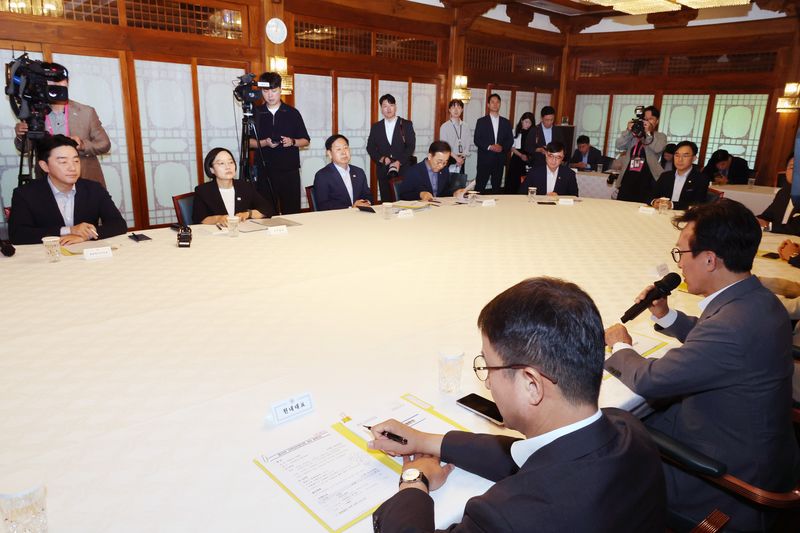
The government's tax reform plan centers on shifting real estate tax benefits from ownership to occupancy. Under the plan, the basic deduction for a single-homeowner under the property holding tax would rise from the current 1.2 billion won to 1.4 billion won for those who actually live in the home, while it would be lowered to 900 million won for nonresidents. The long-term holding special deduction for Capital Gains Tax would also gradually reduce benefits based on ownership period while strengthening deductions tied to residence period.
The Democratic Party of Korea argued that even single-homeowners who cannot live in their homes because of work or family circumstances could be unfairly penalized. That is why the party and the government agreed at the meeting to expand the scope for recognizing residence in unavoidable nonresident cases. In particular, the party went a step further on the property holding tax, strongly urging the government not to distinguish at all between residents and nonresidents for single-homeowners.
Detailed standards were also put on the table for adjustment. The meeting discussed the property holding tax burden cap, the fair market value ratio, and the special deduction for long-term holding for Capital Gains Tax. The government plan includes raising the property holding tax burden cap from 150 percent to 200 percent. The Democratic Party of Korea did not disclose specific adjustment figures, but said it believes the sharp increase in tax burdens must be addressed.
That is also why Kim directly mentioned the property holding tax and the long-term holding special deduction in his opening remarks, stressing that "deep deliberation is needed." The party is not trying to reverse the broad direction of the government's tax reform, but is instead focusing on removing measures that could place an excessive burden on end users.
The ruling party's push for active revisions is rooted in concern over public sentiment on housing. When asked whether the real estate issue had affected approval ratings for the party and the government, Park Seong-jun, the Democratic Party of Korea's Chief Spokesperson, said, "The party is well aware of public sentiment trends, and the government also recognizes that part." The remarks suggest that rather than simply backing the government's proposal, the party intends to lead the effort to make adjustments that reflect public sentiment.
The party also called for faster action on housing supply. The party and the government agreed to improve the system so that authority over redevelopment and reconstruction projects involving 500 households or fewer can be transferred to heads of local governments, and to actively discuss easing regulations on private redevelopment and reconstruction. The use of Yongsan Park was also discussed, but no conclusion was reached on the specific scope of supply.
This week is expected to be a turning point in party-government coordination. Since the government's tax reform plan is scheduled to be submitted to the National Assembly on the 3rd of next month, the two sides plan to hold additional talks before then and produce a revised proposal. From the resident-nonresident distinction under the property holding tax to the long-term holding special deduction and the tax burden cap, the degree to which the party's demands are reflected will likely determine how far the government's owner-occupancy-centered tax reform goes.
At the same time, the Democratic Party of Korea also decided to speed up the push for livelihood and reform bills. Park, the Chief Spokesperson, explained, "The party and the government have decided to prepare a legislative strategy in advance of the September regular session of the National Assembly to ensure the swift implementation of bills tied to key state tasks such as livelihood and reform. The party and the government plan to concentrate legislative capacity so that bills related to livelihood and reform can be passed as much as possible within this year, in line with the regular session and budget review schedule."
[email protected] Song Ji-won, Lee Hae-ram Reporter