After Four-Party Talks, Calls Grow for Disbanding UNC and Transferring DMZ Jurisdiction... Unification Ministry Sidesteps Issue, Saying It Is Not a Point of Contention
- Input
- 2026-08-23 14:14:00
- Updated
- 2026-08-23 14:14:00
In his Liberation Day speech, President Lee proposed building a peace regime through four-party talks involving South Korea, the United States, China and North Korea, alongside an end to the 73-year-old armistice system. In response, U.S. President Donald Trump instructed his aides to pursue a summit with North Korean leader Kim Jong Un at the Asia-Pacific Economic Cooperation (APEC) summit to be held in Shenzhen this November.
A diplomatic circles source said on the 23rd that if a four-party peace framework involving South Korea, North Korea, the United States and China is achieved in November, debate over disbanding UNC in Korea, a key pillar of the armistice system, and transferring jurisdiction over the DMZ to South Korea will come to the surface.
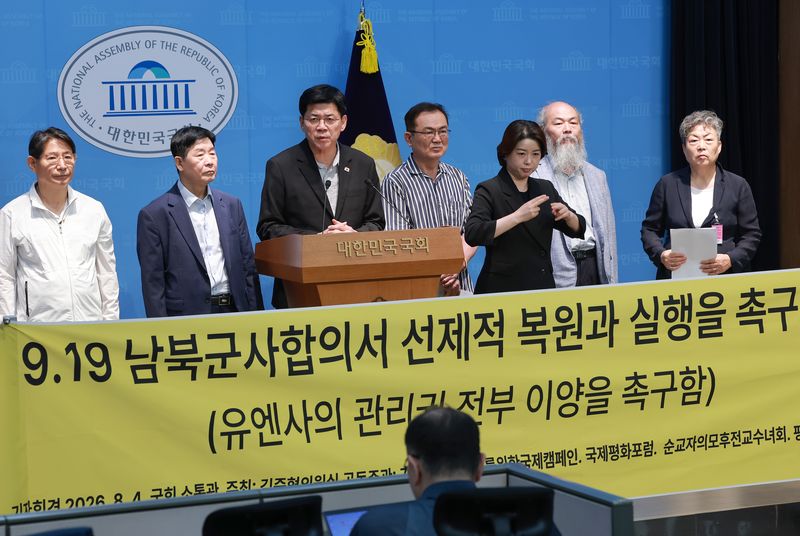
By contrast, the Ministry of Unification, which is pushing for four-party talks, is reluctant to discuss disbanding UNC. Instead, it appears to be focusing only on halting North Korea's nuclear advancement. A senior MOU official with a pro-engagement stance denied the issue, saying, "I understand that disbanding UNC is being discussed, but it is not a point of contention in the four-party talks."
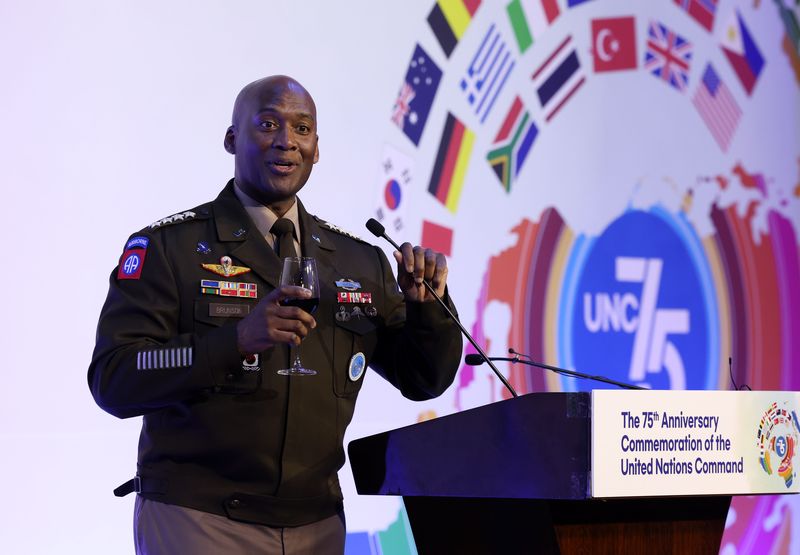
At present, jurisdiction over the DMZ lies not with the Government of the Republic of Korea, but with UNC, the body responsible for managing the armistice agreement. The commander of UNC also serves as the commander of USFK. In effect, USFK is managing the DMZ.
If the military demarcation line is formally recognized as an official border through a peace treaty, jurisdiction over the southern side of the DMZ is likely to first revert to the ROK Armed Forces. Authority over civilian access to the DMZ, inter-Korean road and rail links, and peace tourism — all of which previously required UNC approval — could fully pass to the South Korean government.
But there are variables. In the early stages of a peace treaty, there is also a possibility of creating a joint inter-Korean military committee or an international peacekeeping body to jointly manage the DMZ during a transitional period in order to prevent clashes.
A diplomatic circles source said that because the signatories to the armistice agreement were the United States, North Korea and China, there is also a possibility that they will demand a new management structure that excludes South Korea. "It depends on how the parties reach diplomatic agreement at the four-party peace agreement negotiating table," the source said.
Debate over disbanding UNC has also fueled clashes between political camps. The progressive camp has argued that UNC is an organization that follows only U.S. military orders and does not receive funding or command from the UN. It says that when the command was created in 1950, the UN Security Council merely authorized a U.S.-led unified force, not a military directly under the UN.
The conservative camp and U.S. military experts have offered a strong counterargument. They say UNC is a legitimate subsidiary body established by a clear UNSC resolution and a "critical security asset" that can immediately deploy troops from multinational force-providing countries to the Korean Peninsula in a contingency without a separate UN resolution.
[email protected] Kim Kyung-soo Reporter