Can the 100 Trillion Won Future Response Fund for 'Future Investment' Be Sustained? Three Key Issues
- Input
- 2026-08-23 14:01:18
- Updated
- 2026-08-23 14:01:18
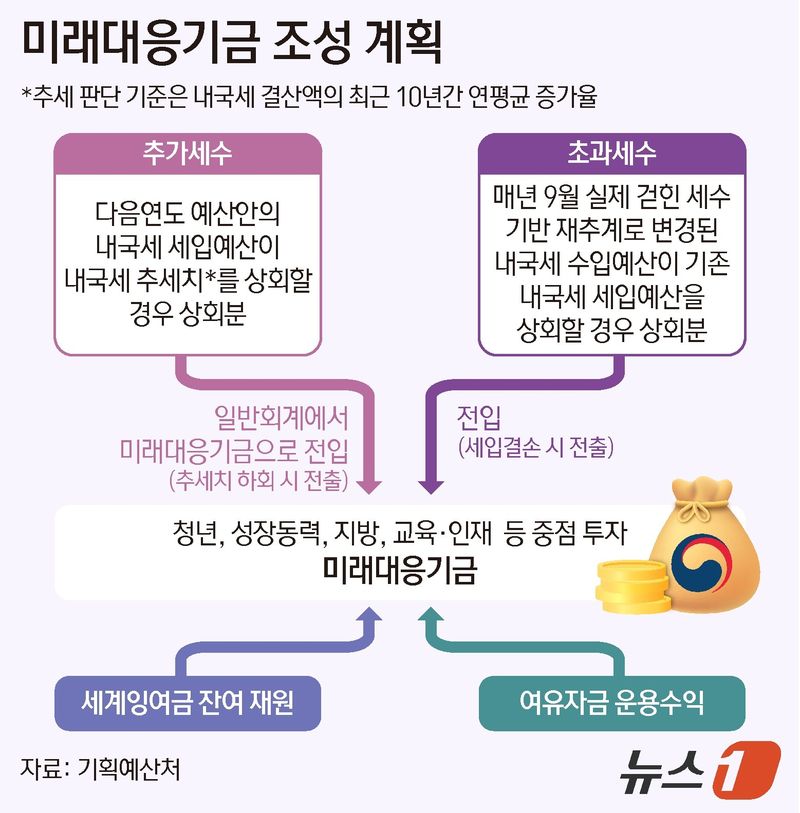
[Financial News] As the government moves to set aside additional tax revenue boosted by the semiconductor boom into a Future Response Fund for investment in young people, regional development and growth engines, concerns are growing over the decision to bundle such a large amount of public money into a separate fund. Critics say the fund could overlap with existing policies and lose effectiveness, while its flexible operation outside parliamentary oversight could turn it into a government slush fund. There are also warnings that increasing future investment on the back of a temporary tax windfall could instead weaken fiscal soundness.
According to the Ministry of Planning and Budget on the 23rd, the government plans to separately set aside additional and excess tax revenue, as well as surplus financial resources, into the Future Response Fund for future generations. The accumulated resources will be concentrated on four areas: youth, regional development, growth engines, and education and talent.1. Effectiveness of overlapping investmentThe problem is that many of these areas are already being pursued through existing fiscal programs. Youth jobs and housing support, regional infrastructure expansion, advanced industry promotion, and education and talent development are all areas in which government ministries are already allocating budgets. If the Future Response Fund merely adds more money to these projects, its necessity and policy impact could be weakened.
In particular, there is a risk that policy tools may overlap in the growth engine sector. The government is also pushing a sovereign wealth fund to make long-term investments in three major megaprojects, including AI and semiconductors. If the Future Response Fund also makes growth engine investment one of its main uses, similar resources could flow through multiple channels, potentially diluting the impact of investment.
Song Young-kwan, senior research fellow at KDI's Market Policy Research Division, said, "Korea's various support policies tend to be scattered, thin, and broad." He added, "There is already a large body of research and real-world evidence showing that this approach makes it difficult to improve policy effectiveness." He went on to say, "When creating a separate fund like the Future Response Fund, the approach should be to identify areas where results are expected and provide targeted support, rather than simply adding money to existing programs."2. Gaps in oversight and checksThe fund's operating method is also drawing criticism. Like other government funds, the Future Response Fund will undergo National Assembly review of its annual management plan. However, depending on the nature of the fund, spending on major items can be changed by up to 20 to 30 percent without submitting an amendment to the Assembly. If a large amount of public money is tied up in the fund, the government could adjust substantial spending without separate parliamentary approval, raising concerns that it could function much like a permanent supplementary budget.
Another challenge is the lack of clear standards for accumulation, management, and withdrawal. If there are no specific rules on when the fund can be drawn down and used, the size of the fund and its spending could shift according to government policy judgments. There are also calls for consistent operating principles, from fundraising to execution, to prevent the fund from accumulating unnecessarily or being withdrawn on a large scale when needed.
Kim Hak-soo, senior research fellow at KDI's Fiscal and Social Policy Research Division, said, "To ensure the sustainability of the Future Response Fund, clear rules for accumulation, management, and withdrawal are essential." He added, "In the case of the Future Response Fund, an independent management and oversight system that can block political influence is also necessary."3. Fiscal soundness pushed asideNational debt, which stands at around 1,400 trillion won, is another variable. If all additional tax revenue from the volatile and hard-to-predict semiconductor boom is used for future investment, the government could miss an opportunity to secure fiscal room. The government has maintained an expansionary fiscal stance and is reluctant to actively use additional and excess tax revenue to repay debt. In fact, of the 26 trillion won supplementary budget drawn up in April, only 1 trillion won was used to repay government bonds.
There is also a strong possibility that fiscal conditions will deteriorate structurally. As the working-age population declines and the country ages rapidly, the tax base is weakening. At the same time, fiscal burdens for welfare-related mandatory spending such as basic pensions and health insurance, as well as public pensions including the civil servants' pension and private school pension, are likely to rise.
The government believes that if the fund's manager invests the resources and earns a return higher than the current 3.8 percent yield on Treasury bonds, it could ease fiscal pressure. However, some of the investment targets may include policy projects that are not designed primarily for profit, making it difficult to offset the fiscal burden through investment returns alone.
Experts said that even if the Future Response Fund serves as a fiscal reservoir to absorb tax revenue volatility, a significant portion of the resources should still be used to repay debt. They also proposed creating a separate account for "sound finance" under the fund's general account.
[email protected] Kim Chan-mi, Jeong Sang-gyun Reporter