Magnitude 5.9 earthquake hits Ibaraki, with Tokyo shaking at intensity 5- lower for the first time in five years
- Input
- 2026-08-23 09:24:11
- Updated
- 2026-08-23 09:24:11
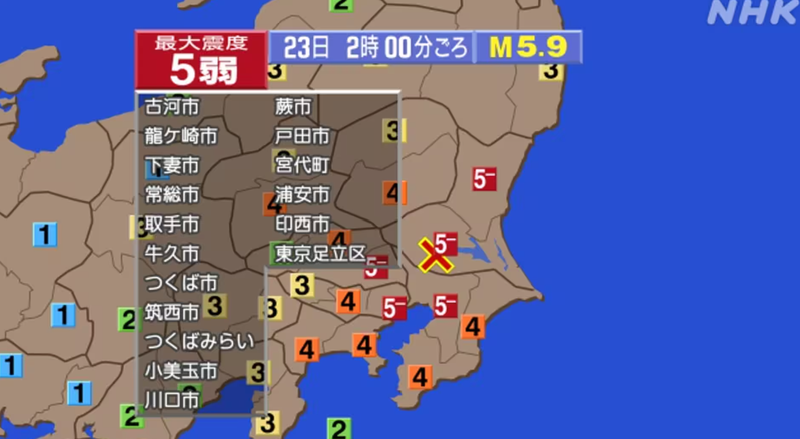
[Financial News Tokyo = Correspondent Seo Hye-jin] A magnitude 5.9 earthquake struck southern Ibaraki Prefecture around 2 a.m. on the 23rd, and strong shaking of up to intensity 5- was observed in Ibaraki, Saitama, and Chiba prefectures, as well as Tokyo Metropolis. At least 17 people were injured across the Kanto region, and damage continued to mount, including rail suspensions and ruptured water mains. It was the first time in about five years that shaking of intensity 5- or stronger had been observed in Tokyo's 23 special wards.
According to NHK and the Japan Meteorological Agency (JMA), the epicenter was estimated to be at a depth of 68 kilometers. No tsunami warning was issued.
Intensity 5- was observed in 17 cities, wards, and towns, including 10 cities in Ibaraki Prefecture, three cities and one town in Saitama Prefecture, two cities in Chiba Prefecture, and Adachi Ward in Tokyo Metropolis. A wide area of the Kanto region, including Chiyoda City and Setagaya City in Tokyo, Saitama City, Chiba, and Yokohama City, recorded intensity 4.
Nine people were injured in Saitama Prefecture and eight in Kanagawa Prefecture. Most of the injuries were caused by falls, dropping from beds or stairs, or cuts from broken glass. The Tokyo Fire Department had received 39 rescue and emergency calls related to the quake by 6:30 a.m. Reports also came in of people trapped in elevators or unable to leave rooms after refrigerators and wardrobes toppled over.
In Koto Ward, Tokyo, water spilled onto the road in an incident believed to have been caused by a ruptured water main, and some areas of Adachi Ward experienced water outages. At a supermarket in Adachi Ward, a fire suppression system malfunctioned and released a large amount of firefighting foam. At Ushiku City Hall in Ibaraki Prefecture, part of the ceiling measuring about 50 centimeters wide and 2 meters long fell, but there were no injuries.
Rail services were also disrupted. Operations were suspended on the Jōban Line between Toride and Tomobe Station, on the Utsunomiya and Takasaki lines between Tokyo and Omiya, and on some sections of the Musashino Line. Temporary power outages also occurred on some sections of the Tohoku, Jōetsu, and Hokuriku Shinkansen lines, but power was restored and services resumed from the first train.
Long-period ground motion classified as 'Class 2' was also observed in Tokyo's 23 special wards and in Saitama and Chiba prefectures, shaking high-rise buildings for a long time and with strong force. At this level, it is difficult to walk without holding onto something, and dishes or books on shelves may fall. It was the first time since the 2021 northwestern Chiba Prefecture earthquake that shaking of intensity 5- or stronger had been observed in Tokyo's 23 special wards.
Shinichi Sakai, a professor at the Earthquake Research Institute, University of Tokyo, analyzed that "because the epicenter was relatively deep, the strong shaking appears to have spread over a wide area." Southern Ibaraki Prefecture also experienced earthquakes with a maximum intensity of 5- in April and June this year.
The JMA urged people to remain alert for earthquakes with a maximum intensity of 5- for about a week, especially over the next two to three days. It also warned of possible landslides and slope failures in Chiba Prefecture and other areas where the ground has been weakened by recent record rainfall.
Prime Minister Sanae Takaichi instructed relevant ministries and agencies to quickly assess the damage and provide accurate information to the public. No abnormalities were found at the Fukushima Daiichi and Fukushima Daini nuclear power plants, or at the Tōkai Nuclear Power Plant in Ibaraki Prefecture.
[email protected] Seo Hye-jin Reporter