August Rate Hike in Focus as Markets Weigh Growth and Home Prices Against Exchange Rates and Inflation
- Input
- 2026-08-23 08:20:59
- Updated
- 2026-08-23 08:20:59
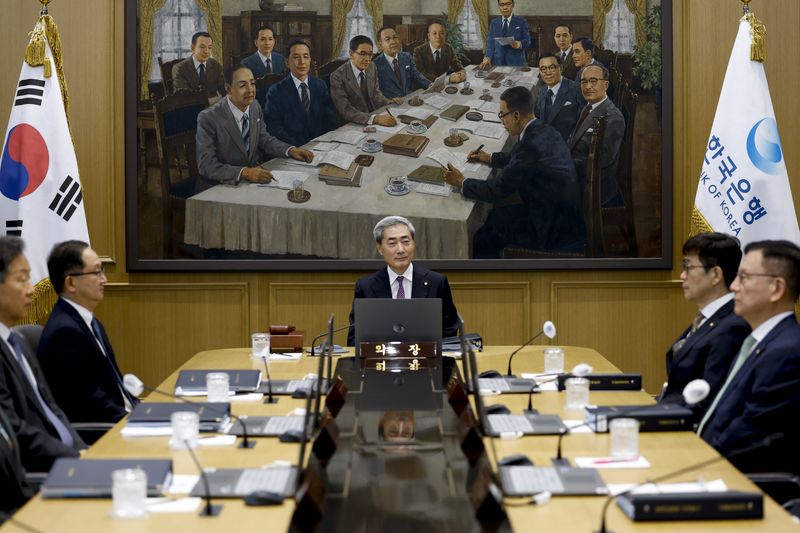
[Financial News] The market is sharply divided over whether the Bank of Korea (BOK) will raise its benchmark interest rate again in August after doing so in July, or whether it will pause for one meeting. The answer could depend on which factor carries more weight: the economic recovery, financial imbalances, the exchange rate, or inflation.
There are solid arguments for another hike if policymakers focus on the recovery, as well as on financial imbalances such as home prices and household debt. On the other hand, the recent sharp decline in the won-dollar exchange rate and the easing inflation trend suggest the BOK could wait to see the effects of July’s hike and then raise rates again in October. Because both a hike and a hold have clear rationale, market expectations have not tilted decisively in either direction.
The BOK will decide the benchmark rate at its Monetary Policy Board meeting on the 27th. The current base rate stands at 2.75 percent. The central bank raised the rate by 0.25 percentage point last month. At this meeting, the key question is whether it will deliver back-to-back hikes or keep rates unchanged for now and move again around October.
"There Is No Need to Take a Break"... The Case for an August Consecutive Hike
According to industry sources on the 23rd, experts who expect another hike in August believe the pace of rate normalization does not need to slow, given that the recovery has been stronger than expected. They also argue that the BOK should raise rates once more to signal its policy resolve, especially with financial imbalance risks such as home prices and household debt still looming.
Park Hyung-jung, an economist at Woori Bank, stressed that "the chances of a hike are high, and it should be raised." He said, "When the rate was raised last month, several reasons were cited," adding that this included stronger growth, inflation concerns, and the need to address financial instability.
He also noted that policy conditions have not changed much in the month since July’s hike. "If you look at what has changed over the past month, the only thing that has stabilized is the exchange rate," he said. "Other surrounding conditions have not really changed. Going forward, real estate lending could increase further, and the property market still carries the seeds of instability."
Park Sang-hyun, a researcher at iM Securities, also leaned toward an August hike. He said, "Annual growth is likely to be revised up significantly, and concerns over core inflation remain." He added that recent instability in home prices is another factor that calls for a preemptive response.
He went on to say, "This year’s growth rate itself is quite high, with nominal growth in double digits," and concluded that "some degree of rate normalization is necessary."
Gong Dong-rak, a researcher at Daishin Securities, also said the BOK would raise the benchmark rate by 0.25 percentage point to 3.00 percent in August. He noted that "real economic conditions are improving quickly enough to justify a sharp upward revision in growth forecasts," and said he had moved up his expected timing for another hike from his earlier outlook.
"It Would Not Be Too Late to Act in October"... The Case for an August Hold
By contrast, some analysts say the BOK should skip one meeting in August and first assess the impact of July’s hike. They argue there is no urgent need to rush another increase, given the recent sharp fall in the won-dollar exchange rate and the easing inflation trend.
Baek Yoon-min, a researcher at Kyobo Securities, forecast that the BOK would keep rates unchanged in August because both July inflation and the recent exchange rate have adjusted significantly, which means the central bank’s existing inflation path must also change. "Although the rate was raised in July, there is not much urgency to do it consecutively," he said. "It would not be too late to wait a little longer and act in October."
He also said an August hold would not necessarily mean a retreat from the tightening cycle. "No one thinks that if the BOK does not hike in August, it will not hike in October, and most houses still expect at least one more increase this year," he said. "An August hold would not significantly reduce those expectations."
Ahn Yeha, a researcher at KIWOOM Securities, also expects the BOK to hold rates in August. She cited the easing inflation burden from the weaker won and recent stock market corrections. After an August pause, she expects the benchmark rate to rise to 3.00 percent in October, with the tightening bias continuing into the first half of next year.
Experts’ year-end forecasts for the benchmark rate are in the 3.00 to 3.25 percent range. In other words, both the hike camp and the hold camp leave room for at least one more increase before the end of the year.
In the end, the August Monetary Policy Board meeting is likely to be a turning point for gauging the pace of rate hikes in the second half of the year, rather than simply a decision on whether to raise rates now. Since both an August hike and an August hold leave the door open to further tightening this year, the key issue is what signal this decision will send about the future path of rate normalization.
[email protected] Hong Ye-ji Reporter