"An Apartment Bought for 600 Million Won in 2004 Is Still 600 Million Won Today"... Is This Real? Policy Loans Trapped by a Ceiling [Real Estate A to Z]
- Input
- 2026-08-22 14:00:00
- Updated
- 2026-08-22 14:00:00
[Financial News]#. A salaried worker in his 30s, identified as A, is struggling to find an apartment in Seoul priced at 600 million won or less, which would make him eligible for policy loan products. In the first half of this year alone, fewer than 9,000 of roughly 40,000 apartment transactions were for homes priced at 600 million won or less. A complained that "the 600 million won cap does not reflect reality at all."The home-price eligibility limits for policy loan products such as the Didimdol Loan and the Bogeumjari Loan are drawing criticism. In general, the cutoff is homes priced at 600 million won or less, and the rule has remained tied to that "600 million won hurdle" for more than 20 years.
It started at 600 million won, and decades later it is still 600 million won
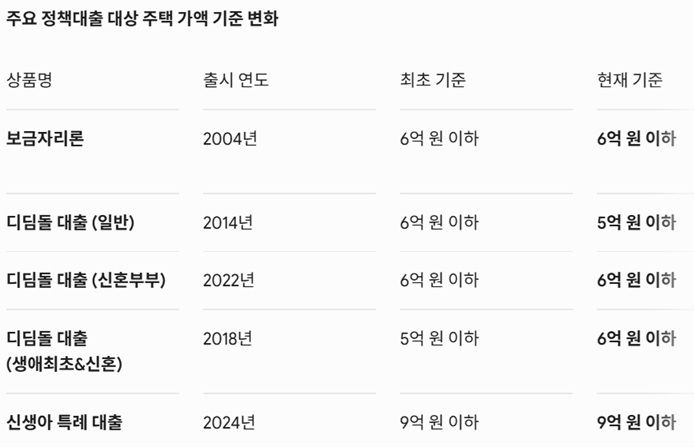
First, look at the Bogeumjari Loan. It was launched in 2004 and was initially offered for homes priced at 600 million won or less. The limit was later raised to 900 million won for a certain period when the special Bogeumjari Loan was introduced, but since 2017 the 600 million won threshold has been maintained again. In effect, the same 600 million won standard has been in place from the launch of the Bogeumjari Loan 22 years ago until now.
The Didimdol Loan follows a similar pattern. The general loan was launched in 2014 for homes priced at 600 million won or less. Since 2017, however, the threshold has been lowered to 500 million won.
The Newlywed Didimdol Loan has been capped at 600 million won since its launch in 2022. The First-time Buyer and Newlywed Loan started at 500 million won in 2018, then was raised to 600 million won in 2023. In practice, both the Didimdol Loan and the Bogeumjari Loan have been tied to the 600 million won ceiling for a long time. Among policy loan products, only the Newborn Special Purchase Loan has a limit of less than 900 million won.
According to KB Real Estate statistics, average transaction price data have been available since December 2018. At that time, the average apartment sale price was 250 million won nationwide, 370 million won in the Seoul metropolitan area, and 520 million won in Seoul. The current average apartment sale price in Seoul is 1.6 billion won, while the metropolitan area average is 870 million won.
Apartment prices have risen by roughly three times in Seoul, but the price threshold for policy loan products remains at 600 million won. Because policy loans are still bound by the 600 million won ceiling, other policies that exclude housing ownership also follow the same rule. Even small non-apartment homes excluded from the housing-count calculation must be priced at 600 million won or less.
The number of apartments priced at 600 million won or less has fallen by 50,000 in one year
To reduce the marriage penalty, the government has eased income requirements for policy loans aimed at newlyweds. But because the home-price cap remains at 600 million won, the effect felt by borrowers is limited.
Apartments eligible for policy loans are also becoming increasingly scarce. According to Real Estate R114, the share of Seoul apartments priced at 600 million won or less fell again from 14% to 12% over the past year. In terms of households, that means about 50,000 units disappeared, dropping from 220,000 to 170,000.
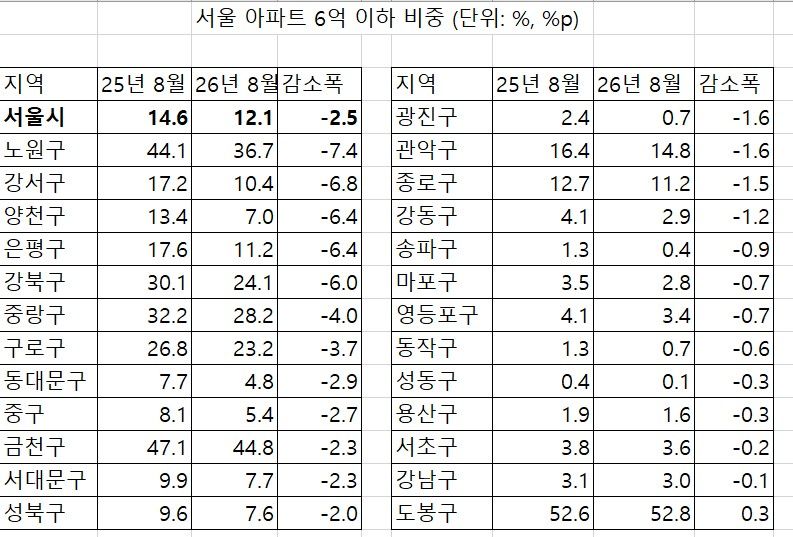
The district with the sharpest decline in the share of homes priced at 600 million won or less over that period was Nowon District. It fell 7.4 percentage points, from 44.1% in August 2025 to 36.7% this August. Gangseo District also saw a steep drop, from 17.2% to 10.4% during the same period.
Some areas may soon have no homes left under the 600 million won threshold at all. As of this August, Seongdong District had just 0.1% of homes priced at 600 million won or less. Songpa District stood at 0.4%, while Gwangjin District and Dongjak District were each at 0.7%.
Experts say that, along with easing income requirements, the home-price cap also needs to be raised. One official pointed out that "there are limits to the funding used to operate policy loan products, but the 600 million won standard is, quite simply, a very outdated yardstick."
[email protected] Lee Jong-bae Reporter