AI Weathercasters That Look and Move Like Humans Make Their Debut [IT Item of the Day]
- Input
- 2026-08-25 07:00:00
- Updated
- 2026-08-25 07:00:00
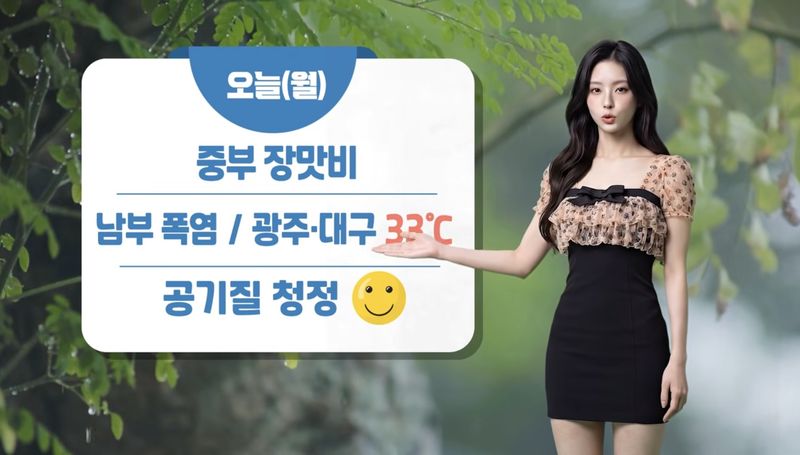
[Financial News] "Isn't it really a person?" An artificial intelligence (AI) weathercaster so natural that it is hard to tell from a human has become a hot topic online. By reproducing not only a face and voice but also facial expressions and hand gestures, AI is moving closer to replacing broadcast staff such as weathercasters and news anchors.
According to the information technology industry on the 25th, an AI weathercaster recently appeared on the YouTube channel "Weather Environment Agency," operated by weather big data platform company Kweather Co., Ltd. The AI weathercaster, using the alias "Kim Si-a," delivers the daily forecast. Map explanations, hand gestures, facial expressions, eye contact and voice were all implemented so naturally that they are difficult to distinguish from an actual weather broadcast. As viewers reacted with surprise at how human-like the result was, debate also grew over whether the revealing outfit was appropriate, further increasing interest in the video.
In domestic broadcasting and public-sector fields, AI-based content production is gradually expanding. MBN, a general programming channel, is using an AI weathercaster to deliver weather information, while local governments such as Jeju Island and Sangju City are also using AI anchors to promote policies and produce news content.
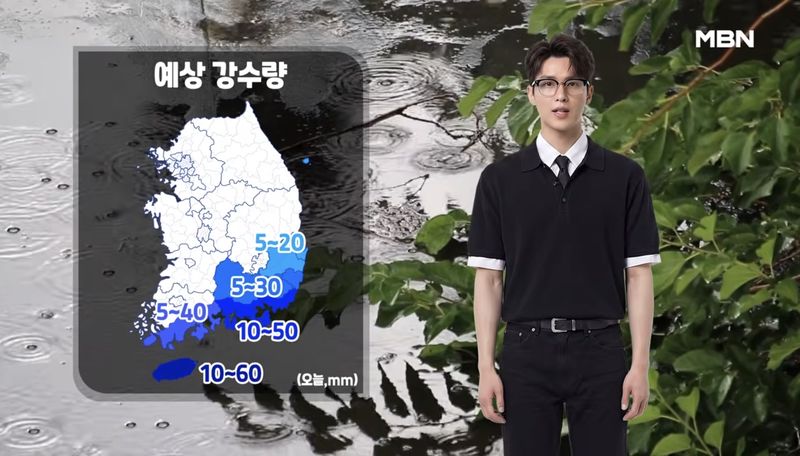
One reason AI weathercasters are drawing attention is their ability to reduce production costs and time. Weather updates and other information content that follow a fixed format can be produced with AI, reducing the manpower and time needed for filming and recording, while allowing content to be created whenever it is needed.
In overseas broadcasting, examples are also emerging in which cost cutting and digital transformation are leading to both workforce reductions and broadcast automation. According to foreign media reports, the British Broadcasting Corporation (BBC) decided this month to cut the number of national weather presenter positions from 11 to 4.5 in order to reduce costs and strengthen digital services. The BBC News channel will continue to provide weather forecasts every 30 minutes, but instead of being presented live by weathercasters, it plans to use automated graphics.
U.S. media company E. W. Scripps Company also decided to cut 268 jobs as it streamlines news production with AI and automation and shifts its business toward 24-hour streaming. The company plans to introduce its own AI system to reduce the resources devoted to production work and reassign staff to field reporting and other tasks.
AI is rapidly expanding beyond delivering weather information to also entering the area of forecast generation. AI weather prediction models such as Fengwu from the Shanghai AI Laboratory, Pangu from Huawei and GraphCast from Google Experience Center learn from vast amounts of historical weather data and produce forecasts far faster than traditional numerical weather prediction methods. In some weather variables, they are showing prediction performance comparable to or better than existing methods. Fengwu reportedly outperformed Google Experience Center's AI weather prediction model GraphCast in about 80% of the weather variables evaluated. It is also said to have predicted the landfall time and location of typhoons with errors of about 30 minutes and 30 kilometers, respectively.
As AI is used in a wider range of tasks, from weather data analysis to forecast generation and information delivery through broadcasting, changes are expected in how broadcasts are produced. In particular, analysts say AI adoption could accelerate in jobs that repeatedly deliver standardized information, such as weather and stock market updates, in a fixed format.
As actual AI weathercaster videos are shared online, concerns about job replacement have also continued among internet users. On X, formerly Twitter, and other social networking services, reactions included comments such as, "Outsourcing to AI is going to become the norm," "Not only broadcast jobs but other occupations are not safe," and "It's scary because you can't tell whether it's a person or AI."
[email protected] Choi Hye-rim Reporter