10,000 Door Handle Tests, 8,000 Done by Computer... Chinese EV New Models Are Being Churned Out in Just Two Years
- Input
- 2026-08-21 16:18:43
- Updated
- 2026-08-21 16:18:43
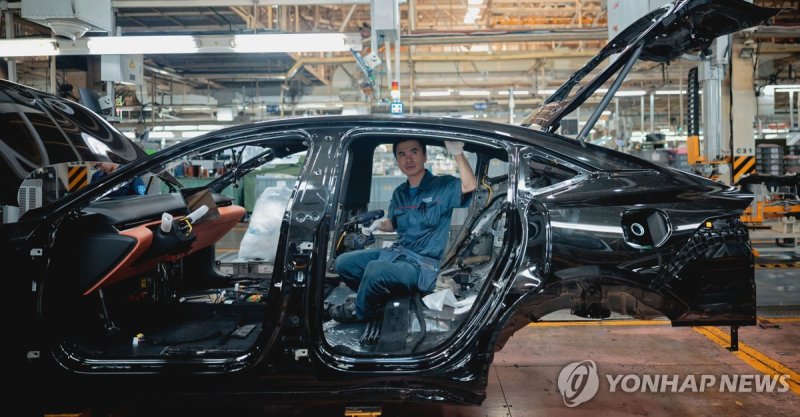
[Financial News] It has been pointed out that the overheated competition in China’s auto industry is leading to shorter new-car verification procedures. Some manufacturers, eager to speed up launches, are skipping road tests and parts verification steps, raising concerns that quality risks are piling up.
China recorded 165 new vehicle models in the first half of this year. That is roughly double the number from the same period in 2016, when there were fewer than 90.
The development cycle for new models has also been cut from five years in the internal-combustion era to two years in the EV era, and some manufacturers are touting the launch of three models a year.
However, industry officials say that at least two years are needed to properly go through the dozens of steps involved, from market research and design to technology development, review, platform application, parts matching, simulation testing, and road testing.
The problem lies in the verification process. When installing parts, both design verification (DV) and production verification (PV) are supposed to be completed, but cases in which only one of the two is carried out have raised concerns that production consistency is weakening and quality variability is increasing.
One manufacturer reportedly conducted only 2,000 physical tests out of 10,000 door-handle tests for a new model, replacing the remaining 8,000 with simulations.
Concerns are also being voiced within the local industry. A research and development executive at Guangzhou Automobile Group Co., Ltd. (GAC Group) said, "A 30,000-kilometer road test is by no means excessive. If you drive 500 kilometers a day, it is over in two months."
Under current national standards, reliability road tests are set at 30,000 kilometers for internal-combustion vehicles and 15,000 kilometers for new-energy vehicles. However, there is no standard specifying the ratio between physical tests and simulations.
In this regard, Lee Fenggang, general manager of Beijing Hyundai, said at the 2026 China Auto Forum held last month, "Some brands are skipping essential tests to speed up launches, turning customers into test personnel," and added, "This will create many potential risks."
[email protected] Sung Min-seo Reporter