Office Worker in His 30s Asks, "Will the Extended ISA Maturity Until 2050 Still Be Subject to the New Tax Reform Proposal?" [Tax and Investment Q&A]
- Input
- 2026-08-23 05:00:00
- Updated
- 2026-08-23 05:00:00

[Financial News] An office worker in his 30s, identified as Mr. A, recently learned that the Individual Savings Account (ISA) would undergo major changes. He had already extended his ISA maturity to 2050, and he wondered whether the total contract period for his existing long-term extension would also be cut to five years. Meanwhile, Mr. B, a man in his 60s who has run a small and medium-sized business for 30 years, sought advice after hearing that the requirements for the Business Succession Deduction would be significantly tightened. He wanted to know whether passing the business on to his children or selling it to a third party would be the better option.
According to KB Securities on the 23rd, the 2026 tax reform proposal announced this month includes measures that will affect both investors and asset holders. However, as this is still a government proposal that has not been finalized, it may change during the legislative process. It will be confirmed only if it passes the National Assembly at the end of the year.
Based on the tax reform proposal announced on the 3rd, the core of the plan is the ISA. Under the newly introduced Productive Finance ISA, interest and dividend income will be fully tax-exempt if invested in domestic stocks, domestic stock-focused funds and ETFs, and the National Growth Fund. The annual contribution limit is 20 million won, with a lifetime cap of 200 million won, and unused annual limits cannot be carried over. For the youth ISA, available to those aged 34 or younger with total salary income of 75 million won or less, an additional income deduction of 10% of contributions, up to 2 million won per year, will be provided.
The existing general ISA will be limited to a total contract period of five years, and the carryover of unused contribution limits will also be abolished. For both ISA accounts, the initial contract period will be three years, with extensions allowed in three-year increments. The measure is intended to prevent high-income financial earners from bypassing eligibility requirements through long-term contracts. However, the details are now being reconsidered as criticism has grown after the announcement.
Under the August 3 tax reform proposal, the five-year cap on the total contract period will apply only to new subscriptions or renewals made on or after Jan. 1, 2027. Since Mr. A has already extended his ISA maturity to 2050, the previous law will apply to his account. The rule barring carryover of unused contribution limits will also take effect from 2027 contributions, so if there is any unused limit, it would be advantageous to contribute within this year.
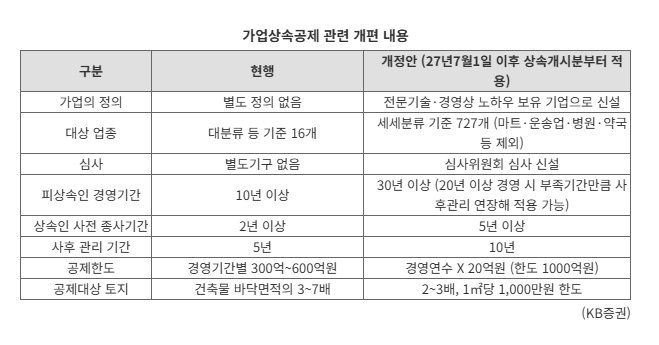
For business owners like Mr. B, the key issue is the Business Succession Deduction. The reform proposal defines a family business as a company that holds specialized technologies and management know-how, such as patents, trade secrets, industrial technology, and skilled techniques, and requires review by a screening committee.
While the eligibility requirements have been tightened, the deduction amount has been expanded in proportion to the length of management. A new special tax treatment for third-party business succession has also been introduced for cases in which succession to children is difficult. Sellers will receive a 20% capital gains tax reduction, capped at 50 million won per year of management, while buyers will receive a 10% reduction in income tax or corporate tax for five years, capped at 500 million won per year. The measure will apply temporarily from 2028 through 2030.
Kang Soo-in, a Tax Specialist Advisor at KB Securities, said, "Because the requirements for the Business Succession Deduction and gift tax deduction have been tightened, the practical use of the system is likely to decline." She added, "Since the requirements have become stricter, I recommend also considering transferring the business to a third party."
Meanwhile, a separate tax regime for Business Development Company (BDC) investments will be introduced. If investors use a dedicated account, dividend income will be taxed separately at 9%. The contribution limit is 100 million won. For publicly offered real estate funds and REITs, the three-year mandatory holding requirement will be removed, and the special separate taxation treatment will be applied automatically.
The income requirement for dependents eligible for the basic deduction will be eased from 1 million won to 3 million won per year. For family members with only overseas stock capital gains and no other income, the dependent deduction will be available for capital gains income of up to 3 million won. For example, if a child has 2.5 million won in overseas stock capital gains income, a basic deduction of 2.5 million won will apply, meaning there will be no capital gains tax and the child can also receive the dependent deduction in year-end tax settlement.
However, revisions to the August 3 tax reform proposal are now widely expected. As investor backlash over the ISA reform plan has intensified, the government is reportedly moving to restore the previously reduced carryover and maturity-extension benefits while only strengthening safeguards against tax avoidance.
Kang said, "A revised version of the tax reform proposal could be released as early as the end of this month, so now is the time to focus on understanding the broad direction of the August 3 tax reform proposal." She added, "Actual decisions should be made after the final law and implementation guidelines are confirmed following year-end passage in the National Assembly, and after consulting with experts."
The [Tax and Investment Q&A] series, based on consultations with tax experts at KB Securities, is published on the fourth week of every month.
[email protected] Park Ji-yeon Reporter