If You Entrust a 200 Million Won Deposit to the Government... Will the Monthly 730,000 Won Payouts Hold Up? Can the Safe Trust Program Take Root?
- Input
- 2026-08-21 15:00:00
- Updated
- 2026-08-21 15:00:00
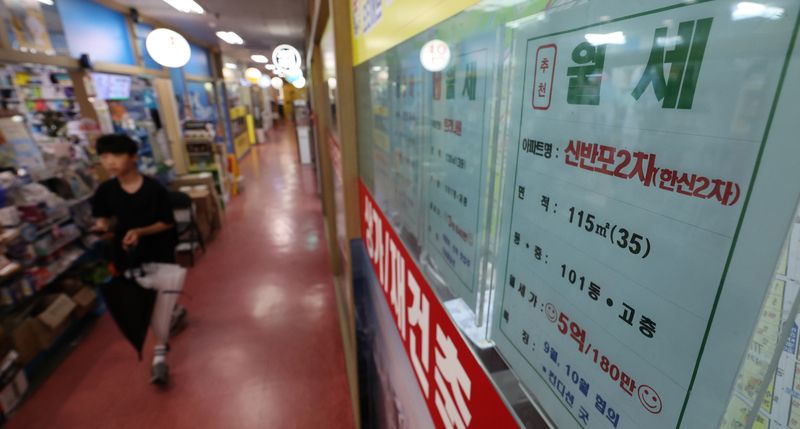
[Financial News] The outline of a 'safe trust' program, in which jeonse deposits are managed by a guarantee institution, has begun to take shape. Its official name is the 'Jeonse-Wolse Safe Trust program.' It will initially be operated for homes with a market value of 2 billion won or less.
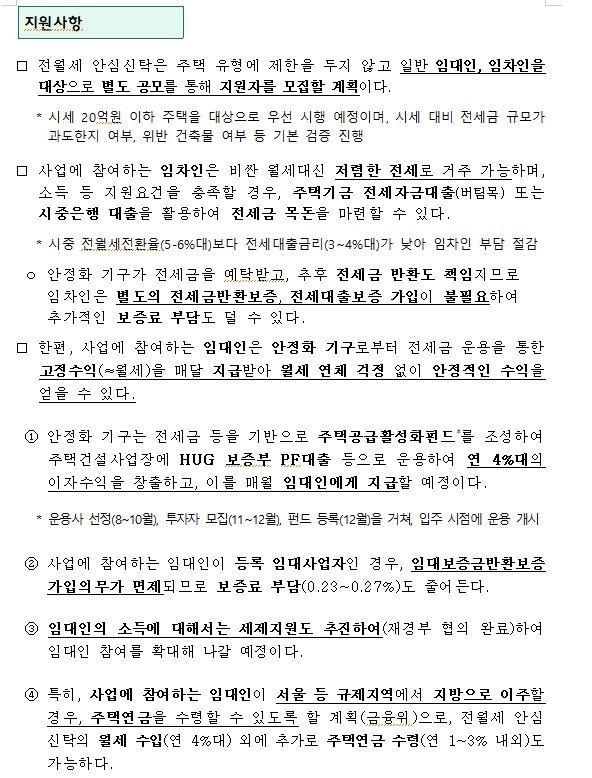
According to the Ministry of Land, Infrastructure and Transport on the 21st, it plans to invite applications for the 'Jeonse-Wolse Safe Trust program' at the end of September. The Jeonse-Wolse Safe Trust is a newly introduced model.■ How the Jeonse-Wolse Safe Trust WorksAccording to the government, the Jeonse-Wolse Safe Trust is a system in which Korea Housing & Urban Guarantee Corporation (HUG), the landlord, and the tenant sign a three-party contract, and the tenant deposits the jeonse payment with HUG. HUG then invests the deposit, pays the landlord monthly income equivalent to rent, and returns the jeonse deposit directly to the tenant when the lease ends.
Under the government's explanation, tenants can live with a lower jeonse payment instead of paying expensive monthly rent. HUG will also be responsible for returning the deposit later. As a result, tenants would not need separate jeonse refund guarantees or jeonse loan guarantees.
Landlords receive monthly income. HUG plans to invest the deposited jeonse funds in project financing (PF) loans and other assets to generate annual returns in the 4% range, which it will pay out to landlords each month. Even if investment losses occur, the tenant's jeonse deposit will be fully protected, and the agreed monthly income for landlords will still be paid as scheduled.
In an example presented by MOLIT, if a landlord participates in the program with a 200 million won jeonse deposit, they could receive about 730,000 won a month in investment income, based on an annual return in the 4% range. Participation is not mandatory, and guaranteed monthly rent is also possible.
The first issue is the current structure of the jeonse market. In general, deposits from new tenants are used to return deposits to existing tenants. If this cycle does not function properly, various problems could arise.
Another obstacle is the shrinking supply of rental homes, as regulations on non-occupying owners of one home have been tightened. One official said, "One of the current administration's main policy directions is actual occupancy," adding, "The rental market itself is disappearing."
Using the safe trust would also expose landlords' income. The government plans to offer tax support for landlords' income, but many owners are likely to be reluctant to reveal their earnings.
The yield would be higher than bank interest, but lower than ordinary monthly rent. According to statistics from Korea Real Estate Board (KREB), as of July, the average jeonse deposit for an apartment in Seoul was 195.56 million won, while the average monthly rent was 1.62 million won. The statistics show that the jeonse-to-monthly-rent conversion rate for Seoul apartments is 4.7%. The actual conversion rate is in the 5% to 6% range.
Above all, there is the issue of policy credibility. The policy for registered rental businesses is a prime example. One landlord said, "The government is tightening the screws on rental businesses more and more, so I wonder whether we can really trust this policy."
[email protected] Lee Jong-bae Reporter