Long-term yields in the U.S., Japan and Europe rose at the same time. Korea could also face a 'rate contagion' linked to stocks, bonds and loans [Worthwhile Issue]
- Input
- 2026-08-24 06:00:00
- Updated
- 2026-08-24 06:00:00

[Financial News] Bond markets in major economies are showing unusual moves. While 10-year government bond yields, the benchmark long-term rates in each country, are rising, ultra-long-term yields such as 30-year bonds are climbing even faster.
In the United States, the 30-year Treasury yield recently surged to its highest level since 2007. Japan's 10-year yield also hit a roughly 30-year high, while Germany, France and the United Kingdom have all reached levels not seen since the Global Financial Crisis (GFC).
If this were happening in just one country, it could be explained by that country's fiscal or monetary policy problems. But because 10-year and 30-year government bond yields are rising at the same time in major economies from the world's largest bond market, the United States, to Japan, Germany, France and the United Kingdom, some are saying Korea should also pay close attention.
Not just the U.S.: bond yields are surging around the world
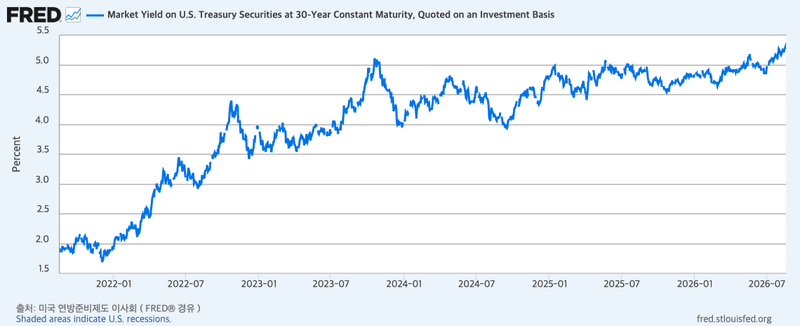
The most striking figure in the recent global bond selloff is the U.S. 30-year yield.
According to the U.S. Department of the Treasury (Treasury Department) website, the 30-year Treasury yield briefly topped 5.33% during trading on the 18th local time, rising to its highest level in about 19 years since 2007. The 10-year yield also climbed above 4.7%.
The next day, the Treasury Department announced that it would expand the size of its long-term bond buybacks, and yields briefly eased. But the relief did not last. On the 20th U.S. time, the 10-year yield rose again to 4.71%, while the 30-year yield climbed to around 5.25%.
In Japan, the 10-year government bond yield rose to 2.945% on the 18th, marking its highest level in about 30 years since 1996. On the 21st, it was still moving in the high 2.8% range.
A similar pattern is also appearing in Europe, according to data from the Deutsche Bundesbank and the Bank of England (BoE).
Germany's 10-year yield rose above 3.2%, reaching its highest level since 2011, while France's long-term yield also climbed to a level rarely seen since the GFC. The United Kingdom's 10-year yield rose to 5.176% on the 18th.
The movement in ultra-long-term bonds, including 30-year maturities, is even more pronounced. As of the 20th, the U.S. 30-year yield had risen to about 5.2%, the U.K.'s to 5.8%, and Germany's to nearly 3.8%.
Why are they rising together? The IMF points to the 'term premium'
Each country faces different circumstances.
The United States is dealing with a massive fiscal deficit and national debt exceeding $40 trillion. Japan is facing policy normalization and high government debt. France and the United Kingdom each have concerns over fiscal soundness. Germany is also seeing a shift as government bond issuance rises with expanded defense and infrastructure investment.
The reasons differ, but there is one common point: investors are simultaneously demanding more compensation for lending money over longer periods. That is the term premium. It is the extra return investors require for holding longer-dated bonds and bearing the uncertainty of locking up money for an extended time.
The International Monetary Fund (IMF) had already examined this issue in detail in its Global Financial Stability Report last October.
At the time, the IMF focused on the G4 economies: the United States, the Eurozone, the United Kingdom and Japan. It analyzed their 10-year government bond yields together with the spread between 30-year and 10-year yields, concluding that rising government bond supply was steepening the yield curve.
The IMF also said that if the share of government bonds held by central banks and other institutions falls, and more bonds are absorbed by private investors who are more sensitive to market prices, investors are likely to demand a higher term premium in return. That, it noted, would push up long-term yields.
More recently, the number of entities needing long-term funding has also increased. Governments are issuing more bonds to finance welfare, defense and industrial policy, while global tech companies are raising huge sums for AI data centers, semiconductors and power grid investments. Added to that are geopolitical tensions in the Middle East and high oil prices, which are fueling renewed inflation concerns.
How it reaches Korea: three channels from stocks to long-term yields to loans
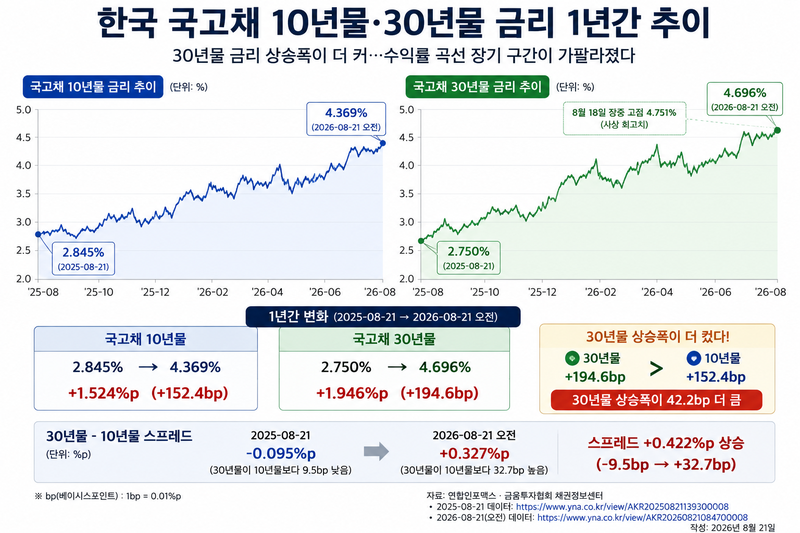
So what about Korea? The fact that Korean long-term yields move with overseas rates is not a new phenomenon.
In its December 2018 issue of the Monthly Bulletin, the Bank of Korea (BOK) published an article titled 'Causes and Implications of the Synchronization of Domestic and Overseas Long-Term Interest Rates.' It said that since the GFC, Korea's long-term yields have shown strong synchronization not only with U.S. rates but also with those of advanced European economies such as Germany.
The BOK also released a study in January titled 'Implications of U.S.-Korea Interest Rate Synchronization and Monetary Policy Spillovers,' which found that the connection between the two countries has become even stronger recently.
Experts also say the simultaneous rise in long-term yields across major economies will have a direct impact on Korea.
Kang Hyun-joo, a senior research fellow at the Korea Capital Market Institute, told Financial News on the 21st that "bond markets in advanced economies are largely in the same situation, and domestic rates have also risen significantly."
She added, "There are some differences by country, but in most cases this is less about expectations for monetary policy and more about a rise in the term premium on bonds. It is quite common for the U.S. term premium to affect the term premium on long-term government bonds in other countries."
She first pointed to the U.S. growth stock market and then to Korea's stock market.
Kang said, "What we recently observed was that as long-term U.S. bond yields rose, U.S. growth stocks underwent a sharp correction." She explained, "Growth stocks have to discount expected future returns to present value, so when long-term yields rise, the present value of future earnings falls."
She added that this could also affect domestic semiconductor stocks such as Samsung Electronics and SK hynix, which tend to move closely with U.S. tech stocks.
She also expects changes in interest rates. If Treasury Bond yields rise, the benchmark rate in financial markets itself moves higher, putting upward pressure on bank bonds and corporate bonds as well. In particular, bank bond yields are used as reference rates for fixed-rate mortgage loans.
Kang explained, "If the yield on five-year bank bonds rises, the reference rate for fixed-rate household loans is based on bank bonds, so loan rates are affected as well." She added, "Even if it has nothing to do with the Bank of Korea's policy rate, financial conditions can tighten in advance."
That is why the simultaneous rise in long-term government bond yields across major economies cannot simply be dismissed as a foreign bond market story with no relevance to Korea.
We cover only the most useful issues from the flood of news. From politics and the economy to society and culture, we examine a wide range of topics from a fresh, sharp and sometimes contrarian perspective.[Worthwhile Issue]If you want to follow this series more easily, please subscribe to the reporter page.
[email protected] Seo Yoon-kyung Reporter